India’s All India Distillers’ Association (AIDA) has asked the government to restore the maize-ethanol incentive to ₹5.79 per litre from ₹2.79 and revise the ₹60.32 per litre rate for ethanol made from surplus Food Corporation of India (FCI) rice. The request follows the Ethanol Supply Year (ESY) 2026–27 tender and does not itself change petrol pump prices, the E20 blending target or what motorists pay today.
Key takeaways
- AIDA wants the maize-ethanol incentive restored from ₹2.79 per litre to ₹5.79 per litre.
- The association has also asked for a higher procurement price for FCI-rice ethanol, currently reported at ₹60.32 per litre.
- AIDA is seeking more flexibility for sugarcane juice, sugar syrup and B-Heavy molasses, subject to government safeguards.
- The OMC tender covers around 1,100 crore litres for ESY 2026–27, running from November 2026 to October 2027.
- This is an industry request, not a notified change to city petrol prices, E20 rules or the fuel available at a pump today.
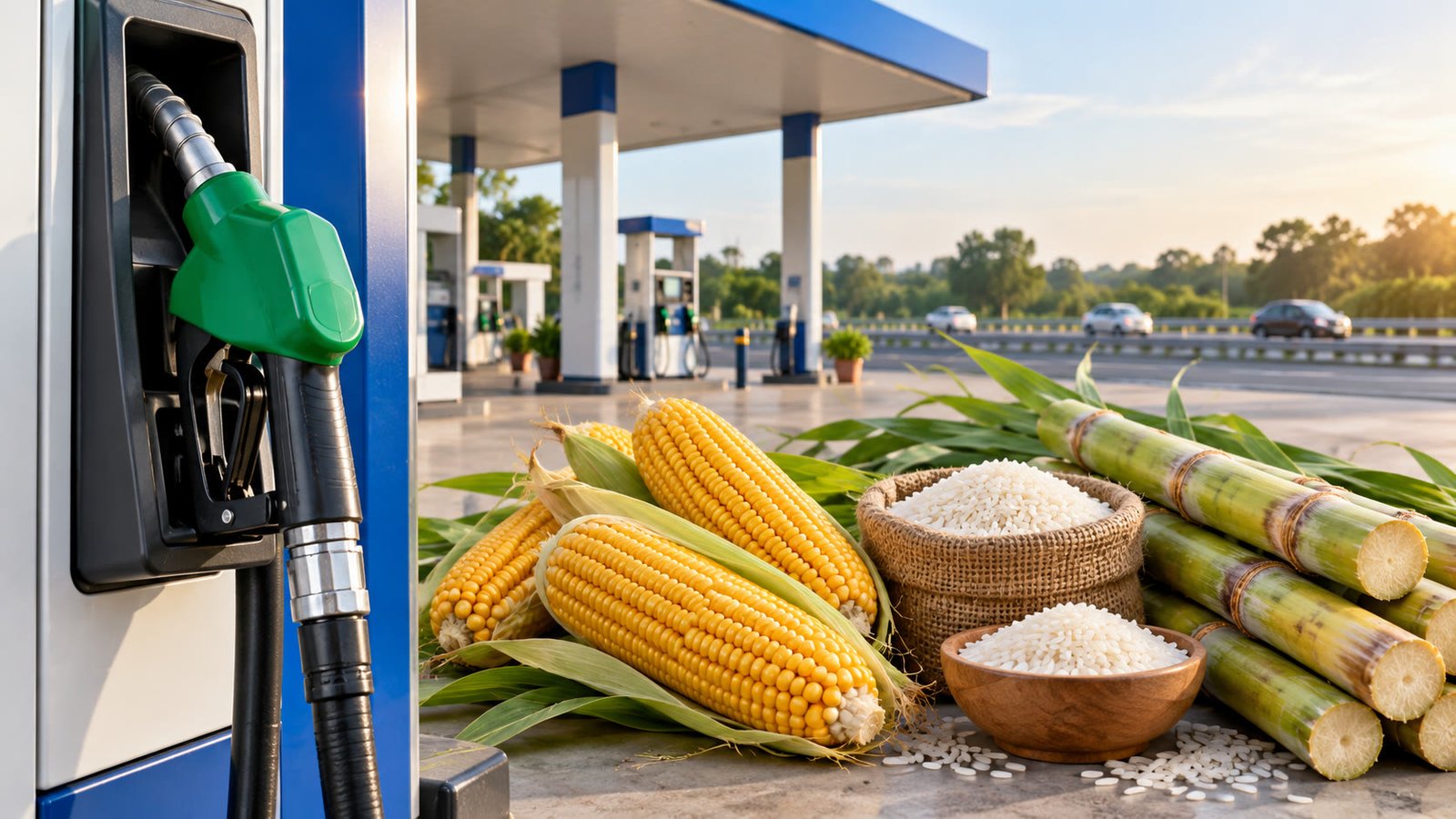
Illustration: FuelPrice editorial visual showing ethanol feedstocks and a generic petrol dispenser; representative, not an official photograph.
What AIDA is asking for
AIDA’s 17 Oct 2026 statement responds to the first procurement cycle for ESY 2026–27. The association says the lower maize incentive puts pressure on grain-based distillery economics because producers also face maize procurement, energy, chemicals, processing and logistics costs. Autocar Professional and Business Today both reported the association’s request and the rates cited in its response.
The reported maize structure is a basic procurement rate of ₹66.07 per litre plus a ₹2.79-per-litre incentive, giving an effective rate of ₹68.86 per litre. AIDA wants the incentive restored to ₹5.79 per litre. The arithmetic difference is ₹3 per litre in the incentive component, but that is not a ₹3-per-litre increase in petrol prices: it relates to ethanol procurement before blending and retail pricing.
The association also wants the ₹60.32-per-litre FCI-rice procurement price reviewed. It says a higher rate would better reflect the cost of raw material, energy, chemicals, processing and transport. These are AIDA’s demands; they are not yet a government-approved revision.
| Feedstock or component | Reported current position | AIDA request |
|---|---|---|
| Maize incentive | ₹2.79 per litre | Restore ₹5.79 per litre |
| Effective maize procurement rate | ₹68.86 per litre | Higher incentive sought |
| FCI-rice ethanol | ₹60.32 per litre | Higher rate sought |
Rates above are the positions reported on 17 Oct 2026; the requested revisions remain proposed.
How the 2026–27 tender changes the backdrop
The OMC tender is for roughly 1,100 crore litres of ethanol for the 1 Nov 2026 to 31 Oct 2027 supply year. ET EnergyWorld reported that the tender follows a government direction to reduce sugar diversion for ethanol to zero for ESY 2026–27. It does not seek offers made from sugarcane juice, sugar, sugar syrup or B-Heavy molasses in this cycle, while categories such as maize, surplus FCI rice, damaged food grains and C-Heavy molasses remain part of the procurement structure.
FuelPrice has already explained the zero sugar-diversion directive in the 2026–27 ethanol tender. The new development is the industry response: AIDA is asking for a more balanced feedstock policy so that grain-based production is not made commercially weak while sugar-based capacity is restricted.
India’s official ethanol procurement framework is designed to support petrol blending and reduce dependence on imported crude. The Ministry of Petroleum and Natural Gas has set a 20% ethanol-blending target in the policy framework. AIDA says a diversified mix of maize, rice and permitted sugarcane feedstocks would make supply more resilient when crop output, raw-material prices or regional availability change.
What this means for petrol users
For a driver, the immediate message is restraint: do not treat ₹68.86 per litre as a city petrol price and do not assume that the ₹3-per-litre incentive gap will appear at the pump. The request concerns the price OMCs pay for ethanol from a particular feedstock. Retail petrol also reflects the petrol component, taxes, dealer commission, freight and other costs, so a procurement proposal cannot be converted directly into a pump-price forecast.
There is also no new vehicle rule in AIDA’s statement. The 20% blending framework remains the reference point in the sources reviewed, and the ESY tender is about supply contracts rather than an announcement that motorists must buy a different fuel grade. Drivers can use FuelPrice’s live fuel-price pages for actual rates, while petrol prices across Indian cities are the useful comparison when a trip crosses state or city boundaries.
The policy still matters indirectly. If the government accepts higher or more flexible procurement terms, it could affect the economics of distillery investment, the mix of feedstocks available to OMCs and the pace at which blending targets are supplied. Those effects would take time and would depend on the final notification, tender terms and physical supply, not on AIDA’s request alone.
What to watch next
The next concrete signals are a response from the Ministry of Petroleum and Natural Gas or the Department of Food and Public Distribution, any revised OMC procurement terms, and the outcome of the ESY 2026–27 bid cycle. Until then, the current rates and exclusions in the tender remain the reported basis for the new supply year, while AIDA’s higher-price and feedstock-flexibility requests remain proposals.
For trip planning, the practical step is to base a budget on the petrol price available in your city and your vehicle’s tested fuel economy. FuelPrice’s fuel-cost calculator can convert that live rate into a route estimate; it should not be populated with the ethanol procurement rates above.
Sources
- Autocar Professional — AIDA Seeks Higher Maize and Rice Ethanol Prices, Flexibility for Sugarcane Feedstocks — 17 Oct 2026
- Business Today — Ethanol industry body seeks higher maize, rice ethanol prices; flags viability concerns — 17 Oct 2026
- ET EnergyWorld — Govt bars OMCs from diverting sugar for ethanol production — 18 Oct 2026
- Ministry of Petroleum and Natural Gas — Long Term Ethanol Procurement Policy — accessed 18 Oct 2026