A fresh cave-in near SD Adarsh School has closed one lane of Gurugram’s Sohna Highway, slowing traffic on a route used to reach the Delhi–Mumbai Expressway. The National Highways Authority of India (NHAI) says a ₹58-crore sewer rehabilitation project is planned, but drivers must manage the immediate lane restriction before that permanent work is completed.
The current reports do not describe a full highway closure. They say the damaged section has been barricaded and traffic is being regulated around it, so commuters should allow extra time, follow the traffic marshals and avoid trying to pass the cordoned edge or use the shoulder as an unofficial lane.
Key takeaways
- One lane near SD Adarsh School on the Sohna Highway has been barricaded after a fresh cave-in reported on 2 Nov 2026.
- The affected opening is about 2.5–3 feet wide, according to the same-day reports, and is linked to a damaged master sewer line beneath the road.
- NHAI’s planned repair uses cured-in-place pipe (CIPP) lining for about 2,700 metres and a new 100-metre section along the service road.
- The estimated project cost is ₹58 crore, with desilting and flow diversion expected in November, CIPP work expected to begin in December and completion targeted by the end of February.
- Reports differ on the repeat-cave-in count: The Times of India said this was the eighth since 2023, while Hindustan reported the seventh.
What happened on the Sohna Highway
The Times of India reported on 2 Nov 2026 that a portion of the highway caved in again, leaving a sinkhole about three feet wide. Its report said the latest failure was roughly 30 metres from a section that collapsed in May and that NHAI closed one lane while regulating traffic. Hindustan’s same-day Hindi report described an opening of about 2.5–3 feet near SD Adarsh School and also said one of the three lanes was barricaded.
The reports attribute the repeated failures to a damaged 1,800-millimetre master sewer line running beneath the highway. Hindustan reported that the line is about 30 years old and lies roughly 22–25 feet below the road, carrying sewage from parts of sectors 45 to 51 towards the Behrampur sewage treatment plant. These are reported infrastructure details, not a claim that the road surface alone caused the cave-in.
The number of incidents is not consistent across the two same-day reports. TOI counted the latest event as the eighth since 2023, while Hindustan counted it as the seventh and listed a different sequence of earlier dates. The disagreement matters because it shows why the repeat-failure history should be treated carefully; the current lane restriction, the sewer-line explanation and the repair plan are consistent across the reports.
What NHAI’s permanent repair plan includes
According to the NHAI official quoted by TOI, the work has been awarded and the immediate preparation involves desilting the line and diverting sewage flow. That preparation was expected to be completed in November, with CIPP work scheduled to start in December and the project targeted for completion by the end of February. Those are an agency timeline and should be read as expected milestones, not as completed work.
CIPP is a trenchless rehabilitation method: a lining is inserted inside the existing damaged pipe and cured in place, reducing the need to excavate the full road length. The reported plan covers about 2,700 metres between Tau Devi Lal Stadium and Sispal Vihar. A separate 100-metre sewer section currently beneath the main carriageway is planned to move to the service road through a new pipe.
The second part is important for road users because it aims to remove a section of the sewer from directly below the main traffic stream. TOI said traffic would be diverted for a short period while that new pipe is laid. The route may therefore see another temporary disruption during the actual utility work even after the present sinkhole is secured.
Hindustan Times had reported in May that NHAI had approved the ₹58-crore plan after earlier cave-ins, with GMDA expected to supervise the repair and take over the pipeline after completion. That background indicates the proposal predates the latest failure; the fresh event has increased the immediate need to execute and monitor it.
What the lane closure means for drivers
For commuters travelling between Gurugram and Sohna, the practical effect is a lower-capacity bottleneck rather than a confirmed route-wide shutdown. Peak-period queues can form because vehicles merge around the barricades, and buses, goods vehicles and two-wheelers may move at different speeds near the work zone. Drivers should keep a larger gap, reduce speed before the barrier and avoid stopping beside the damaged edge.
If the Sohna route is part of a longer trip, compare the expected delay and any available alternate approach in the road-trip planner before leaving. Do not assume an alternate road is faster without checking its distance, traffic and access restrictions.
A diversion also changes fuel use. The extra cost depends on additional kilometres, the vehicle’s real-world mileage and the current fuel rate; it cannot be stated accurately without those inputs. Readers can use the fuel cost calculator to compare the planned route with a detour and estimate the impact of idling or extra distance.
Drivers continuing towards a tolled expressway should separately check the likely toll component in the toll-charge calculator. The current report is about a road-safety and traffic restriction, not a toll-fee revision, so the lane closure should not be mistaken for a change in toll rates.
What to watch next
- Traffic control: whether NHAI and traffic police keep one lane closed or need to widen the barricaded area as the ground is inspected.
- Utility preparation: whether desilting and sewage-flow diversion are completed in November as reported by TOI.
- CIPP start: whether the planned December start happens and whether the service-road pipe shift requires a longer diversion.
- Completion evidence: whether the full line rehabilitation and road restoration are finished by the end-February target, followed by monitoring for fresh settlement.
For now, the useful takeaway is simple: the Sohna Highway has a live lane restriction near SD Adarsh School, and the permanent fix is still a planned project. Check conditions before setting out, obey the temporary traffic arrangement and treat any fresh water, cracks or widening around the barricades as a reason to keep away and alert the authorities rather than attempting to pass through.
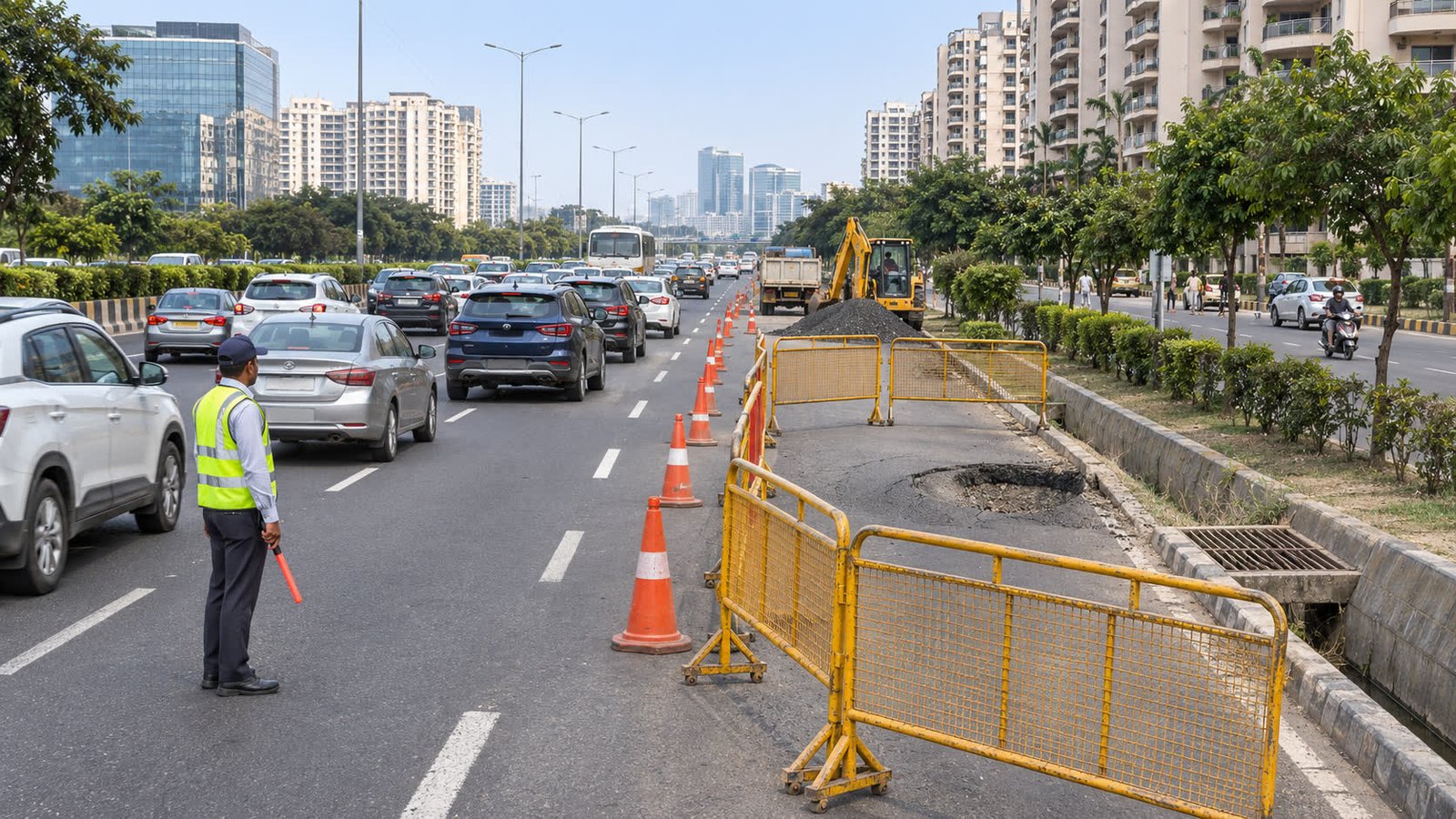
Image note: Illustrative AI-generated visual of a controlled highway repair scene; it is not a photograph of the reported Sohna Highway site.
Sources
- The Times of India — “Sinkhole on Sohna Highway in Gurgaon opens 8th time since 2023; road caves in 2 months after repairs, NHAI looks for permanent fix” — 2 Nov 2026
- Hindustan — “Gurgaon News: गुरुग्राम-सोहना रोड सातवीं बार धंसी” — 2 Nov 2026
- Hindustan Times — “NHAI clears ₹58-crore repair plan for 30-year-old sewage pipeline beneath Sohna Road stretch” — 29 May 2026