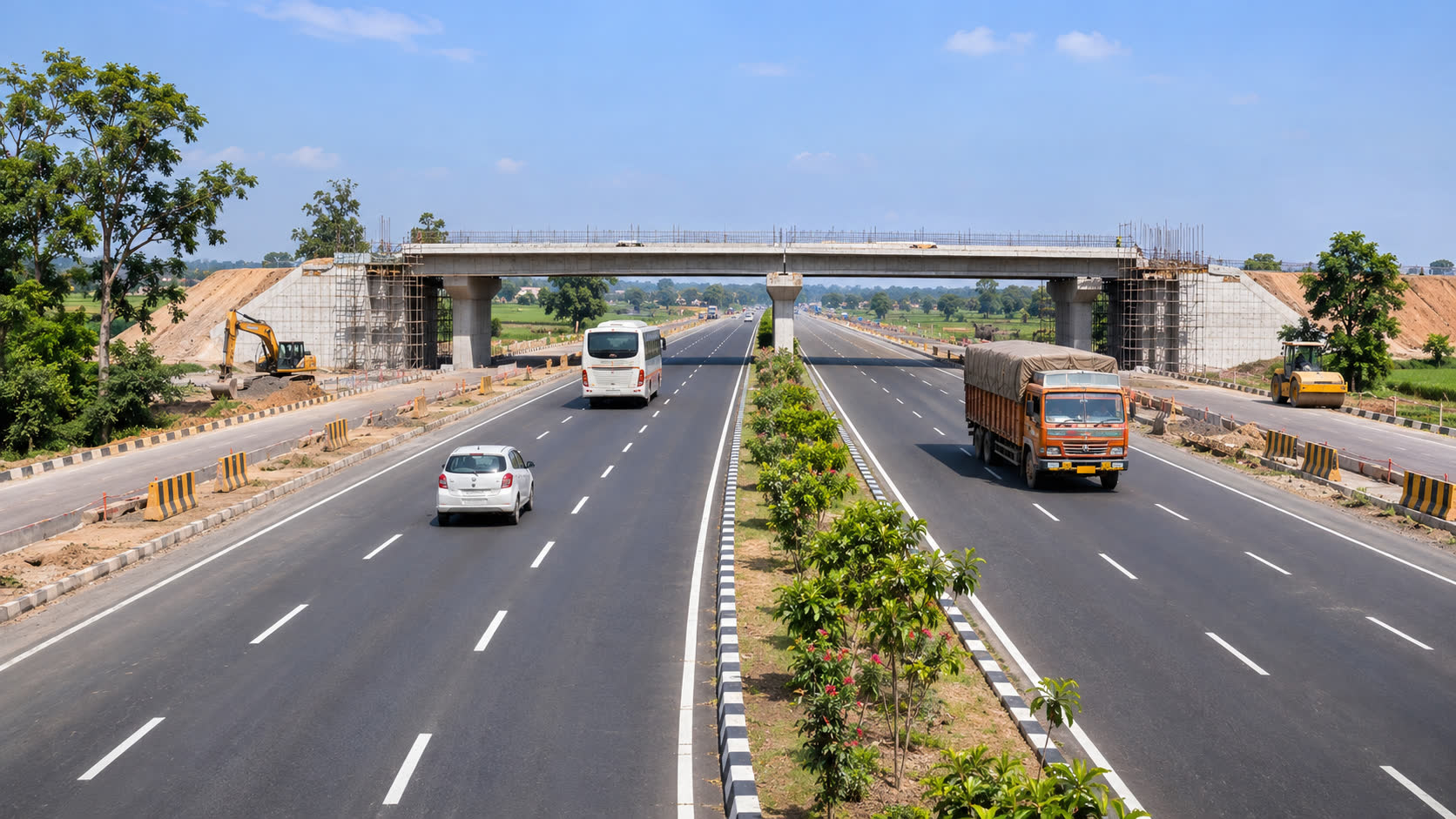
Nearly nine-tenths of the Sonauli–Jungle Kaudia section of Uttar Pradesh’s NH-24 four-laning work is complete, according to the latest progress update reported on 16 Nov 2026. The 79.54-km corridor is intended to make travel between Gorakhpur and the India–Nepal border smoother for private vehicles, buses and freight, but the progress figure does not mean the full route has opened.
For motorists, the useful takeaway is to treat the route as an active construction corridor until the National Highways Authority of India (NHAI) issues a formal opening or commercial-operation update. The finished project is expected to improve traffic flow and safety, while the current report does not announce a revised opening date or a new toll rate.
Key takeaways
- NHAI’s 79.54-km Sonauli–Jungle Kaudia section of NH-24 is reported to be about 89% complete as of the 16 Nov 2026 update.
- The project is widening the existing two-lane-with-paved-shoulders route to four lanes, strengthening the Gorakhpur–Sonauli border connection.
- The corridor is planned to support passenger travel, Nepal-bound freight, tourism and access to Gorakhpur, Kushinagar and Lumbini.
- Planned traffic-management features include CCTV monitoring, emergency call boxes, variable message signs and real-time traffic monitoring.
- The progress update is not a toll hike notice. A Ministry of Road Transport and Highways fee notification says the four-lane fee framework takes effect from the project’s commercial operation date.
What the latest NHAI update says
The Financial Express reported on 16 Nov 2026 that NHAI had shared a fresh update on the Sonauli–Jungle Kaudia project. The report puts construction progress at around 89% across the 79.54-km section and describes the corridor as a link for passenger movement, tourism, freight and regional economic activity.
NHAI’s official project video, published on 21 Jul 2026, also described the four-laning as nearly 89% complete and identified the route as an international corridor connecting India and Nepal. NDTV’s 23 Jul 2026 report independently carried the same progress figure and described the earlier journey on the corridor as taking about three hours, based on an NHAI project official. That is a reference point, not a guaranteed future travel time.
The distinction between construction progress and opening matters. A road can be largely built while finishing work, junction connections, safety installations, inspections and traffic arrangements are still underway. The 16 Nov report did not specify a new commercial-operation date, so drivers should not assume that every part of the four-lane alignment is available for uninterrupted use.
What the wider highway could change
More predictable movement between Gorakhpur and Sonauli
The project is converting the existing two-lane route with paved shoulders into a four-lane corridor. Once the complete alignment is opened, separating opposing traffic and providing more room for local access should reduce the stop-and-go pressure that affects a road serving towns, border traffic and long-distance vehicles.
That benefit is especially relevant to commercial operators. Trucks moving towards the Nepal border can face delays that affect delivery schedules, fuel use and driver hours. A wider corridor cannot remove border checks or congestion beyond the project limits, but it can reduce one recurring bottleneck on the Indian approach to Sonauli.
Better access for tourism and local markets
NHAI and the reports cited in this article link the corridor with Gorakhpur, Kushinagar and Nepal’s Lumbini region. That makes it relevant not only to cross-border freight but also to pilgrims, tourists and residents travelling between eastern Uttar Pradesh and the border. Improved road access can also make it easier for agricultural producers and local businesses to reach larger markets, although those gains will depend on the final opening and traffic conditions.
Safety systems are part of the project
The progress coverage says an Advanced Traffic Management System is being installed along the corridor. The reported package includes CCTV cameras, emergency call boxes, real-time traffic monitoring and variable message signs, alongside road signs, junction lighting, crash barriers and emergency support.
For a driver, these systems matter most during breakdowns, crashes, poor visibility or sudden traffic restrictions. They are useful infrastructure, not a substitute for safe speed, lane discipline or checking a diversion notice. Until the route is formally commissioned, construction zones may still change the practical travel experience.
Tolls: what is known and what is not
The current 89% progress update should not be read as a new toll revision. The MoRTH fee notification published on 19 Jan 2026 describes the user-fee framework for the Sonauli–Gorakhpur four-lane section and says it will come into force from the commercial operation date of the ongoing four-laning work. It also says actual fees and annual revisions are governed by the National Highways fee rules.
That means the toll amount a driver pays should be checked against the applicable notice once the relevant section is operational, rather than inferred from the construction percentage. Before travelling, use the toll-charge calculator to estimate the route cost and check the latest applicable information.
What route users should check now
- Opening status: Look for an NHAI or highway-authority announcement before planning on the assumption that the entire four-lane route is live.
- Construction diversions: Allow extra time if lane shifts, local-access changes or unfinished junctions affect the approach to Gorakhpur or Sonauli.
- Fuel planning: A longer or slower construction-phase journey can change the fuel requirement. Estimate the trip with the fuel cost calculator and check current rates before departure.
- Stops and contingencies: Use the road-trip planner to organise rest, fuel and border-side time rather than relying only on the eventual four-lane travel estimate.
Why the 89% update matters
This is more than a construction milestone for people who use the corridor. The route connects a major eastern Uttar Pradesh city to an international border, serves freight movement and sits near important religious and tourism destinations. Its value will be measured in more reliable journey planning, safer roadside support and fewer construction-related bottlenecks—not simply in the number of lanes.
For now, the responsible reading is that the project is close to completion but not yet a confirmed opening. The next useful update will be NHAI’s notice on final readiness, traffic arrangements and the commercial-operation date. Until then, drivers and fleet operators should plan around the road conditions that are actually in force.
Sources
- NHAI Official, Sonauli–Gorakhpur National Highway: Strengthening Trade, Tourism & Connectivity (21 Jul, 2026)
- The Financial Express, India–Nepal travel to get easier: 89% work completed on NHAI’s 4-lane highway (16 Nov, 2026)
- NDTV India, Delhi to Nepal connectivity set to improve as Gorakhpur–Sunauli NH-24 nears completion with 89% work done (23 Jul, 2026)
- Ministry of Road Transport and Highways, Gazette of India S.O. 370(E): user-fee notification for Sonauli–Gorakhpur NH-24 (19 Jan, 2026)