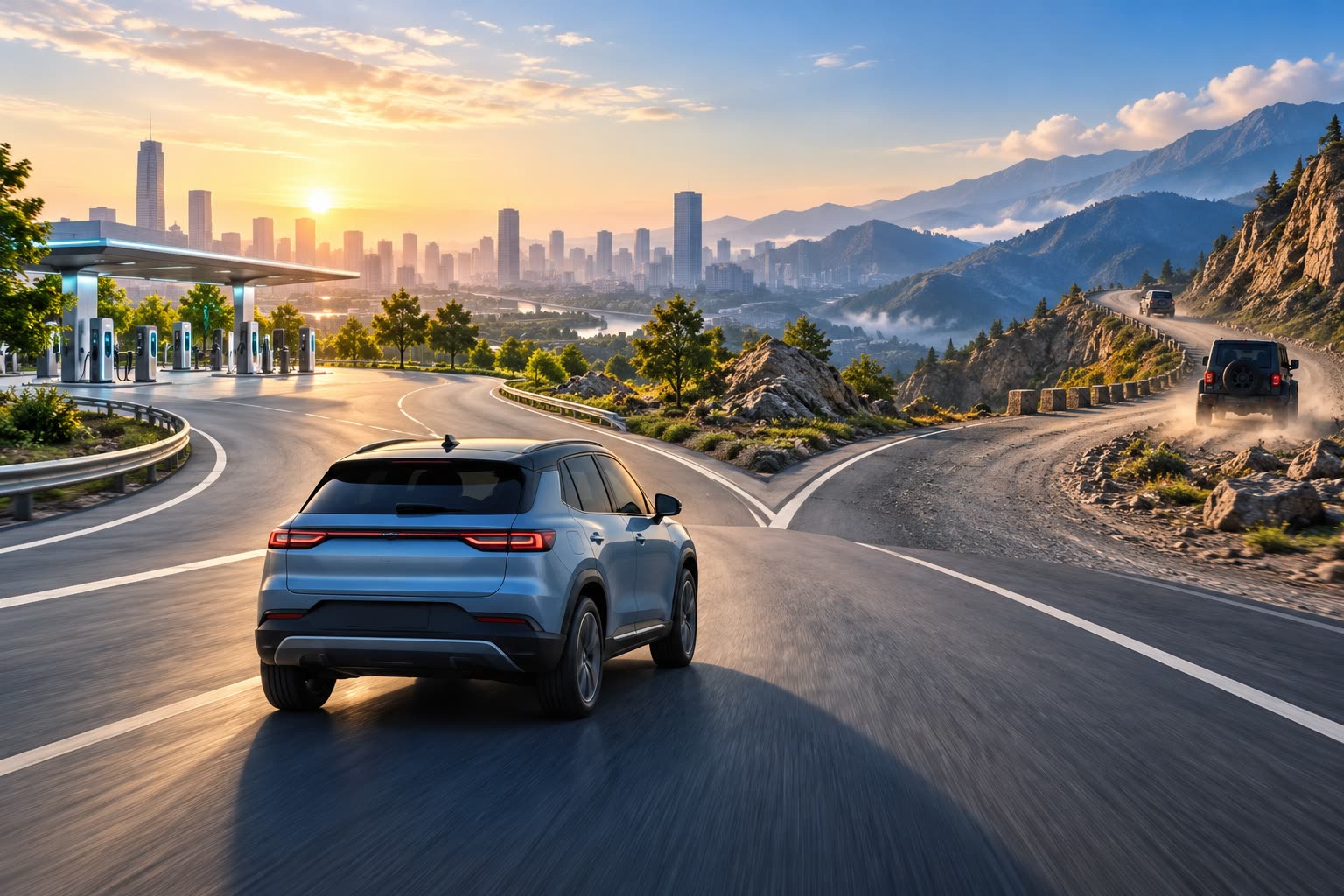
Stellantis India plans to invest about ₹4,000 crore over the next three years and bring 12 new or upgraded Jeep and Citroën products, with the first launch scheduled for the second quarter of 2027. The roadmap includes battery-electric, hybrid and internal-combustion options, so Indian buyers may get more powertrain choice, but model-wise prices, specifications and delivery dates are not confirmed yet.
Key takeaways
- Stellantis India plans ₹4,000 crore of additional investment over the next three years.
- The roadmap covers seven new models and five major upgrades across Jeep and Citroën, according to reports based on CEO Shailesh Hazela's comments on 15 Oct 2026.
- The first of the 12 products is scheduled for launch in Q2 2027; the company has not published a complete model-by-model calendar.
- The powertrain mix may include petrol or other internal-combustion vehicles, hybrids, plug-in hybrids and battery EVs, depending on product economics and demand.
- Jeep has confirmed an India EV plan, while its wider 4x4 approach remains an intention rather than a guarantee for every future model.
What Stellantis announced
Business Standard and The Economic Times separately reported on 15 Oct 2026 that Stellantis India will put around ₹4,000 crore into localisation, customer experience and a 12-product roadmap. The plan has seven all-new models and five major upgrades across the Jeep and Citroën brands. The first launch is scheduled for Q2 2027, but neither report gives a complete public list of model names, prices or launch months.
The investment would be additional to Stellantis India's earlier commitment, taking the company's cumulative stated investment in India close to ₹15,000 crore, according to The Economic Times. Business Standard reported that Jeep's localisation is intended to rise from about 70–75% to around 90%. These figures describe company plans; they do not guarantee a lower showroom price or a fixed saving in ownership costs.
The roadmap is primarily focused on SUVs, with the reported plan also including an MPV and a premium pickup. The company is aiming to expand its presence across the A, B, C and D segments while using India for more engineering, manufacturing and exports. It also wants to develop left-hand-drive versions for overseas markets, but the country list and model allocation have not been finalised.
EV and 4x4 direction: what is confirmed
In a separate 15 Oct 2026 report, Autocar Professional said Stellantis India CEO Shailesh Hazela confirmed that an electric offering is part of Jeep's India plan. The same report said a B-segment Jeep EV is understood to be planned on Tata Motors' ARGOS architecture, but Hazela did not confirm that platform detail or provide a launch date. The Economic Times independently reported that the wider product mix will include battery-electric options.
Hazela also described an effort to retain Jeep's four-wheel-drive character as the brand expands into the B, C and D segments and a D-segment pickup. That is a direction of travel, not a promise that every future model or the planned EV will have 4x4. Buyers should wait for the individual model's drivetrain, ground clearance, battery and homologation details before treating the plan as a confirmed product specification.
This is a materially new update to FuelPrice's earlier report on the Tata–Stellantis product and export pact. That coverage dealt with the formal partnership; the latest statements add the size of the India investment, the 12-product roadmap and a direct confirmation of Jeep's EV direction.
What the roadmap means for Indian buyers
More choice, but no price list yet
A wider Jeep and Citroën range could give buyers more choices between conventional engines, hybrids and EVs. It does not yet establish that a particular future SUV will be cheaper, more efficient or better suited to a given route. The only confirmed timing in the latest reports is that the first product is planned for Q2 2027.
Powertrain will decide the running-cost question
A petrol or diesel vehicle exposes the owner to fuel price and mileage changes; a hybrid adds a different mix of fuel use and upfront cost; an EV shifts the calculation towards electricity tariffs, charging access and battery warranty. Once a model's certified figures are available, readers can estimate a route or commute with the fuel-cost calculator rather than relying on a headline efficiency claim.
For a future electric model, the practical questions will include home charging, connector type, public-charger availability and the time needed for a highway stop. The state-wise EV charging directory can help map the network, while a road-trip plan can separate route distance and stops from the vehicle's laboratory range. Neither tool replaces the manufacturer's final specification or a live station check.
Localisation may help, but service terms matter too
Higher localisation can improve supply-chain scale and may support parts availability, but it is not proof of a particular service price or resale outcome. Before a future model becomes a real buying option, the useful comparison will be the complete on-road quote, warranty, service interval, roadside assistance, charging or fuel requirements and the cost of consumables.
What to check before treating a future model as confirmed
- Model and variant: identify the exact name, body style, seating layout and drivetrain rather than relying on a product-family announcement.
- Price and timing: wait for an ex-showroom price, booking terms, delivery schedule and the cities where the vehicle will be sold.
- Energy use: compare certified fuel economy or EV range with the intended commute, load and highway speed; real-world results will vary.
- Support: check the service footprint, warranty exclusions, battery coverage where relevant and the availability of parts in the driver's region.
- Safety and capability: look for the final safety equipment, certification, drive modes and whether 4x4 is standard, optional or unavailable on the chosen variant.
What happens next
The next meaningful update should be the identity and specification of the first product due in Q2 2027. Until then, the 12-product plan is a company roadmap, not a list of cars available to order. It does not change current petrol or diesel prices, toll charges or the ownership cost of vehicles already on Indian roads.
For buyers, the useful takeaway is to separate confirmed direction from future-model expectation. Stellantis has put a ₹4,000 crore India investment, seven new models and five upgrades on the record, and it has confirmed an EV direction for Jeep. The financial decision will only become measurable when each model's price, powertrain, range or mileage, safety package and service terms are published.
Sources
- Business Standard — “Stellantis to invest ₹4,000 crore, launch 12 products in 3 years” — 15 Oct 2026
- The Economic Times — “Stellantis to invest ₹4,000 crore in India; launch 12 Jeep, Citroën vehicles by 2030” — 15 Oct 2026
- Autocar Professional — “Jeep Confirms India EV Plans, Puts 4x4 at Heart of Expansion” — 15 Oct 2026
- Autocar India — “Stellantis India's Shailesh Hazela on Jeep, Citroen reset and more” — 15 Oct 2026