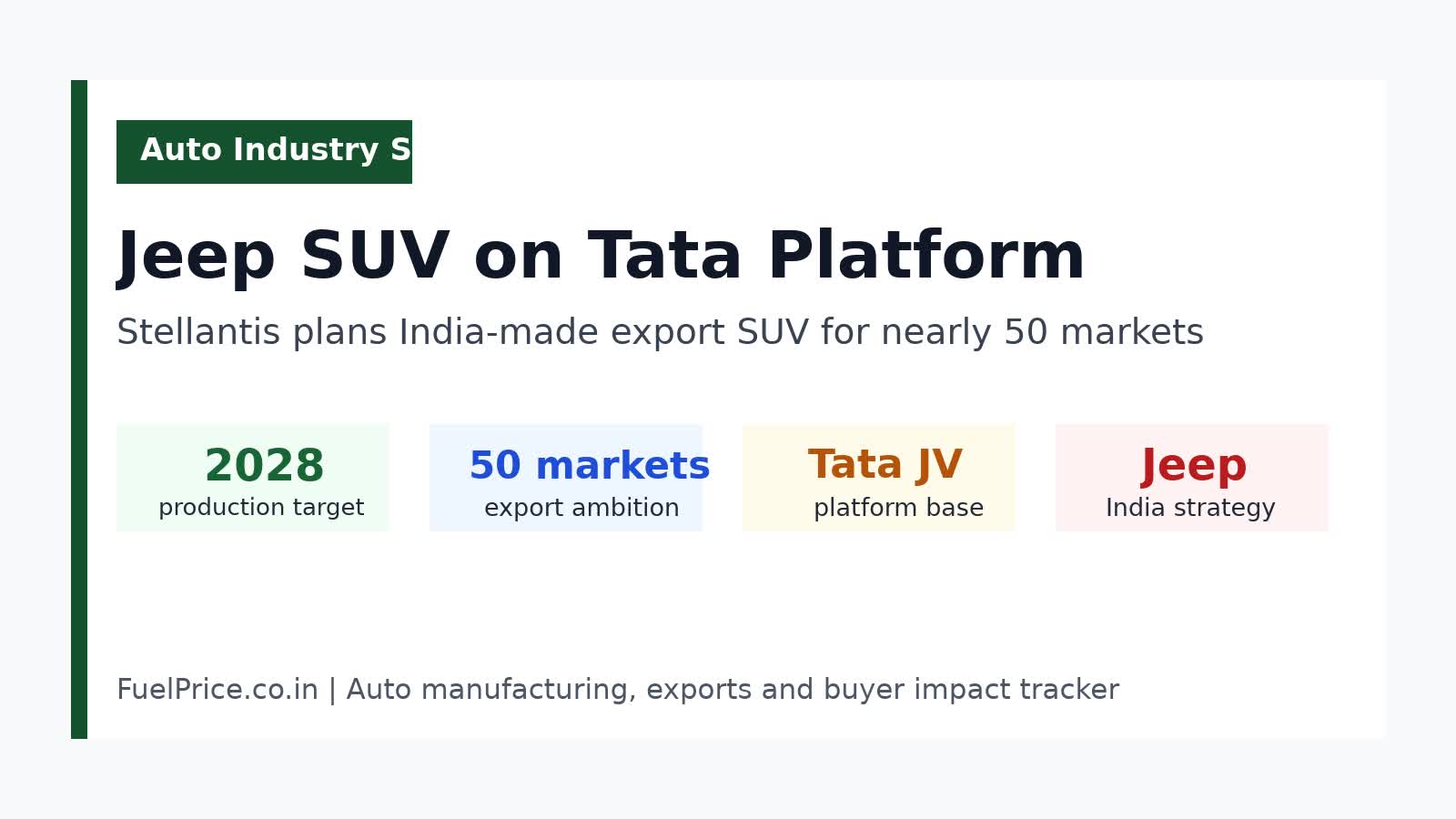
Short brief: Stellantis is preparing a new Jeep SUV that will reportedly use a Tata Motors platform and be manufactured in India through the existing Tata-Stellantis joint venture. The biggest number is the export ambition: the model is expected to target nearly 50 global markets, with production planned around 2028.
The reported Jeep-Tata platform plan points to a deeper India manufacturing and export role for Stellantis.This is not just another upcoming SUV headline. It is a manufacturing-strategy story. If the plan moves as reported, Jeep could use India not only as a domestic SUV market but also as a cost-competitive export base. That matters for pricing, localisation, supplier volumes, dealer confidence and the future of Jeep in a segment where value perception has become as important as brand appeal.
Key points readers should know
- What is planned: A new Jeep SUV is expected to be developed on a Tata Motors platform.
- Where it fits: The model is expected to be manufactured in India through the Tata-Stellantis joint venture.
- Timeline: Production is reported to begin around 2028.
- Export scale: Multiple reports say exports are planned for nearly 50 markets.
- Why it matters: Platform sharing could help Jeep improve cost structure while keeping India central to its global SUV plan.
What happened
At its 2026 Investor Day, Stellantis outlined a broader strategic plan focused on platform efficiency, regional manufacturing strength and sharper product execution. Soon after, Indian auto publications reported that a new Jeep SUV would use a Tata Motors platform and be built in India for domestic and export markets.
The details reported so far point to a 2028 arrival window. The platform-sharing plan is expected to sit inside the existing Tata-Stellantis manufacturing partnership, which already gives both companies a base for operational cooperation in India.
Why this matters for India auto manufacturing
The important part is not only the Jeep badge. It is the direction of travel. Global automakers are under pressure to reduce development cost, shorten launch timelines and make smaller-volume models commercially viable. Using a proven local platform can reduce engineering cost and improve supply-chain confidence, provided brand character and safety expectations are protected.
For India, the reported plan strengthens the role of local engineering, sourcing and manufacturing. If the export target is achieved, India could become a more meaningful global SUV production hub for Jeep rather than only a regional assembly location.
Potential impact by stakeholder
| Stakeholder | Possible impact | What to watch |
|---|---|---|
| Jeep buyers | A better-priced Jeep SUV could widen the brand appeal if feature, safety and ownership costs are competitive. | Final size, powertrain, safety rating and service cost. |
| Tata Motors ecosystem | Higher platform and supplier utilisation could improve scale economics. | How much of the platform, components and engineering are locally sourced. |
| Dealers | A more accessible Jeep could improve showroom footfall if positioned below or around current Jeep SUV pricing bands. | Launch pricing, waiting periods and variant mix. |
| Export supply chain | Nearly 50-market exports can improve capacity planning and supplier volumes. | Which markets receive the India-built model and whether right-hand-drive and left-hand-drive versions are planned. |
Buyer angle: what could change
Jeep has strong brand recall in India, but its products often compete in price-sensitive SUV segments where fuel economy, service reach and ownership cost are serious decision factors. A Tata-platform Jeep could change that equation if localisation helps reduce cost and improve parts availability.
That does not automatically mean the model will be cheap. Jeep will still need to protect its brand identity, ride feel, off-road credibility and cabin quality. The real buyer question will be whether the final product delivers Jeep character with stronger value-for-money than current imported or heavily localised alternatives.
Fuel and powertrain angle
Powertrain details are not confirmed yet. Reports focus on platform and manufacturing strategy, not final engine or EV specifications. For FuelPrice readers, this is the part to watch closely. A petrol, diesel, hybrid or EV direction would change the ownership-cost story completely.
- Petrol route: Would need competitive real-world mileage to work in India.
- Diesel route: Could appeal to long-distance SUV users, but emission rules and demand shifts matter.
- Hybrid route: Could help running costs, but may raise upfront pricing.
- EV route: Would align with long-term global policy, but charging and battery cost remain decisive.
What is still unconfirmed
Several important details are not yet official at a product level. The final model name, dimensions, powertrain, feature list, safety package, launch price and export market list are still awaited. Until Stellantis or Jeep issues a dedicated product announcement, those details should be treated as expected or reported, not final.
Final takeaway
The reported Jeep SUV on a Tata Motors platform is a bigger development than a routine future-model update. It signals that India could become a deeper global production base for Jeep, with Tata-linked platform economics helping Stellantis compete in a cost-sensitive SUV market. For buyers, the real story will begin when powertrain, pricing and safety details are confirmed.
Sources checked
- Stellantis official Investor Day 2026 press release
- Stellantis Investor Day 2026 event page
- India Today Auto: Stellantis to develop India-made Jeep SUV on Tata-derived platform
- CarWale: Next-generation Jeep to utilise Tata platform
- HT Auto: New Jeep SUV to be based on Tata platform, slated for 2028 arrival