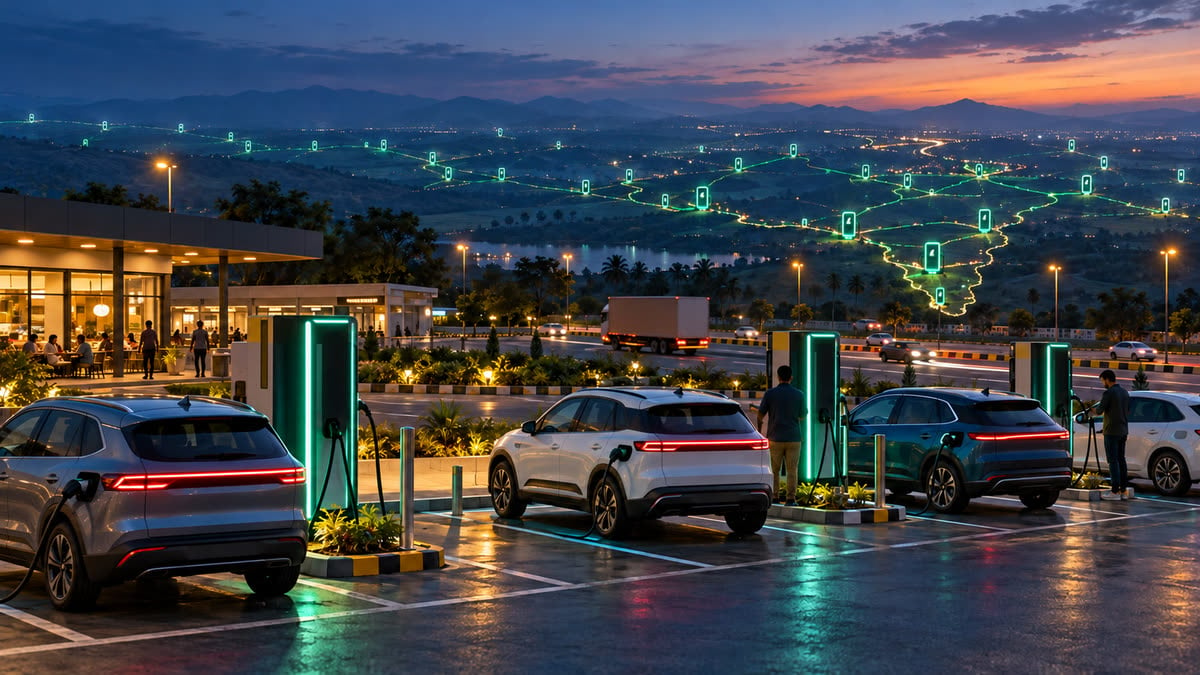
TATA.ev’s Mega Charger network has reached more than 1,000 connectors, according to fresh reporting published on 22 Oct 2026, while the company’s live directory lists over 1,000 consistently reliable chargers. For EV owners, the milestone matters less as a headline number than as a reason to check live availability, connector compatibility and charging speed before a city or highway trip.
Key takeaways
- Whalesbook reported the 1,000-active-connector milestone; TATA.ev’s own directory also lists more than 1,000 reliable chargers.
- The Mega Charger network is open to all EV users. TATA.ev says its customers can receive up to a 25% tariff discount at eligible sites.
- The TATA.ev directory describes ultra-fast charging of up to 120 kW, but the usable speed depends on the site and the vehicle.
- Drivers should check the station’s live status, supported connector, tariff and route position before starting a long trip.
What the 1,000-connector milestone means
The latest update is about the scale of TATA.ev’s branded and verified charging reach. Whalesbook reported on 22 Oct 2026 that the network had reached 1,000 active connectors across 200 Indian cities. TATA.ev’s current Mega Chargers page uses a slightly different description, listing over 1,000 “consistently reliable” chargers and directing users to a live location list.
That wording difference is important. A connector is the plug-and-cable interface a vehicle uses; one charging site can have several connectors. The total is therefore not the same as the number of separate stops, and it does not mean that every location offers the same output, parking capacity or availability.
TATA.ev’s earlier official charging-infrastructure release had said that its broader cumulative work had reached more than 200 cities. That earlier figure included home, community and dealership chargers, so it should not be treated as a like-for-like count of the latest Mega Charger connector network. For a trip, the live directory is more useful than either headline number.
Why this matters for EV road trips
More mapped connectors can make an electric car easier to use beyond its home charging routine, especially when a route includes a highway stop rather than a destination with overnight charging. TATA.ev says its Mega Chargers are open to all EV users, while its own customers may receive preferential access or tariff benefits at eligible locations.
The network is also being built around corridors, not only city centres. In a 10 Sep 2026 release, Tata Power said 10 co-branded Tata Power x TATA.ev Mega Charger hubs across four states had recorded more than 70,000 charging sessions and over 85,000 charging hours. Fortune India independently reported the same utilisation update. Those hubs included locations on the Yamuna Expressway, the Hyderabad–Vijayawada corridor, the Bengaluru–Tirupati route and the Pune–Bengaluru corridor.
The official release said those 10 hubs together used 25 fast chargers and 56 charging guns with 2.7 MW of combined capacity. Those figures apply to the highlighted hub group, not to every connector in the wider 1,000-plus network. The distinction gives drivers a practical expectation: network size can improve route choice, but it does not guarantee that every stop will have multiple high-power bays.
What drivers should check before a charging stop
- Connector compatibility: confirm that the plug supported by the station matches the vehicle. The station listing and the car’s manual or charging screen should agree.
- Live status and queue: check whether the charger is operational and whether another vehicle is already using the bay. A listed location is not the same as an immediately free connector.
- Vehicle charging limit: the directory describes Mega Charger speeds of up to 120 kW, but a vehicle may accept less. Charging time also changes with battery temperature, state of charge and the vehicle’s charging curve.
- Price and eligibility: TATA.ev says eligible customers can receive up to a 25% discount at Mega Chargers. The actual tariff, discount process and payment screen should be checked in the operator app before plugging in.
- A fallback stop: keep a second option on the route, particularly on a long intercity journey or a corridor with fewer alternatives. The state-wise EV charging directory can help compare nearby locations before departure.
How to plan the trip around the network
A 1,000-plus connector network does not remove the need for route planning. Start with the vehicle’s usable range, then identify a charging stop before the remaining range becomes tight. Leave room for traffic, weather, detours and the possibility that a site is busy. The road-trip planner can help map the journey, while drivers comparing the energy cost with a petrol vehicle can use the fuel cost calculator as a separate benchmark.
It is also worth checking the stop immediately before departure rather than relying on an old screenshot or a search result. Charging networks change as operators add, repair or temporarily close equipment. A route plan that includes the station name, operator app, connector type and a backup location is more useful than a broad assumption that charging will be available somewhere along the highway.
What to watch next
The next meaningful test is not only whether the connector count rises, but whether drivers find reliable uptime, transparent pricing and workable coverage on less-served corridors. Tata Power said its broader charging ecosystem had more than 7,000 public and captive charging points across 717 cities and towns, and it has stated a target of 10,000 public charging points and 7.5 lakh home chargers by 2030. Those are company targets, not guaranteed outcomes.
For EV owners, the immediate takeaway is practical: the expanding network may create more charging choices, but the best use of the milestone is to verify the exact stop, speed and tariff for the journey being planned.
Sources
- TATA.ev Reaches 1,000 Charging Connectors: What Investors Should Track — Whalesbook, 22 Oct 2026.
- TATA.ev Mega Chargers: Fast Charging Stations and Network Locations — TATA.ev, accessed 23 Oct 2026.
- Tata Power and Tata Passenger Electric Mobility Ltd Expand Fast-Charging Footprint Across 10 locations in India, Clock 70,000+ Charging Sessions — Tata Power, 10 Sep 2026.
- Tata Power, TATA.ev clock 70,000+ EV charging sessions across 10 hubs; network adds 2.7 MW capacity — Fortune India, 10 Sep 2026.
- TATA.ev to boost India’s Charging Infrastructure to 400,000 Charge Points — Tata Motors, 13 Feb 2025.