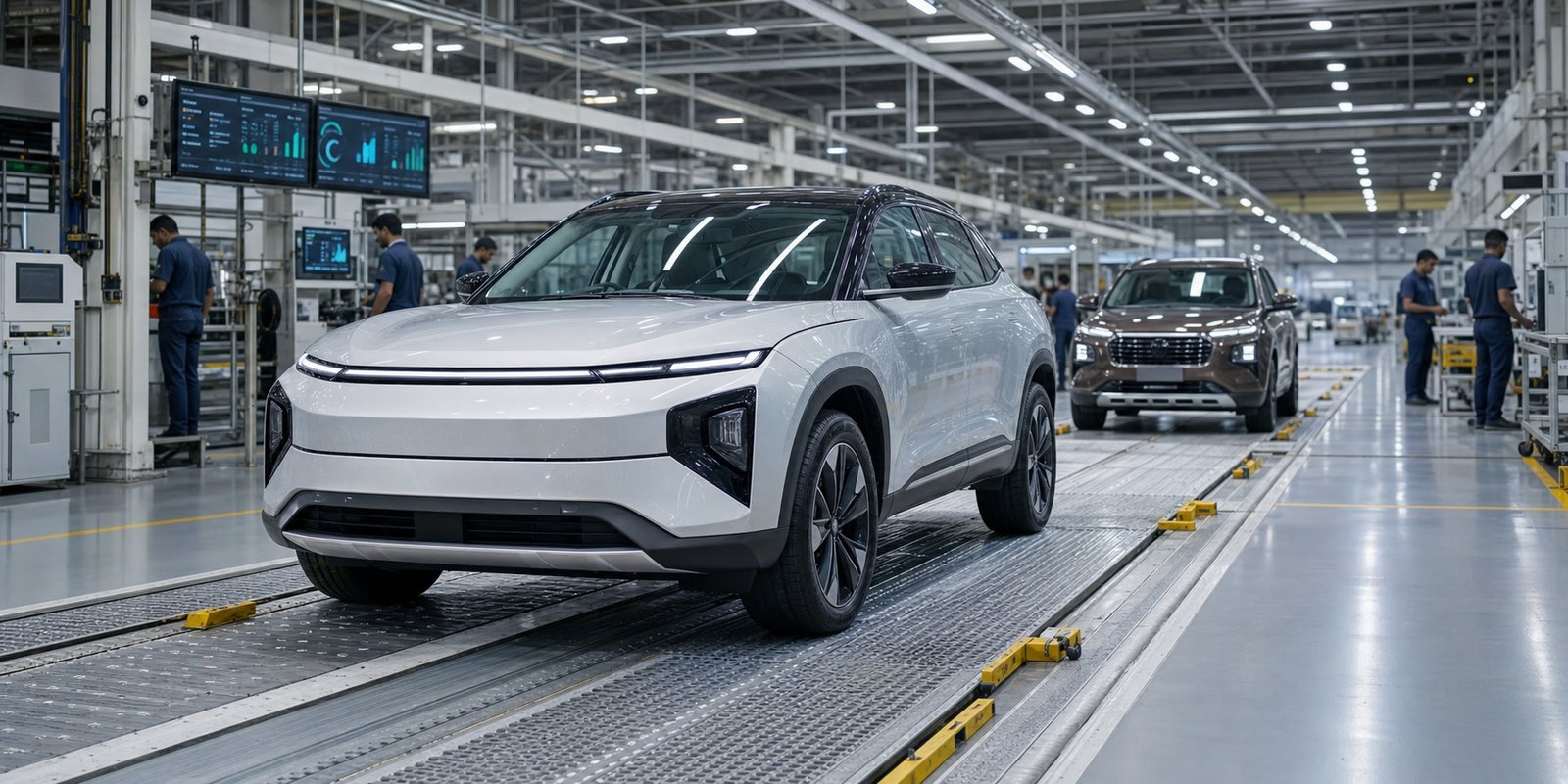
Tata Motors Passenger Vehicles has set out one of the most aggressive growth plans in India’s auto market this year. According to Economic Times, the company is planning to invest between Rs 37,500 crore and Rs 40,000 crore over the next five years, up to FY31, to expand capacity by about 45 percent, launch several new models and push annual sales beyond 1.2 million units.
That is a big number even by the standards of a large automaker. But for FuelPrice readers, the more important point is what sits behind the investment: the company says the growth will be driven heavily by electric vehicles and CNG models. In other words, this is not only a corporate expansion story. It is also a sign of where India’s fuel-cost conversation is heading.
ET also reported on June 23, 2026 that Tata Motors Passenger Vehicles expects revenue to cross Rs 6 lakh crore by FY31, while targeting an EBIT margin of 10 percent. Put together, the revenue target and the capex plan tell the same story: the company wants scale, more product breadth and a stronger position in low-running-cost mobility.
Why this matters now
Most car news focuses on one model launch or one special edition. This story is about the next five years. When an automaker commits this kind of money, it usually means three things: more factories or higher utilisation, more model updates, and more pressure to win the kinds of buyers who are comparing petrol, diesel, CNG and EV ownership more carefully than before.
India’s passenger-car market is still fuel-sensitive. A buyer who drives 1,000 km or more a month thinks very differently from a weekend user. That buyer is asking a practical question: how much will I spend on fuel, maintenance and charging over the next five years? Tata’s roadmap suggests it sees that question becoming more important, not less. EVs and CNG models are exactly the products that can change the answer.
Tata already has a broad electric portfolio on its official EV site, including Tiago.ev, Tigor.ev, Punch.ev, Nexon.ev, Curvv.ev and Harrier.ev. That current lineup matters because this FY31 plan is not happening from zero. It is building on an EV base that already exists, so future investment can be used to deepen the product ladder rather than merely prove the concept.
What the numbers suggest
The headline targets are clear enough to read as a roadmap:
- Rs 37,500-40,000 crore investment: a large capex commitment that signals confidence in domestic demand.
- About 45 percent capacity expansion: more room to build vehicles and potentially shorten product waiting times if demand stays strong.
- 1.2 million-plus annual sales: roughly double the company’s current scale, if the plan plays out.
- Rs 6 lakh crore revenue by FY31: a target that implies Tata wants to become far larger and more profitable in passenger vehicles.
- 10 percent EBIT margin: evidence that the company is not chasing volume alone; it wants stronger economics too.
What matters for buyers is that scale can influence the way a brand prices and supports its products. A bigger product line can mean more price points, more variants and more competition within the same showroom. For EV buyers, it can also mean more attention to charging support, battery warranties, software updates and long-term ownership confidence. For CNG buyers, it can mean more model choices and a stronger service network.
Why EV and CNG are central to the story
Tata’s growth roadmap is especially relevant because EV and CNG are not just alternatives to petrol and diesel; they are the products that directly shape fuel spending. EVs shift the cost from pump prices to electricity tariffs and charging convenience. CNG reduces running cost for many city users and commercial fleets, provided the refuelling network is practical. Both options are part of the broader answer to India’s fuel-cost pressure.
For households, that means the next Tata launches could matter even if they never buy an EV immediately. More EV and CNG options usually push the wider market to think harder about total cost of ownership, not just sticker price. That can influence petrol and diesel buyers too, because automakers cannot ignore a market where fuel economy, range and charging convenience are increasingly central to the buying decision.
The same logic applies to Tata’s push for new models. A larger product cycle usually brings a faster refresh of features, safer platforms, better infotainment, more connected-car tech and a wider spread of automatic or hybrid-like low-cost ownership solutions. If the company is serious about doubling sales, it will need more than one or two bestseller SUVs. It will need a deeper portfolio that works for first-time buyers, upgrade buyers and higher-mileage families.
| What Tata is targeting | Why it matters | FuelPrice angle |
|---|---|---|
| Capacity up by about 45 percent | More output and more room for launches. | Can improve availability of EV and CNG cars that cut fuel spend. |
| Sales above 1.2 million units | Signals a much larger market footprint. | More buyers moving into lower-running-cost vehicles means less dependence on petrol and diesel. |
| EV and CNG as growth drivers | Shows which technologies the company is prioritising. | Directly affects what consumers spend on fuel and charging. |
| Revenue above Rs 6 lakh crore | A scale target that requires profitable product mix. | Could push more efficient, higher-volume, lower-cost ownership models. |
What buyers should watch next
The real test starts after the announcement. Buyers should watch for three things. First, how Tata allocates this capital across plants, platforms and powertrains. Second, whether the company leans more heavily into EVs, CNG, or a mixed portfolio that still protects petrol and diesel buyers. Third, whether the growth plan produces visible changes in pricing, waiting periods and variant availability.
There is also a practical ownership question. Bigger investment does not automatically mean cheaper cars. It can mean more technology, more safety equipment and better factory output, but it can also mean higher feature content and more premium positioning. That is why the most useful comparison is not just ex-showroom price, but five-year running cost and service cost across petrol, diesel, CNG and EV options.
The reader takeaway is simple: Tata Motors is signalling that the next phase of Indian passenger cars will be built around scale, EVs and CNG, not just traditional petrol and diesel demand. If the capex plan and revenue target play out, buyers should expect a bigger Tata product funnel, stronger competition in low-running-cost vehicles and more pressure on rivals to match that pace.
Sources: Economic Times: Tata Motors to invest up to Rs 40,000 crore by FY31, Economic Times: Tata Motors PV eyes over Rs 6 lakh crore revenue by FY31, Tata.ev official EV portfolio, Economic Times: broader auto capex context.