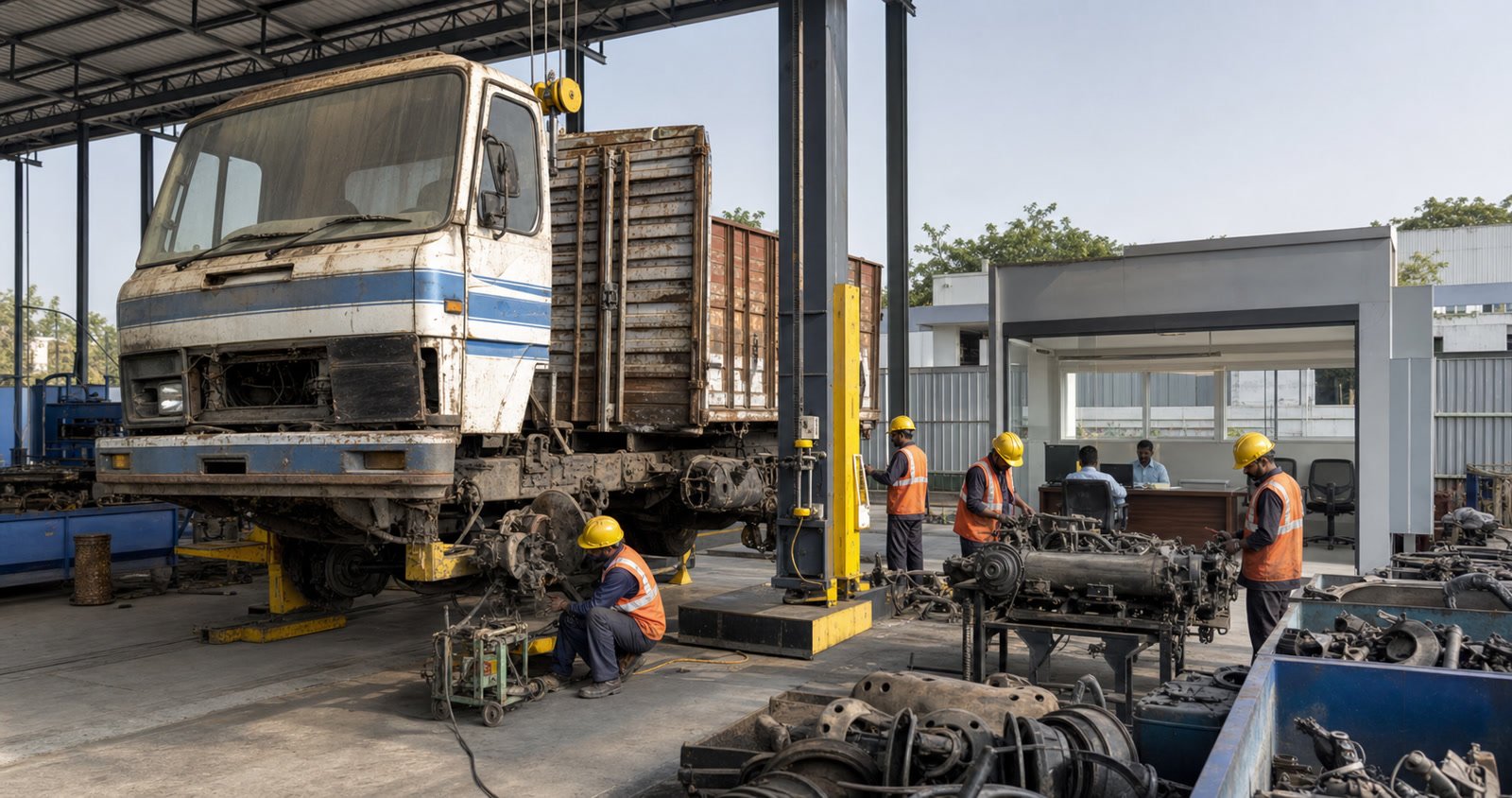
Tata Motors' vehicle scrappage network has moved from a background sustainability initiative to a live commercial and policy story. Fresh reporting says the company now operates 11 registered vehicle scrapping facilities, or RVSFs, across 10 states through its Re.Wi.Re platform, with combined annual dismantling capacity of more than 1.9 lakh vehicles. That scale matters because India's clean-fleet push is no longer only about launching newer trucks, buses or electric vehicles. It also needs a formal way to retire older, high-emission vehicles safely.
The immediate trigger is the Centre's renewed focus on ageing commercial vehicles, especially in the Delhi-NCR belt where older diesel trucks and buses are under policy pressure. A recent report on the Union Cabinet-backed Delhi-NCR replacement plan said the scheme targets more than 1.9 lakh trucks and 16,000 buses in the region and links benefits to cleaner BS-VI or electric replacement vehicles. For FuelPrice readers, the issue is not just corporate opportunity for Tata Motors. It is about how scrappage infrastructure can affect transport costs, fuel demand, vehicle financing, emission compliance and the resale choices of fleet owners.
What happened
Times of India reported on June 8, 2026 that Tata Motors is positioned to benefit from the government's push to retire ageing commercial vehicles. The report said Tata Motors' Re.Wi.Re network has 11 RVSFs across 10 states, excluding the southern region, and can dismantle more than 1.9 lakh vehicles a year. It also reported that several facilities are located in markets linked to the wider NCR scheme, including Delhi-NCR, Haryana, Rajasthan and Uttar Pradesh.
The company has been expanding the network over the past year. In May 2025, Tata Motors launched a registered vehicle scrapping facility in Kalyani, West Bengal, described then as its eighth such facility nationally. That Kalyani unit was reported to have annual capacity for up to 21,000 end-of-life vehicles and to handle passenger vehicles, commercial vehicles, two-wheelers and three-wheelers across brands. The latest 11-facility count shows how quickly formal scrappage capacity is becoming a strategic asset for auto companies that sell commercial vehicles.
Why this matters beyond Tata Motors
Scrappage is often treated as a compliance formality, but for transport businesses it can influence the full cost of fleet renewal. Old trucks and buses are typically more expensive to maintain, less fuel-efficient, and more exposed to emission restrictions. If a formal scrapping channel gives owners a clearer document trail, access to incentives, and confidence that the old vehicle will be deregistered properly, it can reduce one source of friction in replacing a vehicle.
The policy logic is also straightforward. A cleaner vehicle only reduces road emissions when the older one actually exits active use. Without a trusted scrappage process, older commercial vehicles can simply move from stricter urban markets to smaller towns, delaying the air-quality benefit and keeping fuel-inefficient units on the road. Registered scrapping facilities are meant to close that loop by linking ownership transfer, certificate issuance, dismantling, depollution and material recovery to a traceable process.
The MoRTH-linked VAHAN scrapping portal describes itself as the national portal for vehicle scrapping related services and lists state-wise RVSF details. The GSR 653(E) rules define a registered vehicle scrapping facility as an establishment authorized under the rules to carry out dismantling and scrapping operations. The same rules refer to documents such as certificate of deposit and certificate of vehicle scrapping, and describe scrapping as a process that includes depolluting, dismantling, material separation and safe disposal of non-reusable parts.
Impact on fleets, fuel users and the auto market
For fleet operators, the most practical question is whether scrappage economics make replacement affordable. A new BS-VI truck, electric bus or cleaner commercial vehicle can reduce fuel waste, downtime and pollution exposure, but the upfront cost can be high. Incentives, interest support, registration fee relief, state tax concessions and manufacturer discounts can make the decision easier, but only if the owner can scrap or transfer the old asset without uncertainty.
This is where a large RVSF footprint helps. A transporter is more likely to participate if the nearest approved facility is reachable, paperwork is predictable, and the process does not leave the owner exposed to future liability from the old vehicle. Tata Motors' benefit is that it operates both in commercial vehicle sales and in the scrapping ecosystem. That gives it a possible touchpoint at both ends of the cycle: retiring the old asset and selling or supporting the cleaner replacement.
There is also a fuel-price angle. Cleaner and newer commercial vehicles generally use fuel more efficiently than older units, especially where maintenance has deteriorated. If old diesel trucks and buses are replaced with BS-VI or electric alternatives, the impact may show up gradually in diesel consumption patterns, fleet maintenance costs and city-level emissions rather than in pump prices overnight. For logistics users, the benefit depends on total cost per kilometre, financing terms and vehicle utilisation.
| Stakeholder | What changes | What to watch |
|---|---|---|
| Fleet owners | More formal routes to retire old trucks and buses before buying cleaner replacements. | Net cost after incentives, loan terms, scrap value and downtime. |
| Vehicle makers | Scrappage can create replacement demand in commercial vehicle segments. | Whether incentives translate into actual BS-VI and EV sales. |
| Cities and regulators | Formal RVSFs help verify that old vehicles are dismantled rather than shifted elsewhere. | Enforcement, state coordination and RVSF capacity near high-pollution corridors. |
| Fuel and logistics users | Newer fleets can lower fuel waste, breakdowns and emission exposure over time. | Whether savings offset higher vehicle purchase prices. |
The caution for buyers
The policy direction is clear, but the business case is not automatic for every owner. Scrapping a truck too early can destroy resale value. Waiting too long can raise compliance risk, fuel spend and maintenance losses. The right decision will depend on vehicle age, emission category, route exposure, local enforcement, finance availability and whether replacement incentives are actually accessible.
There is also a regional gap to watch. The latest report says Tata Motors' current 11-facility RVSF network excludes the southern region. If replacement pressure expands beyond NCR and western or northern freight corridors, RVSF availability in under-covered regions will become important. Southern states with major freight, ports, auto clusters and bus fleets may need stronger formal scrappage coverage if the national policy push gathers pace.
What to watch next
The first marker will be actual scrapping volumes, not just announced capacity. If Delhi-NCR's replacement plan pushes large numbers of eligible trucks and buses toward formal facilities, RVSFs in Haryana, Rajasthan, Uttar Pradesh and NCR-linked areas could see higher throughput. The second marker will be replacement purchases: whether owners choose new BS-VI diesel vehicles, used BS-VI units, electric buses, or other cleaner options.
For Tata Motors, the strategic question is whether scrappage becomes a recurring funnel for commercial vehicle demand. For fleet owners, the practical question is whether the combination of certificate, incentive, finance and operating savings makes renewal cheaper than running an older vehicle. For fuel users and city residents, the takeaway is simple: scrappage is not just junkyard activity. Done formally, it is one of the mechanisms that can turn vehicle policy into cleaner, safer and more fuel-efficient roads.
Sources: Times of India, Times of India Chennai, Times of India Business Desk, MoRTH VAHAN V-Scrap portal, MoRTH VAHAN RVSF details, GSR 653(E) RVSF Rules, Times of India Kolkata.