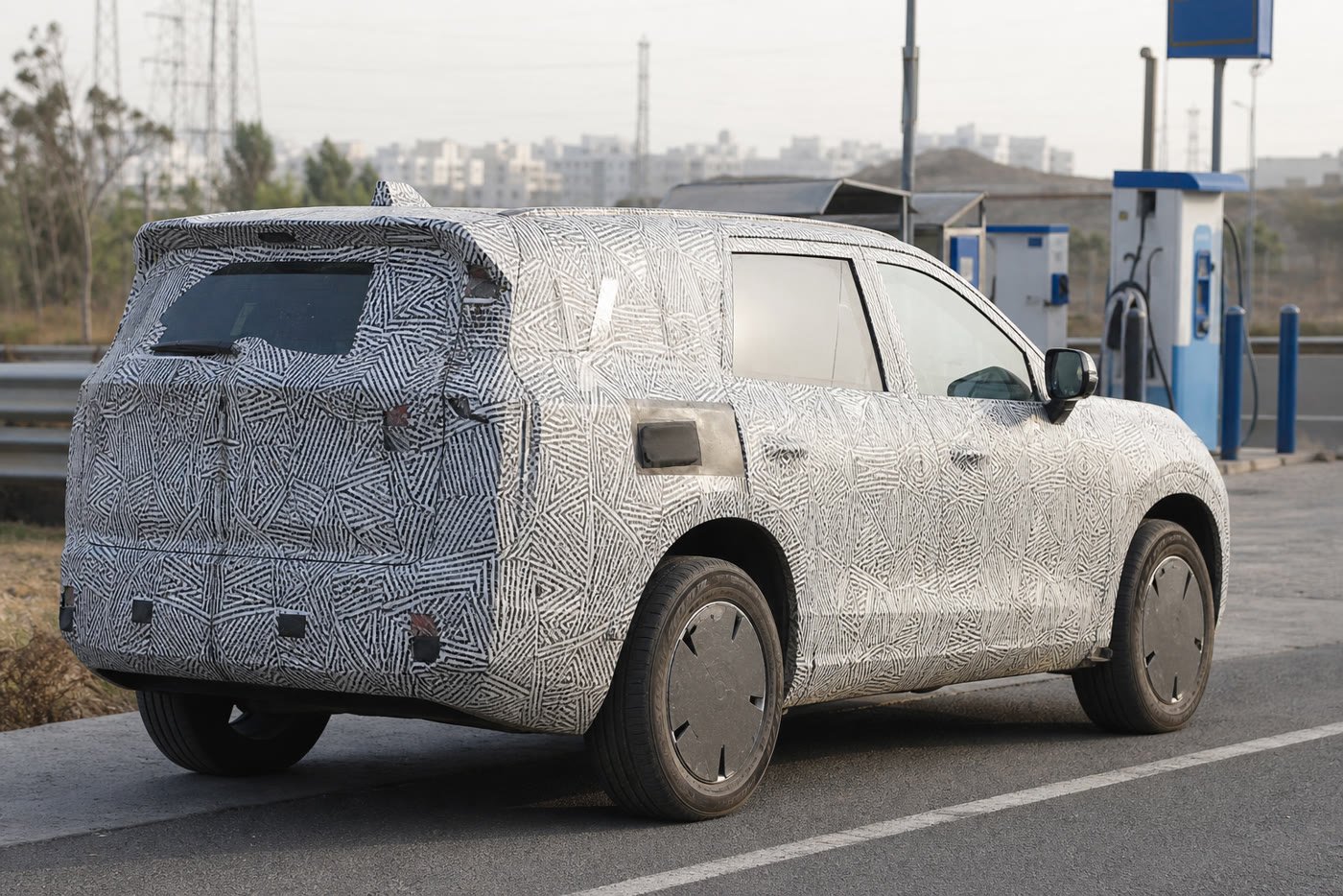
The Tata Safari EV has moved from product-plan speculation to road-test visibility, and that matters for more than just new-car excitement. Fresh reports say a camouflaged Safari EV test mule has been spotted on Indian roads ahead of an expected festive-season 2026 launch. For FuelPrice readers, the important part is not only that Tata may add another EV badge. It is that one of India's best-known three-row SUV nameplates is being prepared for buyers who currently depend on diesel, petrol or hybrid options for family travel, chauffeur use and long highway trips.
AutoX and HT Auto reported this week that the Safari EV has entered road testing, with the test vehicle retaining the familiar Safari shape while showing EV-specific clues such as the absence of an exhaust outlet. Autocar India had earlier reported a festive-season 2026 launch plan, expected production movement around August, and likely sharing of key hardware with the Harrier.ev. Tata Motors has not yet published final Safari EV specifications or an official launch date, so buyers should treat battery, range and variant details as expected rather than confirmed.
What Has Changed Now
The latest spy-testing update is significant because the Safari EV is not a small city EV or a low-speed commuter product. It is expected to be a large, three-row electric SUV positioned above the Harrier.ev, making it relevant for customers who need space, luggage flexibility and highway ability. If Tata keeps the Safari's basic body style and cabin layout close to the diesel model, the EV version could appeal to families and fleet-like premium users who want lower running costs without moving down to a compact EV.
The Safari name also has a fuel-cost context. The current Safari is associated with long-distance diesel use, highway touring, large-family travel and executive mobility. An electric Safari would put the same use case into a different cost equation: home charging, public fast-charging stops, battery warranty confidence, route planning and charger availability become as important as diesel efficiency and tank range.
Known Facts And Expected Details
| Area | Current reading | Why it matters |
|---|---|---|
| Testing status | Camouflaged Safari EV test mule spotted on Indian roads. | Road testing suggests the project is moving closer to market readiness. |
| Launch window | Reports point to festive season 2026, but Tata has not issued final launch confirmation. | Buyers planning a premium SUV purchase may delay decisions until pricing and range are clear. |
| Architecture | Expected to share Harrier.ev-based EV hardware and related technology. | Using proven hardware can reduce development risk and speed up launch timing. |
| Fuel impact | A large SUV use case shifts from diesel refuelling to charging economics. | Running cost, charging time and highway charger access become key ownership factors. |
Why Fuel Users Should Watch This
Large SUVs are often bought for reasons that small EVs cannot easily satisfy: three-row seating, luggage capacity, high seating position, long-trip comfort and family confidence. That is why the Safari EV story is important. If Tata prices it close to the premium diesel SUV band and offers a useful real-world range, it could give buyers a new way to compare monthly fuel spending against charging cost and EMI.
For a city-only hatchback EV, the fuel-saving argument is straightforward. For a three-row electric SUV, the calculation is more complex. A buyer may save on daily office runs if home charging is available, but the same buyer must also consider expressway charging stops, peak holiday queues at chargers, paid fast-charging tariffs, charger reliability and whether the family regularly drives routes with strong public charging coverage. That is why the Safari EV will need more than a headline range number. It will need clear charging data, route-planning support and transparent variant pricing.
What The Harrier.ev Context Tells Us
The Harrier.ev gives useful context for what Tata may carry into the Safari EV. Tata Group's official Harrier.ev launch note highlighted the acti.ev+ architecture, a 75 kWh battery, 504 Nm torque from a dual-motor setup, fast charging that can add 250 km of range in 15 minutes, and a lifetime battery warranty for the Harrier.ev. Reports expect the Safari EV to share some of this hardware and technology, including 65 kWh and 75 kWh battery choices and possible rear-wheel-drive and all-wheel-drive variants.
However, the Safari EV is expected to be larger and heavier than the Harrier.ev. That means final claimed range and real-world highway range may differ. A heavier three-row SUV usually faces more energy demand at expressway speeds, especially with full passenger load, air-conditioning and luggage. Until Tata releases official Safari EV figures, the safest reading is that the Harrier.ev gives the technology direction, not a final Safari EV spec sheet.
Who Is Most Affected
The first affected group is premium family SUV buyers who are considering a Safari, Harrier, XUV700, Innova Hycross, Mahindra XEV 9S or another high-value vehicle in 2026. The Safari EV could make them pause and compare diesel convenience against EV running cost. The second group is highway-focused users who need predictable charging on routes between major cities. The third group is premium taxi, hotel and corporate mobility operators, where operating cost per kilometre matters, but uptime and charging turnaround matter even more.
Auto dealers and charging companies also have a stake. A credible three-row EV from a mass-market brand can push more charging demand beyond city centres and into highway corridors, malls, hotels and large housing societies. It can also pressure competitors to bring bigger batteries, better charging interfaces and clearer warranty packages.
What To Watch Next
The key watch points are simple: official launch timing, battery options, claimed and real-world range, DC fast-charging speed, charger and installation cost, battery warranty terms, boot space with all three rows, and the price gap versus the diesel Safari and Harrier.ev. Buyers should also watch whether Tata offers EV-specific features such as route-based charger discovery, vehicle-to-load support, software updates and advanced driver-assistance features across mid-level variants or only on the top trim.
Reader takeaway: the Safari EV is not yet a launched product, but its road-testing stage makes it one of the most important upcoming EVs for Indian family SUV buyers. If Tata can combine three-row practicality, credible highway range and charging confidence, the Safari EV could shift a part of the large-SUV market away from traditional fuel dependence. If pricing or real-world range disappoints, diesel and hybrid alternatives will remain hard to displace.