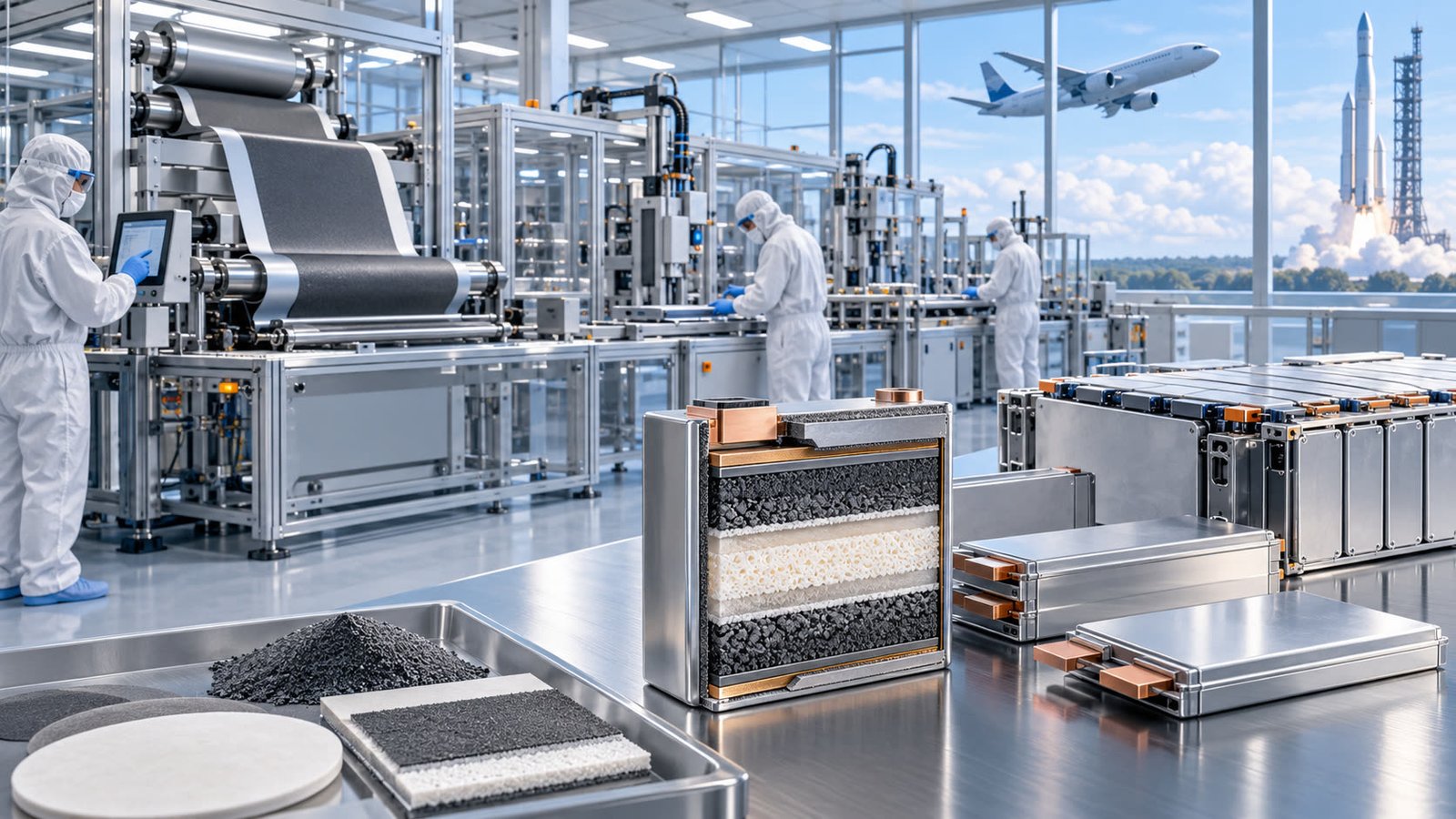
Saft, the battery subsidiary of TotalEnergies, says it has inaugurated new solid-state battery production lines at its Bordeaux site in France. The development matters beyond the factory because it moves a next-generation battery technology toward industrial production, while the first announced targets are aviation and space rather than an immediate consumer-electric-vehicle launch.
Key takeaways
- Saft says the Bordeaux site is the first French manufacturing operation able to develop and produce solid-state batteries using both sulfide and polymer electrolytes at room temperature.
- The company says the technology can offer energy density up to 50% higher than classic lithium-ion batteries, but that is a company-reported potential benefit, not a road-vehicle test result.
- Saft says its dry-electrode process could cut carbon-dioxide emissions from that manufacturing stage by up to 40%.
- The stated applications are future electric and hybrid aircraft architectures and space systems; no consumer-car launch, vehicle price or mass-market supply timetable was announced.
What Saft has started in Bordeaux
In a 19 October 2026 announcement, Saft said it had inaugurated new production lines for solid-state batteries at its Bordeaux facility. The company describes itself as the first French manufacturer with the capacity to develop and produce cells that use sulfide and polymer solid electrolytes at room temperature.
Independent specialist publication pv magazine reported the development on 20 October and described the line as a facility for developing and manufacturing solid-state batteries, rather than presenting it as a high-volume consumer-EV plant. The two accounts agree on the central point: Saft has moved from research capability toward a production-line environment for the technology.
That distinction is important. Neither source gives a line capacity, a cell price, a commercial vehicle contract or a delivery timetable. A production line can demonstrate repeatable processes and generate cells for qualification without meaning that large numbers of road vehicles will soon use the batteries.
Why solid-state batteries matter
Solid-state batteries replace the liquid electrolyte used in conventional lithium-ion cells with a solid material. Saft says that change can improve safety and deliver energy density up to 50% higher than classic lithium-ion technology. The wording matters: this is the manufacturer’s stated potential, not independent evidence that every cell from the new lines will achieve that level or that a finished vehicle will gain the same percentage in driving range.
Saft also links the new lines to a dry-electrode manufacturing process. It says the process can reduce carbon-dioxide emissions from the electrode-production stage by up to 40%. That figure should not be read as a 40% reduction in the full life-cycle footprint of a battery or an aircraft; it refers to the specific manufacturing step described by the company.
Why aviation and space come first
Aircraft and spacecraft place a premium on battery safety, energy density and dependable performance. A lighter cell can potentially improve the payload or efficiency calculation, while a safer chemistry can reduce the consequences of thermal events. Those benefits still have to be demonstrated under demanding qualification, vibration, temperature and lifecycle conditions before they can support commercial transport.
Saft says it has already delivered semi-solid-state cells for evaluation of future electric and hybrid aircraft architectures. It also identifies the space sector as a target because high energy density and safety are valuable there. This places the announcement closer to an industrial qualification milestone than to a confirmed commercial aircraft or spacecraft deployment.
What it means for road EVs
For drivers, the announcement does not change today’s available EV range, charging times or vehicle prices. It also does not confirm that Saft’s solid-state cells will be supplied to a passenger-car maker. The near-term significance is upstream: if the line helps Saft validate materials, manufacturing yields and durability, it could strengthen Europe’s battery technology base for later mobility applications.
For a current fuel-cost baseline, readers can check live fuel prices before comparing petrol or diesel running costs with an electric vehicle.
For a trip-by-trip comparison, the fuel cost calculator can turn a route, distance and vehicle efficiency into an estimate without assuming that future battery technology is already available.
EV owners and prospective buyers can also use the EV charging station directory to assess present charging access; the new Saft lines do not yet alter that infrastructure picture.
What to watch next
- Whether Saft publishes cell-performance data, output information or independent validation from the Bordeaux lines.
- Whether aviation and space partners move from evaluation cells to formal development or supply agreements.
- Whether the technology can meet cost, durability and safety targets outside specialist applications.
- Whether a later announcement connects the solid-state platform to road vehicles, rather than leaving it focused on aviation, space and industrial uses.
Reader takeaway
Saft’s Bordeaux announcement is a meaningful European battery-manufacturing step with relevance to the wider energy-transition and transport markets. It makes solid-state production more tangible, but it is not yet a new consumer-EV battery on sale. For motorists, the useful signal is what happens next: independently verified performance, repeatable output and a named vehicle or transport application would matter more than the existence of a pilot production line alone.