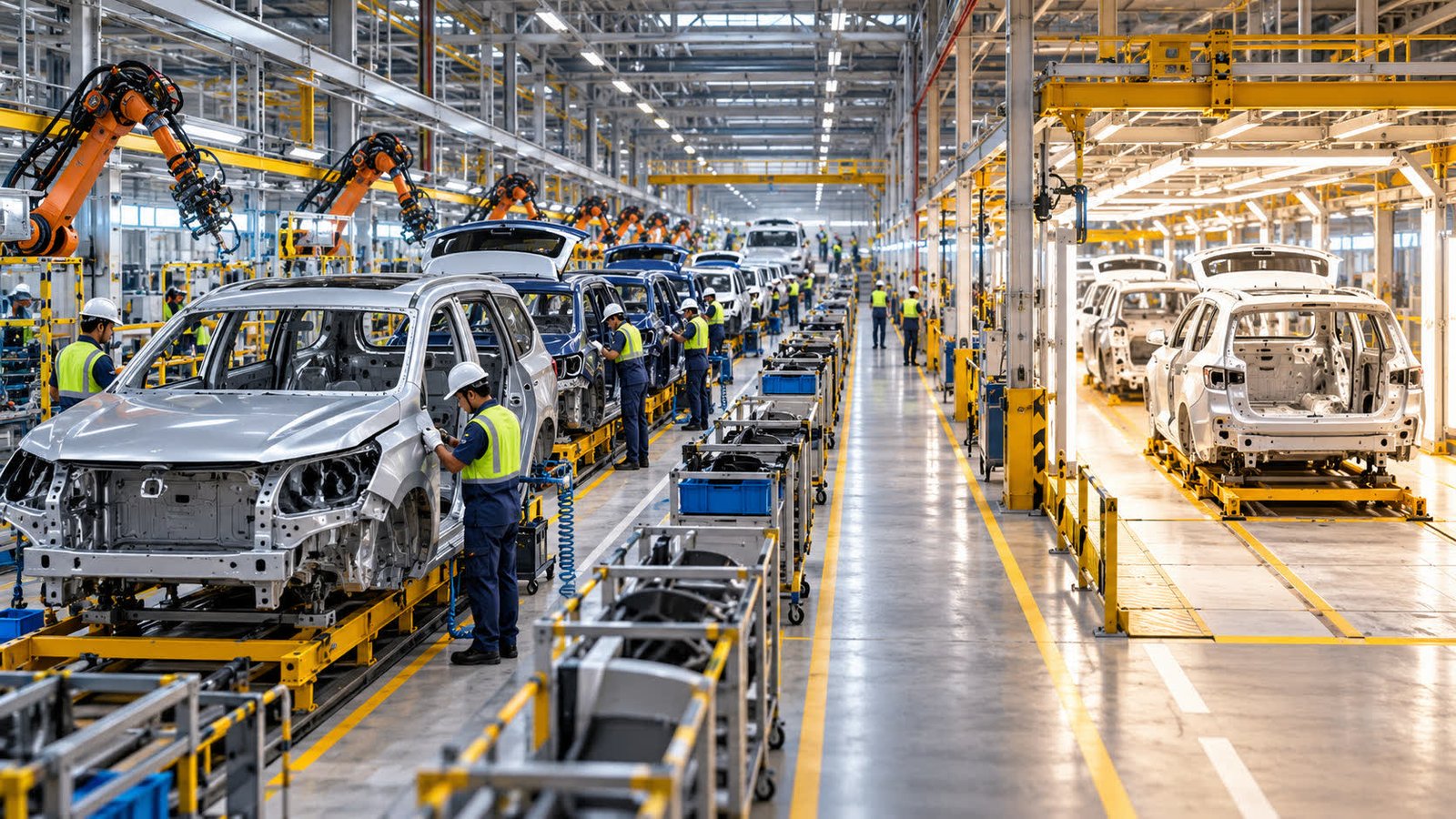
Toyota Kirloskar Motor (TKM) is reported to be preparing a production-capacity increase of 1,00,000 vehicles a year at its Bidadi, Karnataka facility from January 2027. The plan is aimed at easing delivery pressure on popular models, but it is not a confirmed shorter-wait promise for every buyer or variant.
The January timing and 1,00,000-vehicle figure were reported by The Economic Times on 15 Oct 2026 and by ETAuto on 14 Oct 2026. Toyota’s official 21 Nov 2023 investment release also described a third Bidadi plant with annual added production of 1,00,000 units, so the current update is best read as a reported ramp-up of that earlier expansion plan.
Key takeaways
- TKM is reported to be increasing production capacity at Bidadi from January 2027, with the Innova HyCross cited as a key demand driver.
- The reported addition is up to 1,00,000 vehicles a year; it does not mean that every model or variant will immediately become available.
- ETAuto says waiting periods vary by model, with the Fortuner and HyCross among the nameplates facing delivery pressure.
- No specific near-term Toyota price increase was confirmed in the reports; the company said input costs are being assessed.
- For a booking already placed, the useful next check is a written model- and variant-level delivery estimate, not only the headline capacity figure.
What Toyota has reported
The Economic Times reported on 15 Oct 2026 that Toyota plans to add annual capacity of 1,00,000 vehicles at its Bidadi facility from January 2027. The report linked the move to strong demand for the Innova HyCross and said the utilisation of the added capacity would depend on market demand.
ETAuto’s 14 Oct 2026 report gives the same development a wider buyer context: Toyota is looking to increase production from January to improve vehicle availability and manage waiting periods across its portfolio. It also records that waiting periods are model-specific, rather than a single company-wide queue. That distinction matters because extra output allocated to one plant or model does not automatically shorten the queue for another variant.
The current report is therefore a plan, not a delivery guarantee. Neither report publishes a plant commissioning certificate, a model-wise production allocation, or a date by which a specific buyer will receive a car. Those details would be needed before a buyer could treat the update as a confirmed reduction in waiting time.
What is confirmed in Toyota’s plant disclosures
Toyota’s official 21 Nov 2023 release said its third plant at Bidadi was expected to add 1,00,000 units of annual production, alongside an investment of about ₹3,300 crore and approximately 2,000 additional jobs. Those were the figures announced for the expansion plan at that time; they are not a fresh 2026 spending commitment.
In a separate official plant update posted on 11 May 2026, Toyota listed total installed production capacity at its existing Bidadi operations at up to 3,42,000 units a year. The same disclosure lists up to 1,32,000 units for Plant 1, which makes the Innova HyCross, Innova Crysta, Fortuner and Legender, and up to 2,10,000 units for Plant 2, which makes the Camry Hybrid, Urban Cruiser Hyryder and Hilux.
That May 2026 disclosure also covers a separate plant planned for Bidkin in Maharashtra, with production targeted for the first half of 2029 and capacity of 1,00,000 vehicles a year. It should not be confused with the reported January 2027 Bidadi ramp-up; the Maharashtra facility is a later project.
What the ramp-up could mean for car buyers
Availability may improve only after production and allocation
More installed capacity can help when it becomes usable production, but the benefit reaches a customer only after the relevant model is built, dispatched and allocated to the dealer. A buyer with a HyCross booking, for example, still needs to know whether the booking is assigned to the Bidadi production stream and which powertrain or variant is included. The same logic applies to the Fortuner and other models whose queues may be driven by separate production schedules.
Waiting periods can also move for reasons beyond factory output. Dealer allocation, component availability, colour and variant mix, logistics and the size of the booking queue can all affect the promised date. The capacity announcement is useful as a direction of travel, but it does not replace a current written delivery estimate.
Prices are a separate question
ETAuto reported that Toyota was reviewing the effect of rising input costs, but no specific near-term price hike had been confirmed. A higher production capacity does not lock in today’s ex-showroom price or guarantee that the final invoice will be unchanged before delivery. Buyers can ask the dealer how price revisions, accessories and delivery-linked charges would be handled in their booking documents.
If a delayed delivery means keeping an existing vehicle for longer, the running-cost side can be estimated with FuelPrice’s fuel-cost calculator. Use the live fuel-price tracker separately for the current petrol, diesel or CNG rate in the relevant city; the two questions are related, but neither tool predicts a Toyota delivery date.
What buyers should check now
- Ask for the expected delivery month for the exact model, powertrain, variant and colour, rather than a broad brand-level estimate.
- Ask whether the booking has a production or dealer allocation reference and when that status will be updated.
- Keep the booking form, price quotation and any written promise about price validity; verbal estimates can change as production plans change.
- Compare the cost of waiting with the cost of keeping the current vehicle, including fuel, insurance, servicing and any temporary transport need.
Why the Bidadi expansion matters beyond Toyota
The plan is also a signal about India’s passenger-vehicle supply chain. Toyota’s earlier official announcement linked the Bidadi project to local suppliers, manufacturing technology and additional employment. If the added line reaches sustained output, component makers, transporters and dealers could see higher volumes around the facility. That is an industry implication, not a confirmed forecast of jobs, sales or price cuts from the January 2027 ramp-up.
What to watch next
The next useful confirmation would be a Toyota update on the third Bidadi plant’s operating status, the models assigned to the additional capacity, and revised delivery timelines by variant. Buyers should also watch for a formal price circular or updated booking terms, because ETAuto reported that input-cost pressure remains under review.
Reader takeaway
Toyota’s reported January 2027 Bidadi capacity increase could ease delivery pressure, especially for high-demand models, but the immediate test is model-wise availability. Treat the 1,00,000-vehicle figure as planned annual capacity and ask for a written variant-level delivery commitment before relying on it.
Sources
- The Economic Times: “Toyota to add annual capacity of 100,000 units at Karnataka plant from early 2027” — 15 Oct 2026.
- ETAuto: “Toyota Kirloskar Motor Eyes Price Hikes Amid Rising Input Costs and Production Ramp-Up” — 14 Oct 2026.
- Toyota Kirloskar Motor: “Toyota to Build a New Vehicle Manufacturing Plant in India” — 11 May 2026.
- Toyota Kirloskar Motor: “Toyota Kirloskar Motor inks MOU with Government of Karnataka for next round of investments towards setting-up of a new plant” — 21 Nov 2023.