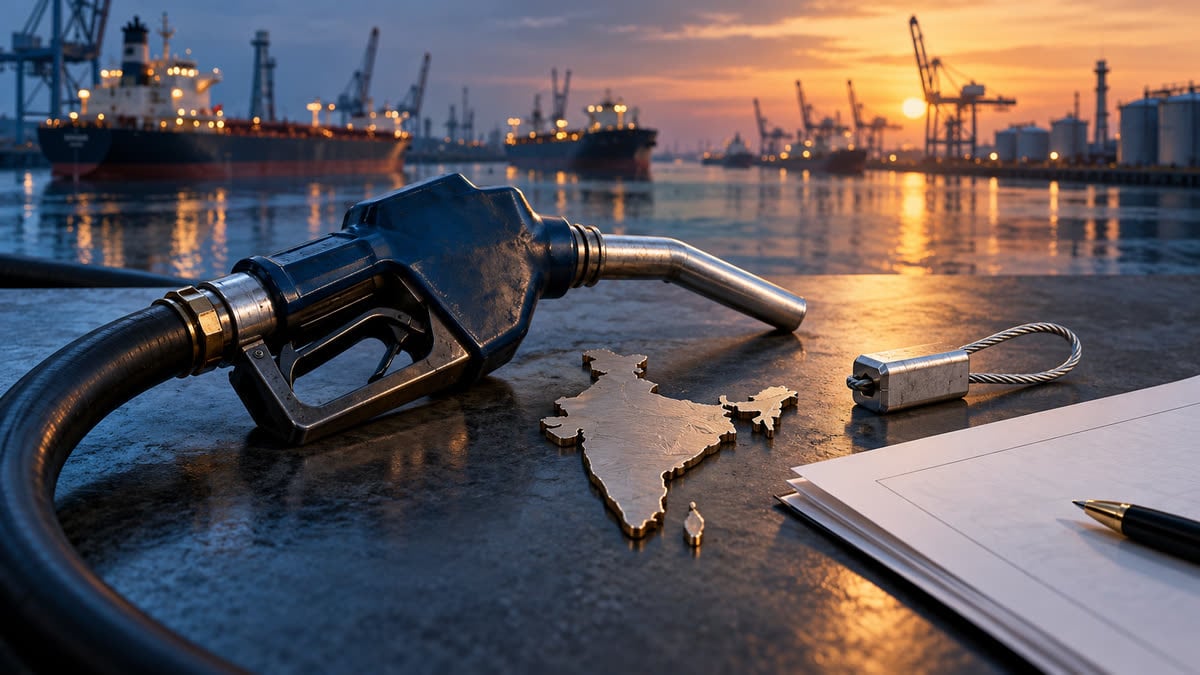
The White House on 16 Oct 2026 waived the new Russia-related sanctions, restrictions and duties created under the Lindsey O. Graham Sanctioning Russia and Iran Act, while leaving a conditional tariff framework for major buyers of Russian oil and gas. For India, the immediate effect is policy uncertainty around crude and diesel trade — not an announced change to petrol or diesel prices at Indian pumps.
Key takeaways
- The White House order dated 16 Oct 2026 waives the application of the new Act’s sanctions, restrictions and duties for now; the waiver can be changed later.
- The underlying framework allows a conditional duty of up to 100% on goods from the five largest importers of Russian crude or natural gas if they make new purchases after 18 Oct 2026.
- The 100% figure is a policy risk and monitoring mechanism, not a new charge that Indian motorists must pay at a fuel station.
- A separate U.S. Treasury licence authorises covered transactions involving Russian-origin diesel through 7 Apr 2027, subject to its conditions.
- Indian refiners and transport operators may feel any change through international trade flows and margins before private motorists see a direct fuel-price effect.
What the White House order actually does
Associated Press reported on 17 Oct that President Donald Trump had put the new Russia sanctions package on hold by signing an executive order and citing the national interest. The primary order is more precise than a simple reversal: it says the President is waiving the application of the sanctions, restrictions and duties created by the Graham Act and the order itself.
The waiver is not described as permanent. The order says it remains in effect until the President or the Secretary of State, in consultation with other officials where required, decides that further action is appropriate. That leaves the legal framework in place while temporarily stopping the specified measures from applying.
The same order directs the U.S. Trade Representative to monitor purchases of Russian crude and natural gas and possible sanctions evasion. It sets out a 100% ad valorem duty mechanism for goods from countries among the five largest importers of Russian-origin crude or natural gas when they knowingly make new purchases after 18 Oct 2026. The order also waives the application of those duties at present.
That distinction matters for Indian readers. The order does not name the five countries in its text, does not announce an Indian duty and does not change India’s fuel taxes or retail pricing rules. It creates a watch point for future U.S. action, while the current waiver means the headline tariff number should not be treated as an amount already added to an Indian fuel bill.
Why India’s fuel market is watching
India is connected to this policy through both sides of the refined-fuel market. Indian refiners buy crude from international suppliers and also export products such as diesel when overseas demand and margins make those cargoes viable. Business Standard and ThePrint reported that the earlier U.S. decision to allow Russian diesel transactions could change regional trade flows and put pressure on Indian refiners if additional Russian supplies reach competing markets.
Those are reported market assessments, not a confirmed forecast of cheaper fuel in India. The effect would depend on whether Russian diesel is physically available, how shipping and payment arrangements work, where cargoes are delivered, and how refiners in Europe, the United States and Asia respond. A change in global diesel competition can alter refinery margins without moving Indian pump prices immediately.
For private motorists, the practical point is simple: a U.S. sanctions waiver is not an Indian petrol or diesel price notification. Domestic pump rates depend on the pricing decisions and taxes that apply in India. The order itself changes none of those items.
The diesel licence is separate and temporary
On 9 Oct 2026, the U.S. Treasury’s Office of Foreign Assets Control issued General License 135. It authorises transactions related to the sale, delivery, offloading and importation of Russian-origin diesel through 12:01 a.m. Eastern Daylight Time on 7 Apr 2027, subject to the licence’s limits.
This is a targeted authorisation for specified diesel transactions, not a blanket removal of every Russia-related sanction. It also does not guarantee that the promised cargoes will arrive or that international diesel prices will fall. FuelPrice’s earlier report on the U.S. authorisation for Russian diesel sales and global fuel-price risk covers that first step; the 16 Oct order is a later development affecting the wider sanctions and tariff framework.
What it means for Indian drivers and fleets
Drivers do not need to change a vehicle document or toll setting because of this U.S. order. They can use FuelPrice’s live fuel-price pages to check the current local rate separately from the international policy story. That separation prevents a global headline from being mistaken for a same-day price revision in a particular city.
For a family or business trip, the more useful calculation is the vehicle’s actual fuel requirement and route distance. The fuel-cost calculator can show how a change in the assumed diesel or petrol rate would affect a trip budget, but it should not be used to present a speculative rate as a forecast.
Fleet and transport operators have a wider exposure. Their costs can respond to diesel availability, freight rates, refinery margins, currency movements and the price terms offered by different suppliers. A change in international trade flows may show up first in procurement conditions or freight economics, while retail prices remain unchanged for a period. The road-trip planner can help separate route distance and fuel use from the uncertain market element.
What to watch next
- Implementation: whether U.S. agencies publish which countries fall within the five-largest-importers category and how the waiver is applied.
- Russian supply: whether the separate diesel authorisation results in actual cargoes, given export, refining, shipping and payment constraints.
- Indian refining: whether diesel export margins, freight routes or competing regional cargoes change enough to affect refinery economics.
- Domestic pricing: whether Indian oil companies or the government issue a separate, dated change to petrol or diesel rates. The U.S. order alone is not that announcement.
The reader takeaway is a distinction between policy risk and pump-price movement. Washington has paused the immediate application of the new Russia sanctions and duties, but it has not removed the possibility of future action against major Russian-energy buyers. For India, that means watching trade flows and refinery economics while checking domestic fuel prices through India-specific sources rather than assuming an automatic increase or decrease.
This article is for general information only and is not financial, insurance or legal advice.
Sources
- The White House, “Implementing the Lindsey O. Graham Sanctioning Russia and Iran Act of 2026” — 16 Oct 2026
- Associated Press, “Trump puts new Russia sanctions that he recently signed into law on hold, citing national interest” — 17 Oct 2026
- U.S. Treasury OFAC, “Russia-related General License No. 135” — 9 Oct 2026
- Business Standard, “Russia to supply diesel to US, global markets: What it means for India” — 12 Oct 2026
- ThePrint, “What Trump’s Russian diesel deal means for US, surging global prices & Indian refiners” — 12 Oct 2026