TVS Motor Company has launched the Armado cargo tricycle globally with a claimed payload capacity of up to one tonne. The 200 cc commercial vehicle is aimed at first- and last-mile logistics, but TVS has not announced an India launch date, India price or domestic availability.
The 27 Nov 2026 announcement is therefore an export and commercial-mobility update for an Indian manufacturer, not an India sales launch. TVS says the Armado will serve customers across Africa, Latin America and ASEAN, while independent coverage identifies Angola as an early market-specific rollout.
Key takeaways
- TVS Motor has globally launched the Armado, a cargo tricycle designed for fleet owners, entrepreneurs and delivery businesses.
- The company quotes a 200 cc oil-cooled engine, 10.6 kW of maximum power, 15.5 Nm of peak torque and a five-speed manual transmission.
- The cargo bed is about two metres long and is rated by TVS for a payload of up to one tonne.
- A 16-litre fuel tank, 230 mm ground clearance and leaf-spring suspension are intended for long commercial operating hours and varied road conditions.
- No India price, booking window, homologation or launch schedule has been confirmed in the current announcement.
What TVS announced
In a press release filed with the NSE and BSE on 27 Nov 2026, TVS Motor described the Armado as a new cargo tricycle for the evolving needs of cargo transportation and first- and last-mile logistics. The release says the product is being developed for entrepreneurs, fleet owners and delivery businesses, and forms part of TVS Motor's broader commercial-mobility portfolio.
TVS's filing describes the Armado as a global launch and names Africa, Latin America and ASEAN as the regions it aims to serve. ETAuto separately reported the vehicle's launch in Angola through authorised distributor SANZI MOTO. That market-specific report is important because a global product announcement does not automatically mean that the vehicle is available in every country where the manufacturer operates.
Armado specifications that matter for cargo work
The Armado is powered by a 200 cc oil-cooled engine. TVS quotes 10.6 kW of maximum power at 7,500 rpm and 15.5 Nm of peak torque at 5,000 rpm, with power sent through a five-speed manual gearbox. The vehicle also has a 16-litre fuel tank, according to the company release and independent launch coverage.
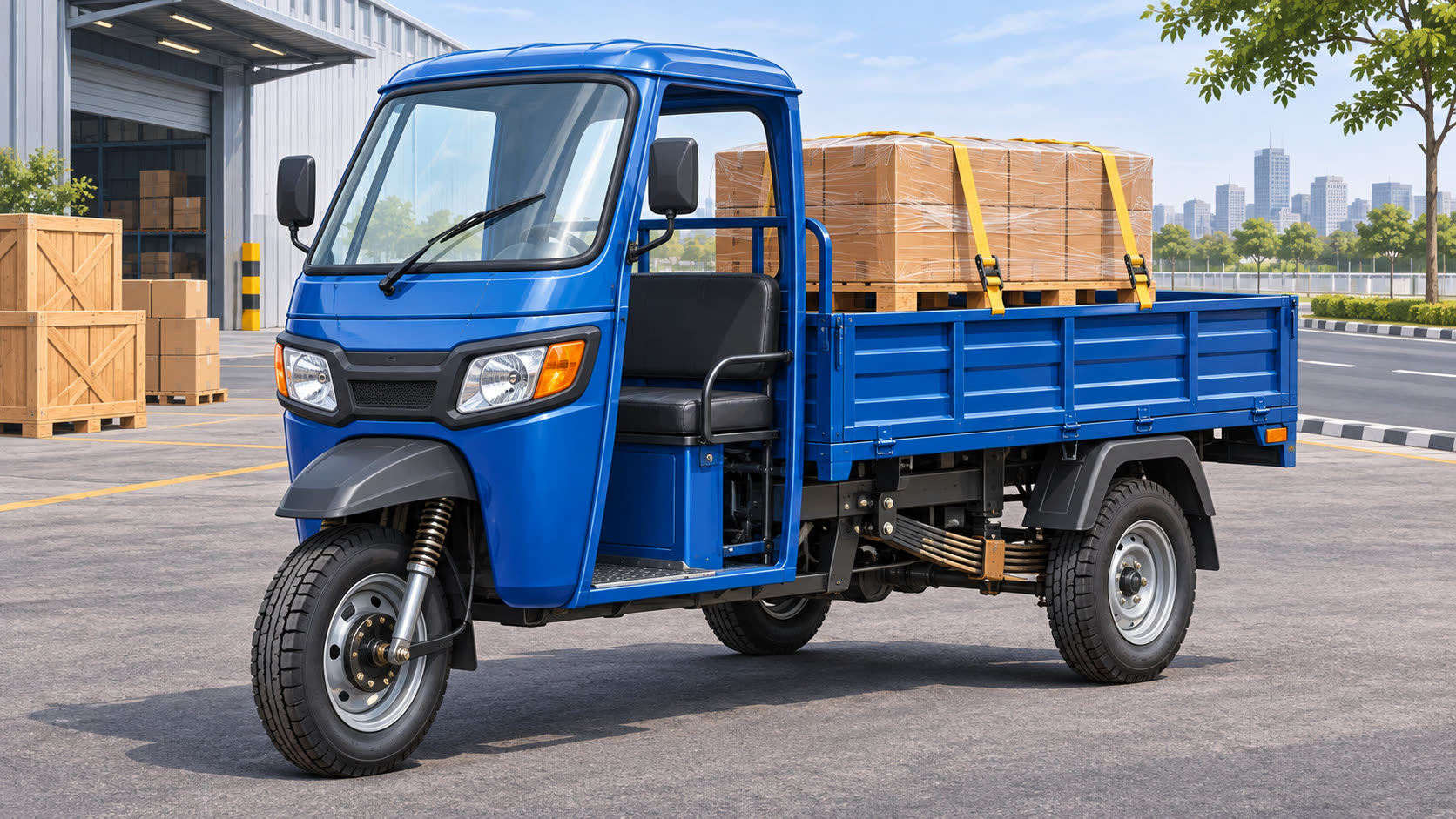
Its main commercial feature is the cargo platform. TVS lists a two-metre-long bed with payload capacity of up to one tonne. The vehicle also gets 230 mm of ground clearance and leaf-spring suspension, features intended to support urban, suburban and rural cargo routes.
Independent coverage also reports a digital instrument cluster and USB charging port. The figures above are manufacturer-quoted specifications; a maximum payload is not a promise that every load, road or operating condition will support that weight. Operators still need to follow the rules and limits in the market where the vehicle is registered.
Why the launch matters to fleet operators
For a delivery or small-freight business, the Armado's proposition is practical rather than performance-led: move more goods per trip, keep the vehicle running through long shifts and use a cargo bed that can be accessed in tight loading areas. Whether that translates into lower cost per delivery will depend on the actual load carried, route length, traffic, maintenance, fuel economy and downtime.
The 16-litre tank should not be read as a range claim. A tank tells an operator how much fuel the vehicle can hold; it does not reveal how many kilometres it will cover without a verified real-world fuel-consumption figure. Once a market-specific mileage figure and local petrol price are available, operators can model fuel spending with the fuel-cost calculator and check current rates through the live fuel-price pages.
For any eventual India rollout, route economics would also include permits, insurance, loading limits and toll treatment. Intercity operators can use the toll-charge calculator when a confirmed route and vehicle classification are available, but the current announcement does not provide an India registration category or toll classification.
What Indian buyers should not assume
There is no India price or booking step to act on from this announcement. TVS's filing does not list Indian variants, an India launch date, local homologation, a domestic warranty schedule or an Indian service plan for the Armado. Rushlane also reported that pricing, country-wise availability and an India launch plan had not been announced.
That means an Indian fleet operator should not treat the global specifications as a local purchase quote. If TVS later announces the Armado for India, the useful comparison will need more than engine size and payload: the ex-showroom price, payload certification, registration class, service coverage, parts availability, warranty terms, real-world fuel economy and insurance cost will all affect operating cost.
What happens next
The next material update would be a market-specific announcement from TVS or an authorised distributor. For India, that would need to identify whether the Armado is being offered, which configuration is approved, how much it costs and when deliveries can begin. Until then, the confirmed story is TVS Motor's expansion of its commercial-mobility portfolio across overseas markets.
For Indian transport and delivery businesses, the launch is still relevant as a signal of where an Indian two- and three-wheeler manufacturer is looking for growth. It is not, however, evidence of a new cargo vehicle being available on Indian roads today.
Image note: The hero is a representative editorial illustration of a cargo tricycle, not a photograph of the TVS Armado.