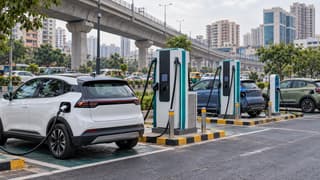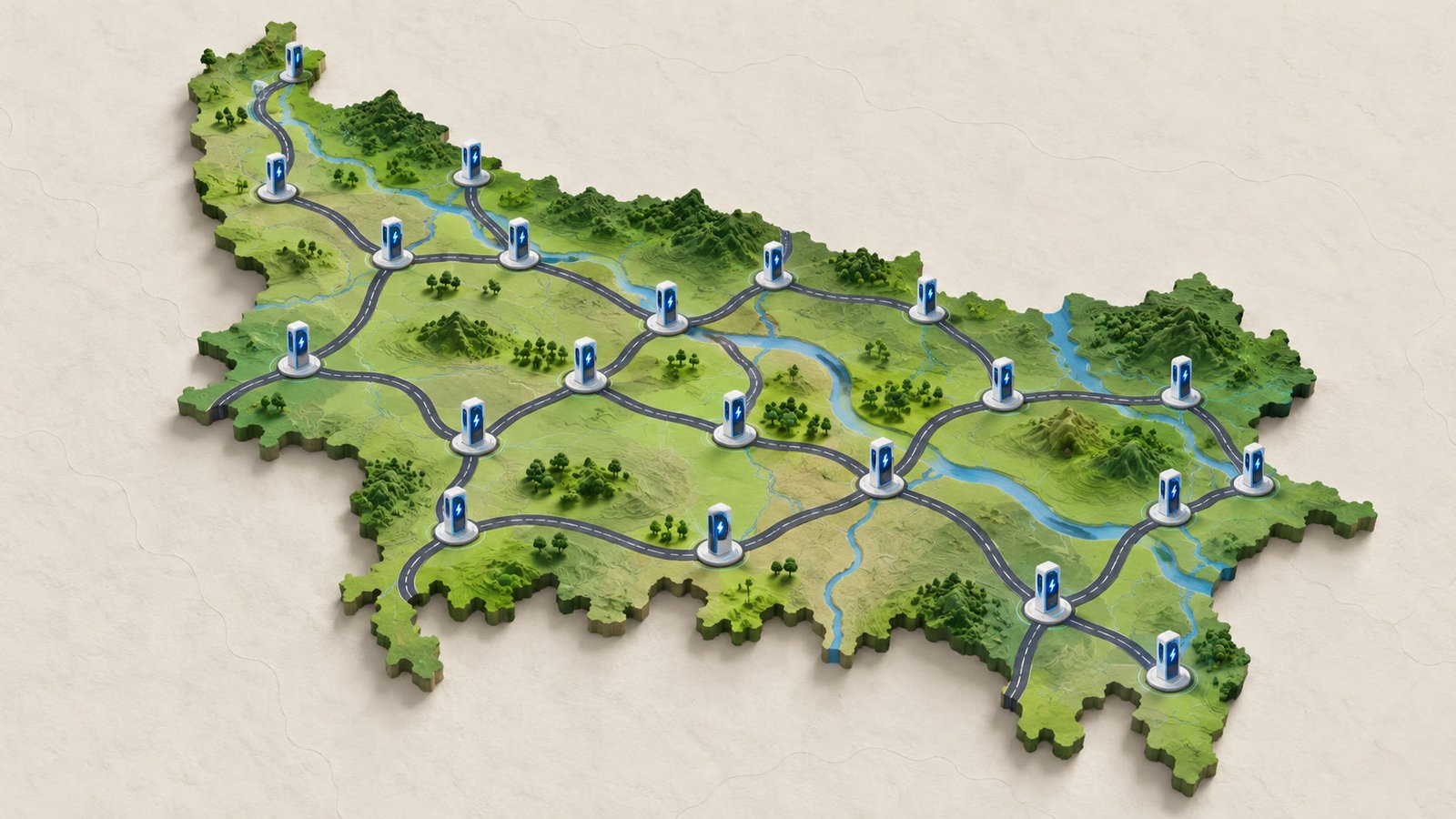
Uttar Pradesh is moving to expand public EV charging under the PM E-DRIVE scheme, with a fresh report describing a wider second-phase site-identification exercise across the state. For EV drivers, this matters because more public sites could make intercity trips easier, but a proposed location is not the same as an operating, compatible charger.
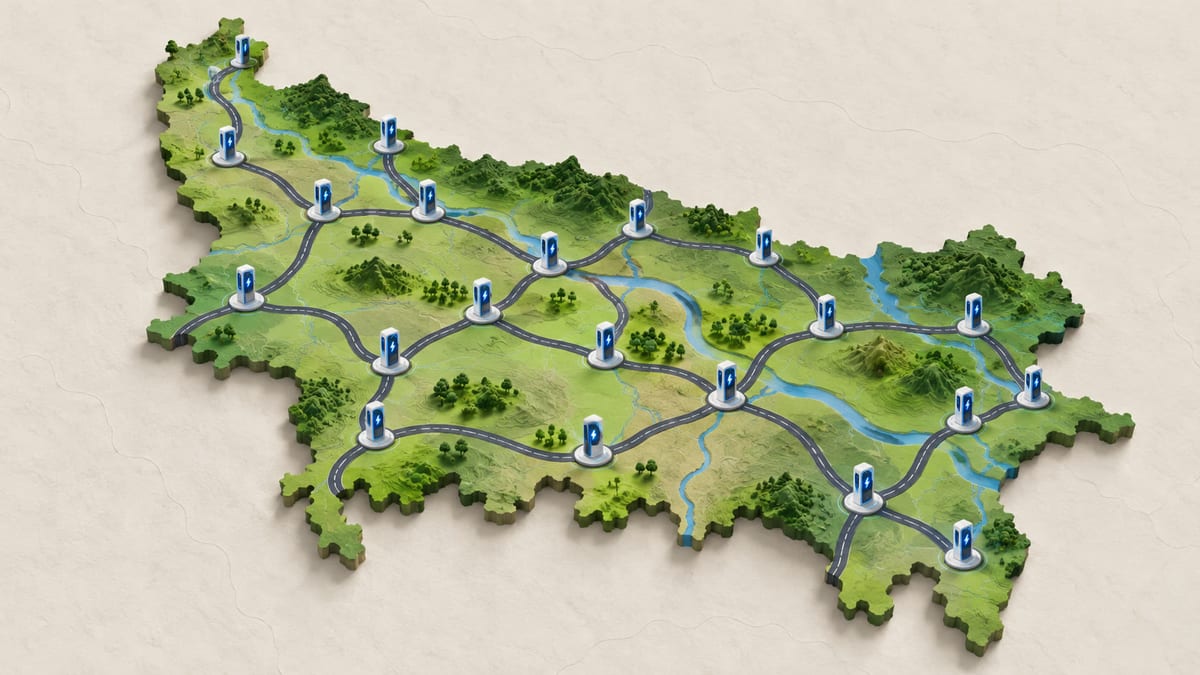 Illustrative map-style visual of a possible statewide public EV charging network; not to scale and not a map of confirmed station locations. Credit: FuelPrice-generated editorial illustration.
Key takeaways
- Uttar Pradesh is preparing a broader public-charging rollout under PM E-DRIVE.
- The reported exercise is about identifying sites and progressing projects; it does not mean every proposed location is open.
- EV drivers should continue checking live availability, connector compatibility, payment options and a backup stop before highway trips.
- The official state tender and the Union scheme guidelines show the work has a formal procurement and policy framework.
What Uttar Pradesh has reported
The Times of India reported on 1 October 2026 that Uttar Pradesh officials were asked to accelerate public charging-station work under PM E-DRIVE. The report said district authorities would identify suitable locations and send proposals to the concerned department as the state prepares a wider second-phase rollout.
The important distinction is between a site being identified, a project being awarded, a charger receiving an electricity connection and a station being available to drivers. Those are separate steps. The fresh report describes administrative progress, not a statewide opening date or a guarantee that a charger can be used today.
The state’s official eProcurement portal independently lists a tender titled “Setting Up of Public Charging Stations under PM E-DRIVE Scheme for Electric Vehicles in Uttar Pradesh”. The listing is under Uttar Pradesh Power Corporation and Uttar Pradesh Renewable and EV Infrastructure, or UPREV. That confirms an active public-charging procurement route, while the listing itself does not establish that every planned site has been commissioned.
Why the rollout matters for EV users
For an EV owner, public charging is most useful when it is placed along the route, works when needed and supports the vehicle’s connector and charging requirements. A larger state network could make it easier to plan beyond a familiar daily commute, particularly for drivers travelling between cities or using expressways and other busy corridors.
It could also help fleet operators reduce uncertainty around return trips and charging breaks. But the benefit will depend on station uptime, access hours, queue information, pricing transparency and the quality of route-level information. A headline count of proposed sites cannot answer those practical questions by itself.
FuelPrice’s state-wise EV station directory is the natural place to check charging options before leaving. Drivers can also use the road-trip planner to build a route with charging stops and rest breaks. For a household comparing an EV with a petrol or diesel vehicle on the same journey, the fuel-cost calculator can estimate the combustion-vehicle portion, although an EV comparison also needs the applicable charging tariff and vehicle consumption.
What to check before relying on a new station
Confirm that the charger is live
Do not treat a proposed site, tender listing or map pin as proof of availability. Check the latest operator status, opening hours and whether the location is accessible to the public. If the trip is time-sensitive, keep a second charging option within practical range.
Match the charger to the vehicle
Check the connector, charging speed and any vehicle-specific limits before setting the route. A station can exist but still be unsuitable if its connector is incompatible, its power output is too low for the planned stop or its equipment is temporarily unavailable.
Check payment and access details
Drivers should verify whether the station needs an operator app, a digital payment method, a membership or a separate authentication step. They should also check the displayed tariff and any parking or session fee before starting a charge.
What the official framework does—and does not—promise
The Ministry of Heavy Industries’ PM E-DRIVE portal lists operational guidelines for deploying public EV charging stations. That gives the rollout a national policy framework, but it does not make a state proposal an operating station. The state still has to take projects through site selection, procurement, power connection, installation, testing and commissioning.
That sequence is also why drivers should expect information to change as projects move forward. A district may identify land before a tender is awarded; a contractor may install equipment before testing is complete; and a commissioned charger may still need regular maintenance and accurate status updates.
What to watch next
The useful milestones will be the publication of final site lists, tender outcomes, construction and power-connection updates, and clear confirmation that stations are open to public use. For long-distance drivers, the most valuable update will be reliable live information showing connector type, operating status, queue conditions and the price of a session.
Until those details are available, the reported UP rollout is best understood as a positive infrastructure direction rather than an immediate change to every EV route. Drivers planning a trip should use currently verified charging points and keep a practical fallback, even as the state expands the network.