Compressed natural gas (CNG) in Mumbai and Mahanagar Gas Limited’s adjoining service areas will cost ₹91.50 per kg from 15 Nov 2026, after the company raised the rate by ₹1.50 per kg. The change increases the refuelling bill for private CNG cars, auto-rickshaws, taxis and other CNG vehicles, with MGL attributing the revision to higher gas procurement costs, lower domestic allocation and greater reliance on imported regasified liquefied natural gas (RLNG).
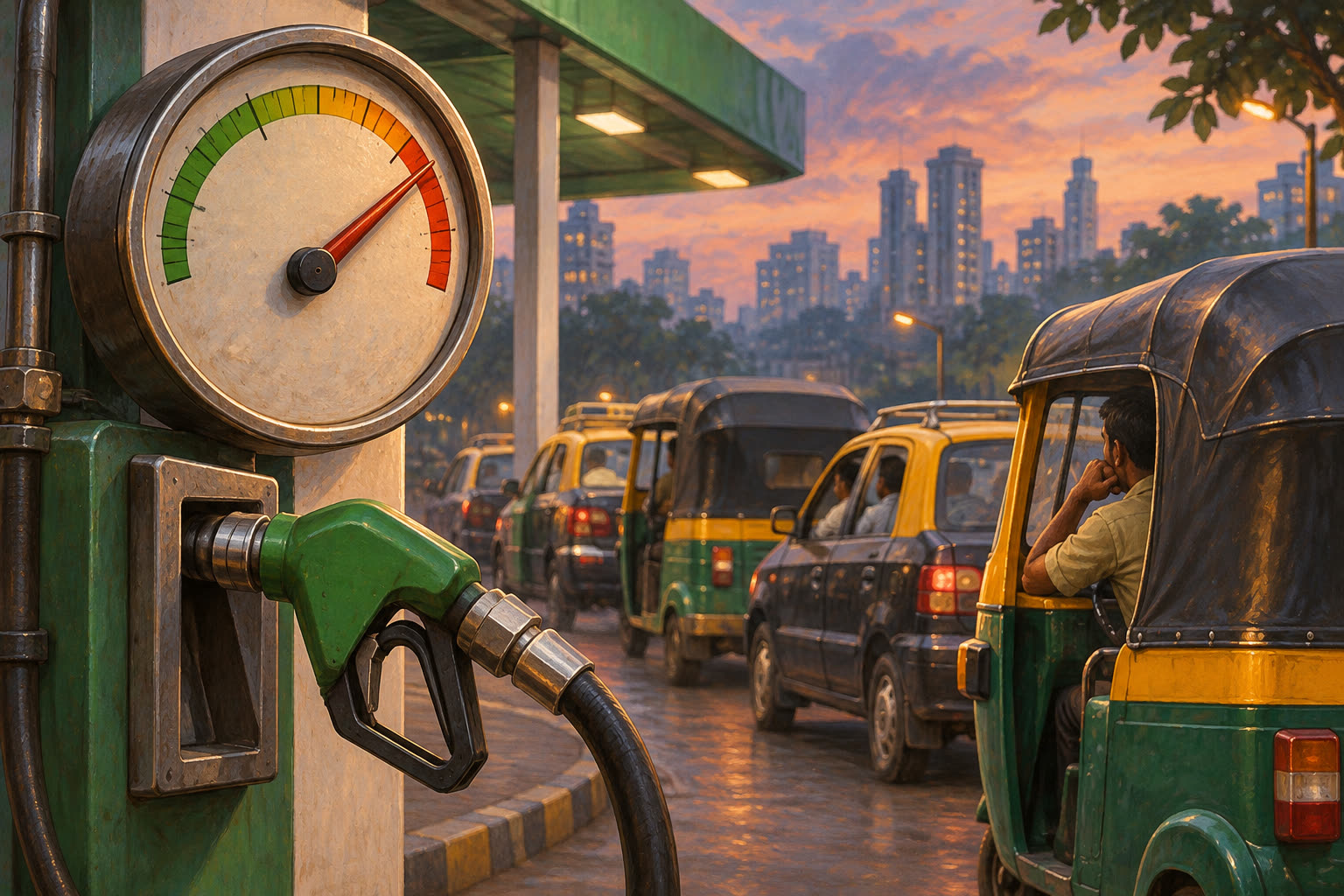
Illustrative image: a stylised CNG gauge and Mumbai-area traffic; no specific station or vehicle model is shown.
Key takeaways
- MGL’s revised CNG rate is ₹91.50 per kg from 15 Nov 2026; the change takes effect from midnight on 14 Nov.
- The increase is ₹1.50 for every kilogram purchased, so the direct cost depends on how much CNG a vehicle uses.
- The latest revision follows a ₹1-per-kg increase reported from 1 Nov, making this the second increase in a fortnight.
- MGL says rising input-gas costs, reduced domestic allocation and increased dependence on imported RLNG are behind the change.
- The price announcement does not itself confirm a new auto, taxi or bus fare; any fare change would need separate confirmation.
What changed in Mumbai’s CNG price
MGL announced that its retail selling price for CNG in Mumbai and adjoining areas would rise from ₹90 per kg to ₹91.50 per kg. The Indian Express and The Times of India both reported that the new rate would apply from the start of 15 Nov, after the midnight change on 14 Nov.
This is the second reported increase in a fortnight. The earlier revision took the rate to ₹90 per kg from 1 Nov. For a CNG user, the important distinction is that the increase is charged by kilogram, not by litre: the extra amount on a refill depends on the kilograms dispensed at the station.
Why MGL has raised the rate
MGL said its gas procurement costs had risen, citing the ongoing crisis in the Middle East, a reduced allocation of domestically produced gas and greater dependence on imported RLNG. The company said the price revision would partially offset the higher input cost while helping maintain an uninterrupted and sustainable CNG supply.
That explanation describes pressure on the gas supply and procurement side. It does not mean that every CNG station or every city in Maharashtra will display the same number: city-gas distributors, taxes, transport costs and local supply arrangements can differ. Drivers leaving the MGL service area should therefore check the current rate for the next city rather than carry Mumbai’s price across the whole journey.
What the ₹1.50-per-kg increase means for drivers
The direct change is ₹1.50 for every kilogram of CNG purchased. The following examples are simple arithmetic based on the reported MGL revision, not a forecast of any driver’s monthly usage:
| Illustrative CNG use | Extra cost from 15 Nov | Calculation |
|---|---|---|
| 10 kg refill | ₹15 | ₹1.50 × 10 kg |
| 50 kg in a month | ₹75 | ₹1.50 × 50 kg |
| 100 kg in a month | ₹150 | ₹1.50 × 100 kg |
For private motorists, the monthly effect will depend on kilometres driven, the vehicle’s real-world CNG consumption and the amount bought at each refill. For an auto-rickshaw, taxi, bus or delivery vehicle that runs throughout the day, the same ₹1.50-per-kg increase is applied repeatedly across a larger fuel log. Operators should separate the fuel-cost effect from any later fare or contract decision instead of assuming that a retail CNG revision automatically changes passenger fares.
How CNG users can plan around the new rate
Start with the actual kilograms purchased rather than the vehicle’s tank label. A driver who records the refill quantity and distance travelled can see the change in the fuel line of the trip budget without mixing it up with tolls, parking or maintenance.
For a current city-by-city check, use the CNG price directory before an intercity trip. To estimate how the new rate changes a journey’s fuel bill, enter the route and vehicle assumptions in the fuel cost calculator. If the route includes multiple stops or a longer drive, the road-trip planner can help organise the journey around refuelling and breaks.
These tools are planning aids, not substitutes for the station’s displayed rate and receipt. The amount charged at the pump is the reference for the refill, especially when a driver crosses from MGL’s network into an adjoining area supplied by another distributor.
What private and commercial users should check now
- Check the CNG rate shown at the station and retain the receipt after the 15 Nov revision.
- Record kilograms dispensed and kilometres covered; this gives a more useful running-cost comparison than comparing only the total bill.
- Rework a monthly fuel budget using actual CNG use. A 10 kg refill, for example, carries ₹15 more at the revised rate.
- For autos, taxis and fleets, keep fuel costs separate from fares, contracts and reimbursements until a competent authority or counterparty confirms any change.
- Before an out-of-town trip, check the destination city’s current CNG rate because the MGL Mumbai-area price is not a national rate.
What to watch next
MGL’s immediate announcement covers the ₹1.50-per-kg revision effective from 15 Nov. It does not set out another future increase, so drivers should not treat the latest change as proof of a fixed schedule. The useful signals to watch are a fresh MGL price notice, the rate displayed at the station and any separate transport-authority order affecting fares.
For commuters, a higher CNG price can raise the operating cost of vehicles they use without changing the fare on the same day. A fare revision should therefore be treated as a separate development and verified independently. Until then, the confirmed change is the fuel charge: ₹91.50 per kg in Mumbai and adjoining MGL service areas from 15 Nov 2026.
Reader takeaway
Budget ₹1.50 more for every kilogram of MGL CNG purchased in Mumbai and adjoining areas from 15 Nov. The increase is small on a single kilogram but becomes visible over repeated refills, so private drivers and commercial operators can use their actual kilograms bought to measure the monthly effect and check the current rate again before leaving the MGL network.
Sources
- The Indian Express — Mumbai CNG price hiked by Rs 1.50 to Rs 91.50 per kg from November 15 (14 Nov 2026)
- The Times of India — Rs 1.5/kg CNG hike in Mumbai region, up Rs 5.5 in 75 days, rekindles autorickshaw fare row (14 Nov 2026)
- Mid-day — Mumbai: CNG price rises to Rs 91.50 per kg amid West Asia crisis (14 Nov 2026)