Uttar Pradesh has put lower winter speed limits into force on five expressways from 15 Nov 2026 to 15 Feb 2027, or until fog conditions return to normal, with separate day and night caps for light vehicles, passenger vehicles and goods carriers. The change matters to anyone using these routes because journeys may take longer, enforcement is expected, and very poor visibility can trigger traffic controls.
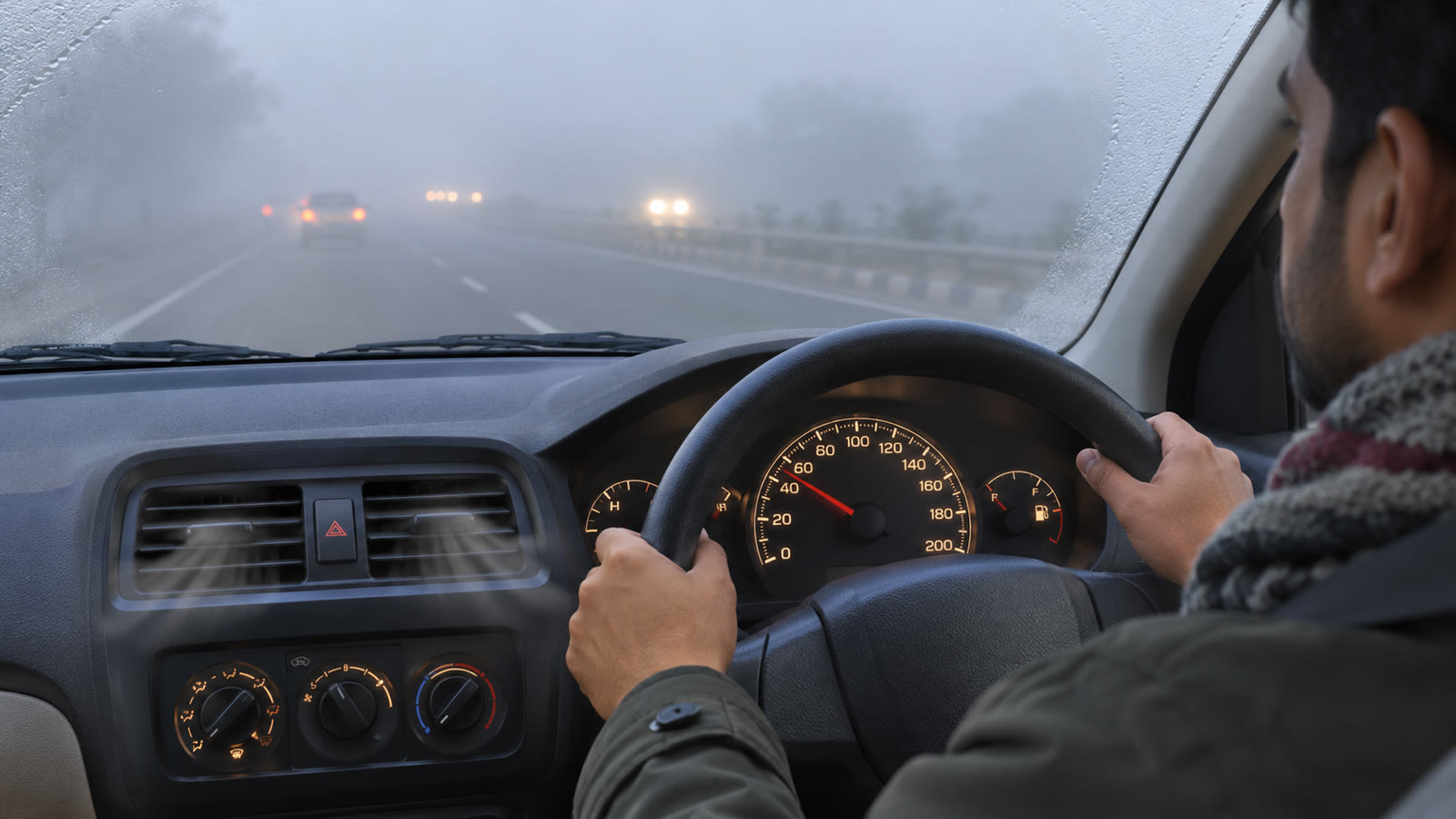
Illustrative image: a driver maintains a controlled speed in winter fog; no specific Uttar Pradesh expressway or vehicle is shown. Illustration generated for FuelPrice.
Key takeaways
- The revised limits apply on the Agra–Lucknow, Purvanchal, Bundelkhand, Gorakhpur Link and Ganga expressways.
- UPEIDA’s detailed schedule sets daytime limits of 80 kmph for light motor vehicles, 60 kmph for M-2/M-3 passenger vehicles and 50 kmph for goods vehicles.
- The corresponding night limits are 60 kmph, 50 kmph and 40 kmph respectively.
- The seasonal window is 15 Nov 2026 to 15 Feb 2027, or until fog conditions normalise, according to UPEIDA’s detailed advisory.
- If visibility falls below 50 metres, vehicles may be stopped at safe locations or moved in supervised convoys, according to PTI reporting.
What Uttar Pradesh has changed
The Uttar Pradesh Expressways Industrial Development Authority (UPEIDA) issued a winter-fog safety advisory for the state’s major expressways. Its detailed 12 Nov 2026 notice classifies vehicles by the M-1, M-2 and M-3 categories and provides different ceilings for daytime and night-time travel. The stated purpose is to reduce crash risk when fog lowers sight distance.
| Vehicle group | Day limit | Night limit |
|---|---|---|
| Light motor vehicles and M-1 vehicles | 80 kmph | 60 kmph |
| M-2 and M-3 passenger vehicles | 60 kmph | 50 kmph |
| Goods vehicles | 50 kmph | 40 kmph |
UPEIDA’s notice says the revised limits run from 15 Nov 2026 to 15 Feb 2027, or until fog conditions improve. The authority has also said that patrol teams, ambulances, emergency vehicles, warning boards and other safety arrangements will remain available on the covered expressways.
Why the reported time windows differ
A 21 Nov report by The Times of India summarised the daytime measure with cars capped at 80 kmph, passenger buses at 60 kmph and trucks and trailers at 50 kmph. That is consistent with the daytime figures in UPEIDA’s more detailed advisory, but it does not include the separate night limits.
PTI’s 18 Nov report, carried by ThePrint, gives the fuller day-and-night schedule and says violations can attract fines and legal action. Drivers should therefore follow the speed shown on road signage and directions from traffic personnel at the time of travel, rather than treating the daytime summary as the entire rule.
Routes affected by the winter rule
The advisory covers five UPEIDA-managed expressways:
- Agra–Lucknow Expressway
- Purvanchal Expressway
- Bundelkhand Expressway
- Gorakhpur Link Expressway
- Ganga Expressway
The Agra–Lucknow Expressway is one of the covered corridors and connects Agra with Lucknow through districts including Firozabad, Mainpuri, Etawah, Auraiya, Kannauj, Kanpur Nagar, Hardoi and Unnao. It is a major route for private cars, buses and goods traffic, so the seasonal caps matter to both everyday travellers and long-distance operators.
What drivers and fleet operators need to plan
The immediate impact is on travel time. A route that is normally planned around clear-weather speeds may need a larger buffer when the seasonal caps are active. The road-trip planner can help compare distance and expected journey time before a fog-season departure; actual conditions, traffic management and stoppages can still change the result.
For private motorists, the lower limit is only one part of the trip budget. Weather-related slowdowns can change the number of rest or refuelling stops, while idling and detours can affect the final fuel use. Readers can use the fuel-cost calculator with their own distance and mileage assumptions instead of treating the speed limit as a fuel-economy promise.
The cited announcement does not announce a toll-rate revision. Anyone budgeting a route should check the applicable toll charges and trip cost separately, then add a time buffer for fog, enforcement or a possible convoy. For goods carriers and buses, the night limits are particularly relevant because a schedule based only on the daytime 50/60 kmph caps may understate the time required during night travel.
Fog-season checklist
- Keep the vehicle within the applicable day or night limit and follow any lower speed displayed on a roadside sign.
- Use low-beam headlights and fog lamps when visibility is poor; high beam can reflect off fog and reduce useful visibility.
- Maintain a larger gap from the vehicle ahead and avoid sudden lane changes or hurried overtaking.
- Keep the windscreen, mirrors and lights clean so that the available visibility is not reduced further.
- If visibility becomes extremely poor, follow instructions to stop at a safe location or join a supervised convoy.
UPEIDA’s public safety posts also list helpline 14449 for expressway emergencies. Drivers should keep their vehicle’s lights, reflectors and emergency contact information ready before starting a long winter journey.
What to watch next
The current restriction is seasonal and is scheduled to run through 15 Feb 2027 unless fog conditions normalise earlier. The useful follow-up will be whether UPEIDA changes the end date, revises the limits for a particular corridor or publishes additional traffic controls when visibility falls below the stated threshold. Until then, the practical rule is to plan for the lower cap, follow on-road instructions and allow more time than a clear-weather journey would require.
Sources
- UPEIDA, “Winter fog safety measures and revised speed limits on five expressways” — 12 Nov 2026
- UPEIDA, “Revised winter speed limits now in force” — 20 Nov 2026
- The Times of India, “Speed limits reduced on Agra-Lucknow Expressway amid fog” — 21 Nov 2026
- ThePrint/PTI, “Speed limits reduced on Agra-Lucknow Expressway to prevent accidents during winter fog season” — 18 Nov 2026