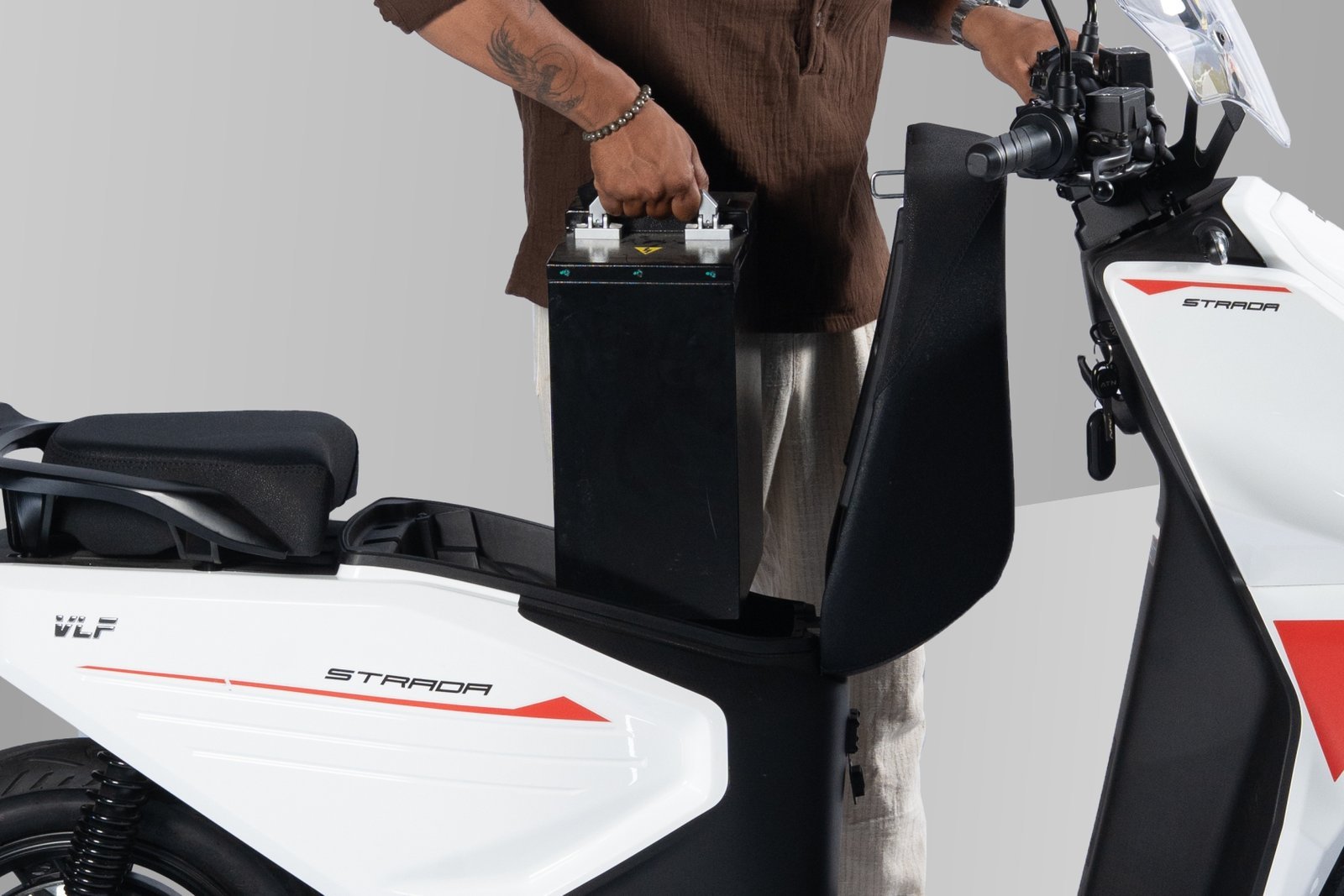
MotoHaus launched the VLF Strada electric scooter in India on 11 Oct 2026, with ex-showroom prices starting at ₹1,19,999. The two-variant range pairs a lower-priced City version with a claimed 130 km IDC range and a Max version that claims up to 250 km, giving urban buyers a choice between upfront cost and fewer charging stops.
The launch matters because the Strada is built around removable batteries rather than a single fixed pack. That makes the charging question more practical for riders who cannot park close to a socket, but the headline IDC range still needs to be separated from the distance a rider will see in traffic, heat, load and mixed riding modes.
Key takeaways
- The VLF Strada City is listed at ₹1,19,999 ex-showroom, while the Max is ₹1,55,500 ex-showroom, as of 11 Oct 2026.
- City uses one 2.16 kWh removable battery and claims 130 km IDC range; Max uses two such packs, totalling 4.32 kWh, and claims 250 km.
- Both variants are listed with an 85 km/h claimed top speed and disc brakes with Combined Braking System (CBS).
- MotoHaus lists charging times of about three hours for one battery option and six hours for the dual-battery option.
- Same-day reports say deliveries are expected from November 2026, but an exact delivery date is not stated on the manufacturer’s product page.
VLF Strada price and battery options
MotoHaus’s product page and independent launch coverage from Cartoq list the Strada in two variants. The price and range comparison below uses the figures published on 11 Oct 2026; these are ex-showroom prices, not final on-road costs.
| Variant | Ex-showroom price | Battery setup | Claimed IDC range |
|---|---|---|---|
| City | ₹1,19,999 | One removable 2.16 kWh pack | 130 km |
| Max | ₹1,55,500 | Two removable 2.16 kWh packs; 4.32 kWh total | 250 km |
The listed gap between the two variants is ₹35,501. That extra amount primarily buys the second battery and the longer claimed range, rather than a different top-speed headline. The final on-road gap will be different after registration, insurance, accessories and any local charges are added.
What the extra battery changes
The City variant is the lower-entry option for a rider whose daily use is comfortably within its claimed range and who has a predictable place to charge. The Max is aimed at a different use case: longer gaps between charging sessions or a rider who wants more range headroom before accounting for traffic, riding mode, road conditions and payload.
Both packs are removable, according to MotoHaus and the launch reports. That is relevant for apartment residents, office commuters and small commercial users who may be able to carry a battery to a safe charging point even when the scooter cannot be parked beside one. It does not remove the need to check charging access, ventilation, electrical safety and the manufacturer’s battery-care instructions.
IDC range is a standardised test figure, not a promise of daily distance. Cartoq notes that real-world range will vary with riding style, traffic, road conditions, rider weight and the selected mode. A route with frequent stops, high speeds or a heavy load can produce a different result from the published figure.
Performance, charging and hardware
MotoHaus lists an 85 km/h claimed top speed for the range, while Cartoq reports the same figure for both City and Max. The scooter has Eco, City and Sport riding modes, with the full top-speed figure associated with Sport mode in the independent report. The manufacturer lists an LFP battery chemistry, front and rear disc brakes, and CBS.
The company’s charging information lists about three hours for one battery option and six hours for the dual-battery configuration. The time is useful for planning but should be read alongside the charging setup, battery state and operating conditions. Buyers comparing the variants need to ask whether the quoted time is for one battery or both, and what equipment is included.
MotoHaus lists a 780 mm seat height, 175 mm ground clearance and 98 kg kerb weight. Those details matter more in daily use than a range headline alone: seat height affects reach at stops, ground clearance matters on broken city roads, and weight affects manoeuvring in parking areas. The product page also lists a 5-inch TFT display, keyless entry, USB Type-A and Type-C ports, and a rear luggage carrier.
Running-cost questions for buyers
The Strada’s electric running cost will depend on the electricity tariff, charging losses, battery usage and the distance actually covered. The petrol comparison is easier to estimate because it can be tied to a local pump price and a scooter’s observed mileage. Readers comparing an electric commute with a petrol alternative can use the FuelPrice fuel cost calculator for the petrol side, then ask the dealer or electricity provider for a realistic charging-cost estimate.
Charging access is part of the ownership calculation. A rider who cannot charge at home may value the removable packs, but still needs a reliable and safe place to plug them in. The state-wise EV charging directory can help identify public charging locations, although the availability of a compatible charger and the time required should be confirmed before planning a regular route.
Availability and checks before booking
Cartoq and EvPost reported on 11 Oct 2026 that bookings had opened through the official MotoHaus website and that deliveries were expected from November 2026. Because the manufacturer’s product page does not publish an exact delivery date, the November timing should be treated as reported or expected rather than a confirmed handover schedule.
Before booking, the useful checks are practical:
- Confirm the selected variant’s final ex-showroom and on-road price, including registration, insurance and accessories.
- Ask for the final battery capacity, charging equipment and charging time for the exact variant.
- Compare the claimed range with the intended route, traffic pattern and load instead of treating IDC range as guaranteed daily distance.
- Check service coverage, battery warranty terms and the process for a replacement or repair if a removable pack develops a fault.
- Ask for a test ride and confirm whether the seat height, weight and ground clearance suit the rider and parking environment.
What to watch next
The immediate watch points are the final delivery schedule, city-wise availability and the on-road prices quoted by authorised outlets. The two-battery layout gives the Strada a clear point of difference, but its usefulness will depend on how easily buyers can charge, carry and maintain the packs over time.
For now, the VLF Strada is a confirmed India launch with a ₹1,19,999 entry price and a ₹1,55,500 longer-range Max variant listed by MotoHaus. The buyer decision is less about choosing the biggest range number and more about matching the battery setup, charging routine and total on-road cost to the way the scooter will actually be used.