The Union government on 26 November announced a major West Bengal highway package: 22 National Highway projects worth more than ₹8,700 crore were inaugurated or taken to foundation stage at Kolaghat. For drivers and freight operators, two pieces are already operational—the six-lane Palsit–Dankuni section of NH-19 and a four-lane Ganga bridge at Farakka—while most of the larger pipeline is still to be built.
Key takeaways
- Two National Highway projects were dedicated to traffic at the Kolaghat programme: the 63.83-km Palsit–Dankuni six-lane stretch and the Farakka Ganga bridge with its connecting roads.
- Foundation stones were laid for 20 other projects, including vehicle underpasses, light-vehicle underpasses, bypasses and bridges.
- The Ministry of Road Transport and Highways describes a separate West Bengal road pipeline of approximately ₹75,000 crore; The Indian Express reported a broader fresh-approval figure of ₹1 lakh crore.
- The announcement is not a new toll tariff or a promise that every proposed corridor is open. Drivers should continue to check the route, toll and fuel position for each trip.
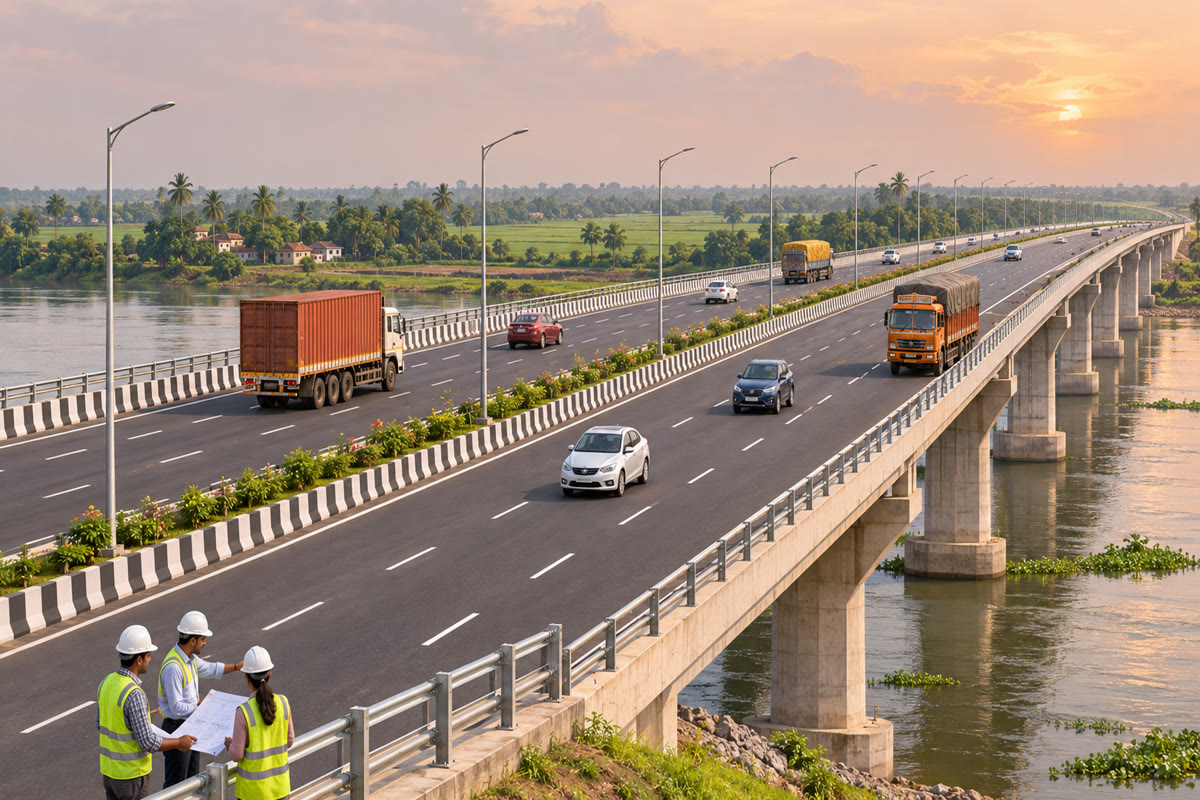
Illustration: Representative highway and bridge infrastructure; not a photograph of a specific West Bengal project.
What was announced at Kolaghat?
The Ministry of Road Transport and Highways said Union Minister Nitin Gadkari inaugurated and laid foundation stones for 22 National Highway projects at Kolaghat in East Medinipur on 26 November. The ministry put the combined value at more than ₹8,700 crore. The Indian Express independently reported the same 22-project programme and the ₹8,700-crore value, while describing a wider road package announced at the event.
The confirmed operational work includes the Palsit–Dankuni section of NH-19, upgraded to six lanes. The ministry said this stretch will strengthen the Howrah–Hooghly–Burdwan connection and the Kolkata–Durgapur industrial corridor. The second project is a four-lane bridge over the Ganga at Farakka, built with its approach roads. The official release said it is intended to improve movement between Murshidabad and Malda and support travel towards North Bengal.
For a person driving through these sections, the immediate benefit is better road capacity and a more direct connection at two important points. That does not mean every journey will be faster: congestion at town approaches, construction activity on adjoining links, weather and the final condition of connecting roads will still matter.
Why the larger number needs context
The ministry's release says West Bengal has a road-infrastructure pipeline of approximately ₹75,000 crore. It also says around ₹40,000 crore of National Highway work has been completed in the state and around ₹35,000 crore is under way. The Indian Express used a broader figure of ₹1 lakh crore for fresh approvals and separately reported the completed and ongoing totals.
These figures should not be added together or treated as one immediate spending commitment. They describe different scopes in the reporting: the ministry's ₹75,000 crore is a pipeline figure, while the newspaper's ₹1 lakh crore is a broader event-level figure. This article treats the ₹75,000-crore amount as planned work, not as completed road length or a guaranteed opening schedule.
What the 20 foundation-stage projects mean
The ministry said the 20 projects whose foundations were laid include 57 vehicle underpasses and light-vehicle underpasses on NH-12 and NH-19. It also listed the Ramanagar Bypass on NH-116B and bridge projects at Norghat and over the Dwarkeshwar River. These works are designed to address road safety, crossings, local congestion and connectivity, but a foundation ceremony is not the same as a road opening.
The wider announcements include the ₹14,000-crore Kolkata Ring Road, the Dankuni–Kolaghat eight-lane corridor and the Moregram–Kishanganj high-speed corridor. The ministry also referred to the Gorakhpur–Siliguri Greenfield Highway and a proposed Siliguri–Guwahati High-Speed Corridor. The status of each corridor, including land acquisition, clearances, detailed project reports and construction contracts, will determine when motorists can use it.
What drivers and transporters should do now
There is no new toll rate in the announcement. Toll liability continues to depend on the applicable fee notification, vehicle class and route. If the journey crosses existing fee plazas, use the toll-charge calculator to estimate the highway portion instead of assuming that a new project announcement removes or changes the charge.
Freight operators and private motorists can also compare the full trip cost using the fuel cost calculator. A wider road may reduce queueing at a particular bottleneck over time, but any fuel saving will depend on the actual route, traffic flow, vehicle load, speed and stops outside the project section.
For longer journeys through West Bengal and neighbouring states, the road-trip planner can help organise the route around the roads that are open today. It is safer to treat a foundation-stage corridor as a future option until an official opening or traffic notification confirms that it is usable.
What to watch next
The next useful updates will be official construction schedules, land-acquisition and clearance progress, traffic diversions, project completion notices and any separate fee notifications. The ministry itself highlighted the need for timely land acquisition and clearances. For now, the two dedicated projects are the immediate road changes; the 20 foundation-stage works and the larger pipeline are a longer-term mobility story.