The Yamaha EC-06 and Suzuki e-Access now give Indian electric-scooter buyers two very different Japanese options. A comparison published on 26 Sep 2026 puts the Yamaha ahead on listed price and claimed range, while the Suzuki has a shorter full-charge time and a lighter body—trade-offs that matter more in a daily commute than the badge on the handlebar.
The figures below are ex-showroom or manufacturer-claimed specifications, not a promise of real-world range or a final on-road price. State registration, insurance, charging conditions, rider weight, traffic and riding mode can all change the ownership calculation.
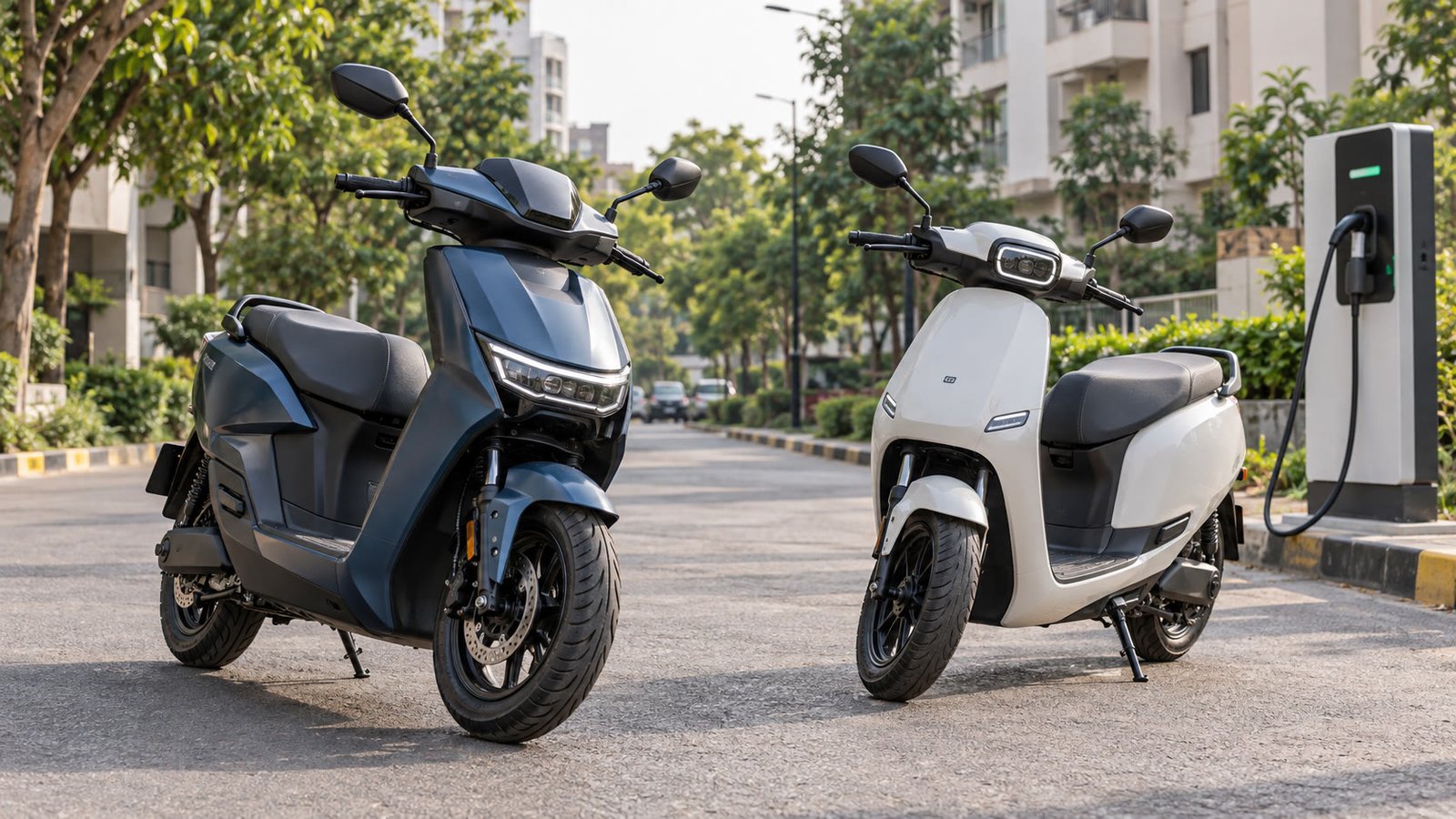
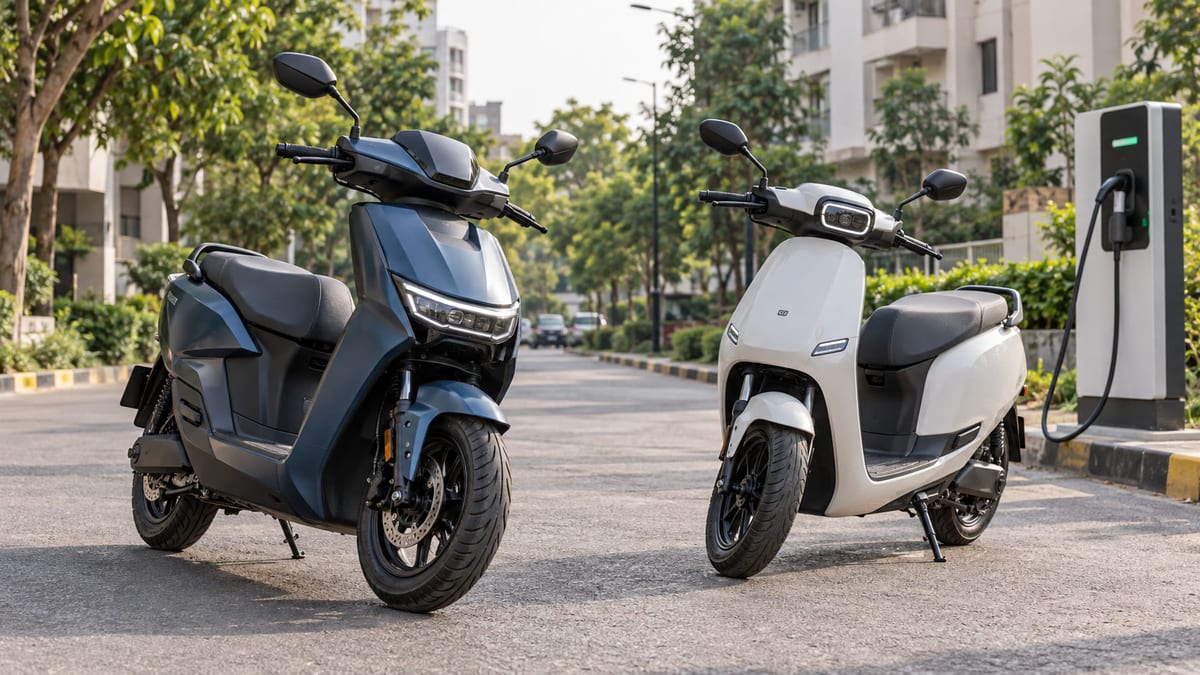 FuelPrice illustration: two unbranded electric scooters in an Indian urban setting; not an official product photograph.
Key takeaways
- ZigWheels lists the Yamaha EC-06 at about ₹1.71 lakh and the Suzuki e-Access at about ₹1.88 lakh ex-showroom; Autocar’s Bengaluru comparison shows a different city-specific Suzuki figure.
- The EC-06 is listed with a 169 km claimed range and a 4 kWh battery; the e-Access has a 95 km certified range and a 3.072 kWh LFP battery.
- Yamaha’s listed full-charge time is 10 hours, while Suzuki lists about 6 hours 20 minutes with its portable charger.
- The Suzuki is 122 kg and the Yamaha 132 kg in the cited specifications, so the e-Access has the lower kerb mass.
- Check city-specific on-road quotes, home charging practicality and the route’s actual range requirement before treating the headline specifications as a buying decision.
Price: Yamaha has the lower listed entry point
ZigWheels’ comparison updated on 2 Sep 2026 lists the EC-06 at ₹1.71 lakh ex-showroom and the e-Access at ₹1.88 lakh ex-showroom, and calculates the difference at ₹17,290. Autocar India’s 26 Sep 2026 comparison instead shows Bengaluru figures of ₹1.71 lakh for the Yamaha and ₹1.92 lakh for the Suzuki. The difference is a useful warning that city, tax and listing basis matter when these scooters are compared.
Suzuki’s own media information lists the e-ACCESS at ₹1,88,490 ex-showroom in Delhi, which broadly matches the independent ₹1.88 lakh listing. Yamaha’s official online product page presents the EC-06 booking flow and says the final quotation is determined through the dealer, so a buyer should obtain a written city-specific quotation before comparing the two totals.
The practical price question is therefore not only which scooter is cheaper on paper. It is whether the lower initial price still works after registration, insurance, any home electrical work and the charging arrangement available where the scooter will be parked.
Range and charging pull in opposite directions
EC-06: more claimed distance, longer charge window
Yamaha’s EC-06 product information lists a 4 kWh battery, a 169 km Indian Driving Cycle range and a 10-hour 0–100% charging time. ZigWheels lists the same 169 km claimed range, 4 kWh battery and 10-hour charging figure. That gives the Yamaha a nominal 74 km range advantage over the Suzuki’s certified figure, but the difference is a test-cycle comparison, not a guarantee that either scooter will travel that distance on a busy route.
The EC-06’s larger battery and longer charge time suggest a scooter designed around overnight home charging rather than quick top-ups between short trips. Riders who can leave it plugged in after the day’s commute may value the extra range; riders who need a faster turnaround should check charging access before placing a booking.
e-Access: smaller battery, faster portable charging
Suzuki’s official product page lists a fixed 3.072 kWh LFP battery and a 95 km range under AIS 040. It gives a portable-charger time of about 6 hours 20 minutes from 0 to 100%, while fast charging is listed at 2 hours 12 minutes from 0 to 100%. Autocar and ZigWheels also place the e-Access near the six-hour charging mark in their comparison data.
On the cited full-charge figures, the Yamaha takes about 3 hours 40 minutes longer than the Suzuki with the supplied charging setup. That does not automatically make the Suzuki cheaper to run: electricity tariffs, charging losses and the number of kilometres actually ridden will decide the bill. It does make the charging schedule easier to plan for riders whose scooter is used again soon after returning home.
What the numbers mean for daily riders
The range gap matters most when a rider regularly approaches the e-Access’s 95 km certified figure between charges, or cannot charge at the workplace or destination. A rider with a short, predictable urban commute may never use the EC-06’s additional claimed range and could place more weight on the Suzuki’s lighter 122 kg kerb mass. The EC-06 is listed at 132 kg, so its 10 kg higher mass is relevant when moving the scooter without power, parking on a slope or manoeuvring in a tight space.
Neither scooter should be judged from a single showroom specification. Ask for a test ride on the kind of road the scooter will actually use, check how the range indicator behaves in the chosen mode and confirm whether the charger can be carried or stored conveniently. The route also matters: an apartment user with no dedicated socket faces a different ownership problem from a homeowner with a fixed parking point.
For a broader running-cost comparison, an owner can first check nearby locations in the state-wise EV charging directory. The road-trip planner can help test whether a planned inter-city route fits the available charging stops, while the fuel-cost calculator provides a petrol benchmark for the same distance. Those tools cannot replace a dealer quotation or a home electricity bill, but they make the comparison more concrete.
Checks before booking
- Confirm the price basis: ask whether the quote is ex-showroom or on-road, and list registration, insurance, accessories and delivery charges separately.
- Confirm stock and delivery: Yamaha’s online page currently routes buyers through dealer selection, so ask which variant and colour are physically available rather than relying only on a booking screen.
- Check charging access: verify the socket location, cable length, permission for metered charging and whether fast charging is available where the scooter will be used.
- Compare the usable route: treat 169 km and 95 km as test-cycle or certified reference points, then leave room for speed, passengers, gradients, weather and battery state.
- Read the ownership terms: compare battery and vehicle warranty, service reach, roadside assistance and the cost of replacing consumables before deciding how much the initial price gap matters.
Bottom line
The Yamaha EC-06 makes the stronger paper case for riders who prioritise listed price and claimed range. The Suzuki e-Access counters with lower kerb mass, an LFP battery and a shorter portable-charging window. For Indian commuters, the better fit will depend on the distance between charging opportunities and the real on-road quote in their city, not on range alone.
FAQ
Which scooter has the higher claimed range?
The Yamaha EC-06 is listed at 169 km on the Indian Driving Cycle, while Suzuki lists the e-Access at 95 km under AIS 040. These are reference-test figures and should not be treated as guaranteed trip distances.
Which scooter charges faster?
Suzuki lists about 6 hours 20 minutes for a 0–100% portable charge, compared with Yamaha’s listed 10 hours for the EC-06. The e-Access also has a listed 2-hour 12-minute 0–100% fast-charge time, subject to the required charger and access.
Are the listed prices final?
No. The comparison figures are ex-showroom references. Registration, insurance, state charges, accessories and dealer terms can change the final on-road amount.
Sources
- Autocar India — “Suzuki e-Access vs Yamaha EC-06 comparison: Night & Day” — 26 Sep 2026
- ZigWheels — “Suzuki e Access vs Yamaha EC-06” — 2 Sep 2026
- Suzuki Motorcycle India — “Suzuki e-ACCESS Electric Scooter Price, Colours, and Features” — accessed 27 Sep 2026
- Suzuki Motorcycle India — “Suzuki e-ACCESS media and press information” — accessed 27 Sep 2026
- Yamaha Motor Co. — “Yamaha Motor Launches Two New Electric Scooter Models for India” — 12 Nov 2025
- Yamaha Motor India — “Yamaha EC-06 Electric Scooter for Smart Urban Mobility in India” — accessed 27 Sep 2026