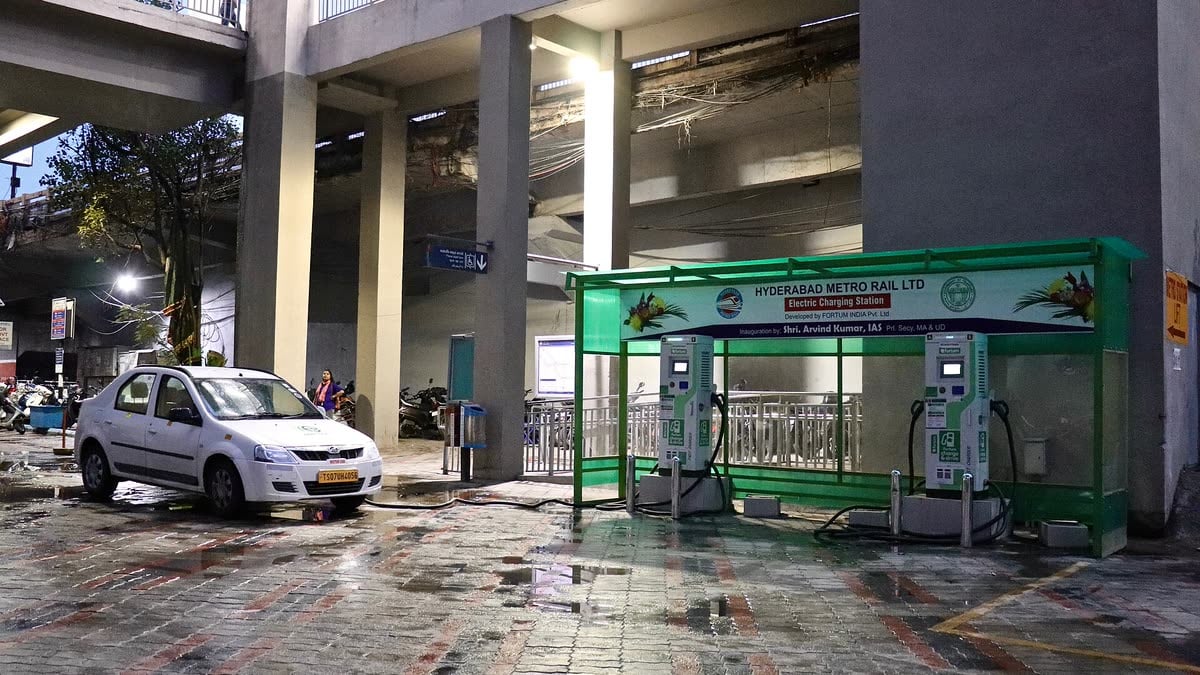
India’s EV charging network is moving beyond city centres, with more attention on homes, housing societies, dealerships and rural highway sites. On 31 Oct 2026, the Ministry of Panchayati Raj said it had signed an MoU with CESL for charging and battery-swapping stations on Panchayat land; on 27 Oct, Autocar Professional reported a FADA warning that securing additional electricity load can be a bigger hurdle than the charger itself. For a household, the lasting lesson is simple: check the vehicle’s accepted power, your sanctioned load and the parking arrangement before comparing charger prices.
This guide explains kW versus kWh, charging-time and rupee math, what the Ministry of Power’s 2024 rules mean for home and society charging, and the checks that belong on an installation worksheet.
Key takeaways
- kW measures charging power at a moment; kWh measures the energy drawn and is the unit used for most charging-cost calculations.
- Residential owners can use an existing connection, request a separate metered EV connection or apply for a sanctioned-load increase when the present supply is insufficient.
- As of the Ministry’s 17 Sep 2024 guidelines, public and community service-charge ceilings are ₹3/kWh for AC charging during solar hours, ₹4/kWh during non-solar hours, ₹11/kWh for DC during solar hours and ₹13/kWh during non-solar hours, excluding GST and land cost.
- Charging time is energy added divided by the power actually delivered, not simply the number printed on a wall box.
- Home tariffs vary by DISCOM and bill slab. Public charging also adds electricity, tax, land or parking components, so a headline per-kWh number is not always the final bill.
1. Why sanctioned load matters more than the charger label
A charger is an electrical load. Your bill records the connection’s sanctioned load, while the charger’s nameplate shows its maximum power. If other appliances are running at the same time, the house may demand more power than the connection or wiring can safely support.
- kW: the rate at which electricity is used; higher kW can add energy faster but creates larger instantaneous demand.
- kWh: the energy consumed, used in the basic cost formula: kWh multiplied by the applicable rupee rate.
- Sanctioned load: the power limit recorded by the distribution licensee, not the car’s battery capacity.
The Ministry of Power’s Guidelines for Installation and Operation of Electric Vehicle Charging Infrastructure-2024 say owners may charge at home using an existing connection. If charging requires more power than the current sanctioned load, the owner is to apply to the distribution licensee for an increase. Domestic electricity rates apply at home.
A higher-rated charger is therefore not automatically a better purchase. Compare the car’s accepted AC input, the bill’s sanctioned load, the wiring route and the time available for charging. The recent FADA warning is a reminder that connection capacity and utility work can become a project cost.
2. Home, society and public charging compared
The table uses the Ministry of Power’s dated 17 Sep 2024 framework. The public service-charge ceilings remain stated through 31 Mar 2028 and were independently reported by Mercom India on 20 Sep 2024. They are reference rules, not a single all-India retail tariff.
| Charging route | Published reference | What the number means | What to check |
|---|---|---|---|
| Home on existing meter | Domestic electricity tariff; no national ₹/kWh rate | Energy is billed through the home connection under the applicable local tariff and slab. | Sanctioned load, phase, wiring, meter capacity and car AC input. |
| Separate home connection | Dedicated EV tariff may be requested | A separate meter can make vehicle energy easier to account for, but tariff and process are local. | DISCOM application, charges, tariff category and parking permission. |
| Public or community AC | ₹3/kWh in solar hours; ₹4/kWh in non-solar hours | Service-charge ceiling, excluding GST and land cost, until 31 Mar 2028. | Electricity pass-through, GST, land or parking fee, connector and live status. |
| Public or community DC | ₹11/kWh in solar hours; ₹13/kWh in non-solar hours | Service-charge ceiling, excluding GST and land cost, until 31 Mar 2028. | Vehicle DC input, connector, queue, station tariff and idle fee. |
| Separate public EV station connection | LT connection up to 150 kW | MoP’s separate-connection provision for charging stations; not a guaranteed home-load entitlement. | Whether the site is public, community or private, and the DISCOM process. |
The key distinction is between a home tariff and a public service-charge ceiling. The ₹3, ₹4, ₹11 and ₹13 figures do not by themselves tell you what a driver will pay at a public socket. The Ministry’s fee structure also includes electricity supply tariff, service charge, land cost where applicable and GST.
3. Calculate charging time from usable energy
Use two formulas:
- Energy required: distance in km × consumption in kWh per 100 km ÷ 100.
- Ideal charging time: energy added in kWh ÷ power actually delivered in kW.
For a worked illustration, assume your trip log shows 15 kWh per 100 km and the planned leg is 200 km. The estimate is 200 × 15 ÷ 100 = 30 kWh. If the vehicle and charger actually sustain 7.4 kW, ideal arithmetic is 30 ÷ 7.4 = about 4.05 hours. The 7.4 kW figure is the minimum public-charger preference for small EVs stated in the Ministry’s 2024 guidelines; it is not a promise that every car will accept that power at home.
Real time can be longer because the car may accept less power than the charger, the battery may taper at a high state of charge, and energy losses occur between meter and battery. Record kWh and start/end times across similar sessions for a personal estimate.
4. Work out the rupee cost without mixing components
For home charging, use home energy cost = kWh drawn × the marginal electricity rate on the bill. Do not call a generic ₹/kWh figure a national home rate: tariffs, slabs, fixed charges and duties differ.
If a bill shows a marginal rate of ₹8/kWh, an illustrative month using 1,000 km and 15 kWh per 100 km would use 150 kWh and produce ₹1,200 of energy cost before allocating fixed household charges. The ₹8 rate and 1,000 km distance are placeholders; replace them with the current bill and the driver’s own log.
At the same illustrative 15 kWh for 100 km, the public service-charge components are:
- AC in solar hours: 15 × ₹3 = ₹45.
- AC in non-solar hours: 15 × ₹4 = ₹60.
- DC in solar hours: 15 × ₹11 = ₹165.
- DC in non-solar hours: 15 × ₹13 = ₹195.
These results exclude electricity supply tariff, GST and land cost, as the Ministry’s table states. A station may also display parking, idle, booking or other disclosed charges. Use the live operator screen for the payable amount and save the receipt.
5. AC or DC: match the route and the vehicle
AC is usually the practical home or long-parking route because the vehicle’s onboard charger controls the conversion. DC is used at public stations when a driver wants to add energy during a shorter stop. Compare the car’s input limit, connector, station availability, tariff and parking time.
- For home, record the car’s maximum AC input from the current manual or specification, then compare it with the charger rating and household load.
- For a highway stop, verify the vehicle’s DC connector and maximum accepted DC power. A station’s higher nameplate cannot make the car take more than its own limit.
- For a society or office, decide whether energy is billed through an existing meter, sub-meter or separate connection and who maintains the equipment.
- For a public session, check the tariff, GST, connector, access hours, queue information and any idle or parking condition.
The Ministry’s guidelines require charging equipment to comply with applicable BIS standards and CEA safety and connectivity requirements.
6. What the 2024 rules mean for a flat or house
- Independent house: use the existing connection if suitable, or request a separate metered EV connection. Apply for a load increase if required.
- Apartment with a dedicated parking slot: the guidelines allow a private charging point in the allotted space, supplied through the resident’s meter or a separate sub-meter depending on the arrangement. Confirm the society’s cable route and electrical process.
- Common charging area: a group housing society can establish community chargers in consultation with the distribution licensee. Set out billing, maintenance, access, damage and idle-parking rules.
- Workplace: existing connections can be used, while the building owner can seek a higher load or separate connection when required.
- Public rollout: the 31 Oct 2026 Panchayat-CESL MoU is an infrastructure announcement, not proof that a particular village or highway charger is live.
For a long journey, use the state-wise EV charging directory to identify possible stops, then verify the operator’s live status and connector details. The directory helps with discovery; the operator’s current screen controls availability and price.
7. Installation and trip checklist
Charging is a sustained electrical load, so treat installation as electrical work rather than as a plug-in accessory. The vehicle manual, charger documentation, CEA safety rules and DISCOM conditions all matter.
- Read the electricity bill and note sanctioned load, phase, meter type and the DISCOM contact route.
- Check the vehicle’s AC and DC input limits, connector and charging schedule from the current manual or specification.
- Ask the installer to document cable size, protective devices, earthing, isolation and weather or water protection.
- Use EVSE meeting applicable BIS and CEA requirements; keep the model, serial number, invoice and warranty record.
- Confirm whether the parking bay is owned, allotted or shared, and obtain landlord or society approval for the cable route and meter.
- Ask the DISCOM whether the connection is sufficient or needs load enhancement or a separate meter.
- Keep the charger away from water accumulation, pedestrian pinch points and vehicle-impact paths; do not use an improvised extension arrangement as a permanent installation.
- After commissioning, record one complete session’s kWh, start time, end time and bill or app reading.
- For a road trip, use the FuelPrice road-trip planner, choose a primary and backup charger for each long leg, check live status and connector, add a margin for traffic and detours, and budget tolls separately.
For a petrol, diesel or CNG comparison on the same distance, the fuel-cost calculator shows the fuel side separately. That keeps energy cost distinct from insurance, maintenance, financing and depreciation.
EV home charging FAQs
Can I charge an EV at home using my existing electricity connection?
Yes. The Ministry of Power’s 17 Sep 2024 guidelines allow residential owners to use an existing connection. If the required load is above sanctioned load, apply to the distribution licensee for an increase; domestic electricity rates apply.
Does a 7.4 kW charger always charge at 7.4 kW?
No. The actual rate is limited by the vehicle’s accepted power, the connection, charger conditions and any power sharing. Use the lower real-world rate from the car and installation when estimating time.
Are ₹11 and ₹13 the full price of public DC charging?
No. They are the Ministry’s service-charge ceilings for DC charging in solar and non-solar hours under the 2024 framework, excluding GST and land cost. The final invoice can also include electricity supply tariff and disclosed site or session charges.
Does the Panchayat-land EV announcement mean a charger is ready near my village?
No. The 31 Oct 2026 MoU is a framework for identifying, installing and operating charging and battery-swapping facilities. Check the live listing, connector, access and operator confirmation before planning around a location.
Sources
- Ministry of Power — Guidelines for Installation and Operation of Electric Vehicle Charging Infrastructure-2024 — 17 Sep 2024
- Ministry of Power — Rajya Sabha answer: Guidelines for EV Charging Infrastructure 2024 — 09 Dec 2024
- Mercom India — Ministry of Power Releases EV Charging Infrastructure Guidelines — 20 Sep 2024
- Autocar Professional — Electricity Connection Costs Could Slow Dealership Charging Rollout: FADA — 27 Oct 2026
- Press Information Bureau — MoU Signed to Set Up EV Charging and Battery Swapping Stations on Panchayat Land — 31 Oct 2026
- Wikimedia Commons — Electric car charging station in Begumpet, Hyderabad, by iMahesh, CC BY-SA 4.0 — 30 Aug 2019; accessed 01 Nov 2026