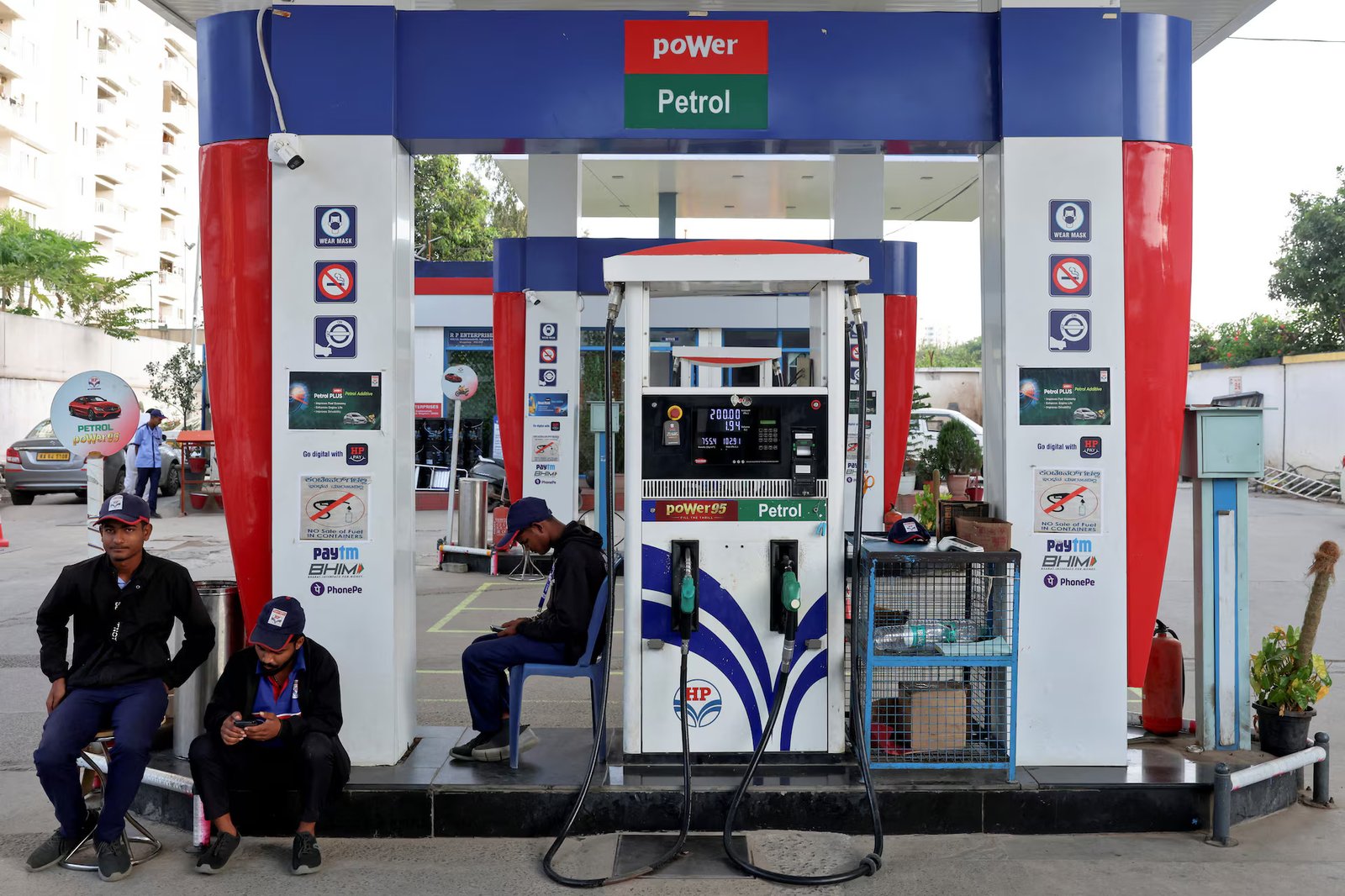
Fuel in India is not just a transport story. It is a household-budget story, a fiscal-policy story, an inflation story, a foreign-exchange story and, in many moments, a political story as well. Petrol and diesel are visible to consumers because they are bought at retail stations, but their impact spreads much more widely than what appears on a fuel-station board. They influence freight, farm economics, aviation, city logistics, industrial costs, delivery businesses, cab fares, government finances, and the Reserve Bank of India’s inflation problem.
That is why a serious understanding of fuel in India must go beyond the simple question of “Why did petrol or diesel become expensive?” The more useful questions are: how are fuel prices actually built; why do retail prices sometimes remain stable when global oil is moving sharply; what role do taxes play; how much does India depend on imported crude; what happens to consumers and businesses when crude spikes; and what are the practical differences among petrol, diesel, CNG, LPG, electric mobility and other alternatives?
This guide answers those questions in a structured way. It combines price history, policy context, economic transmission, comparison tables and practical consumer interpretation. The goal is not to create a one-day news explainer, but a useful reference page that helps readers understand how fuel works inside the Indian economy.
Fuel in India sits at the intersection of consumer budgets, taxation, inflation, logistics and energy security.1) Why fuel matters so much in India
India is one of the world’s largest energy consumers, but it is also heavily dependent on imported crude. That dependency turns oil into a macro variable, not just a commodity. When global crude rises, the issue is not only whether motorists pay more at the pump. The broader question is how the shock spreads through imports, the rupee, freight bills, refinery economics, inflation expectations, subsidies, excise collections and corporate margins.
In practical terms, fuel matters in India for five reasons. First, it is a direct consumer expense for households using two-wheelers, cars, generators and LPG-linked products. Second, it is a core business input for logistics, aviation, buses, construction and agriculture. Third, it is a major fiscal lever: the Union government and states both earn significant revenue from fuel taxation. Fourth, it matters for external balance because crude imports require foreign exchange and influence India’s current account. Fifth, it shapes inflation directly and indirectly, making it relevant for monetary policy.
That final point is often underestimated. A fuel shock can affect consumer inflation not only through petrol and diesel directly, but through transport costs and second-round effects in goods and services. That is one reason the RBI and economists treat fuel as a supply-side shock variable with consequences that can outlast the original oil move.
2) What “fuel” means in the Indian context
When people say “fuel” in India, they often mean petrol and diesel. But the real Indian fuel universe is wider. It includes petrol, diesel, LPG, CNG, PNG, ATF, furnace oil, naphtha, pet coke in industrial contexts, and increasingly electricity as a mobility fuel. Different sectors care about different fuels, and the price sensitivity is not uniform.
| Fuel type | Main use | Typical user concern | Key market story |
|---|---|---|---|
| Petrol | Cars, bikes, scooters | Retail price, mileage, city affordability | Most visible consumer price |
| Diesel | Trucks, buses, agriculture, generators | Freight cost, industrial use, farm cost | High pass-through into the wider economy |
| LPG | Cooking fuel | Affordability, subsidy, refill frequency | Household welfare and subsidy politics |
| CNG | Urban mobility, taxis, fleets | Cost advantage over petrol and diesel | Important transition fuel in cities |
| ATF | Airlines | Ticket pricing and margin pressure | Very sensitive for airline profitability |
| Electricity | EV charging | Charging time, range, tariff stability | Alternative to petroleum in mobility |
This distinction matters because the economic story changes depending on which fuel is under pressure. Petrol stress is visible to urban consumers. Diesel stress has a broader supply-chain and inflationary impact. LPG stress hits household welfare. ATF stress hits airline fares and margins. A sophisticated analysis of fuel in India must separate these channels rather than treating “fuel” as one homogeneous bucket.
3) How petrol and diesel prices are actually built in India
The pump price of petrol or diesel in India is not equal to crude oil converted into rupees. That is the most common misunderstanding in public debate. Retail prices are built through a layered structure that includes crude cost, refinery margins, freight, dealer commission, central excise, state VAT and other smaller components. This means a change in crude will matter, but the size and speed of pass-through depend on the rest of the price stack and on policy decisions.
A simplified retail price build works like this: crude is procured and processed by refiners; refinery transfer price or trade parity/import parity logic affects the base cost; marketing companies add freight, handling and retail-network economics; the Union government adds excise duties; dealers receive a commission; and then state governments add VAT or sales tax, which can vary across states. The result is that India can have one broad national retail price narrative, but still display state-level differences because of tax structure and local levies.
The importance of taxes cannot be overstated. Taxes often form a meaningful share of the retail price and can either cushion or amplify the translation of crude movements into pump prices. That is why retail fuel sometimes does not fall as quickly as global oil and sometimes does not rise as much as global oil, depending on whether governments are adjusting tax policy or asking oil marketing companies to absorb part of the move.
4) Price deregulation and why “market-linked” still does not mean fully free
India deregulated petrol before diesel, and that changed the way price moves are transmitted. In theory, deregulation means prices should respond more flexibly to global conditions. In practice, fuel remains politically sensitive. Governments care about inflation, elections, public sentiment, fiscal math and the financial health of state-run oil marketing companies. So the Indian system often behaves like a managed market rather than a purely free retail fuel market.
This is why retail prices can remain sticky even when crude spikes or falls. Sometimes the state reduces excise to soften the shock. Sometimes refiners or OMCs absorb margin pain. Sometimes retail prices stay frozen while upstream and downstream entities rebalance internally. That is also why fuel-price analysis in India has to be institutional as well as economic. The market is not simply crude in, petrol out.
The policy lesson is straightforward: fuel in India is economically market-linked, but politically and fiscally mediated. Any serious retail-price forecast that ignores that policy layer will usually be incomplete.
5) Historical retail fuel prices in Delhi: what the long arc shows
Official PPAC historical revisions for Delhi show how far the market has travelled since the early 2000s. Petrol in Delhi was in the mid-20s per litre in 2002; by the early 2010s it had crossed the 50s and 60s; by the mid-2010s it moved through the 70s; and by 2025–26 it remained near the mid-90s. Diesel followed a similar but lower path until later years, eventually moving into the high-80s by 2025–26. This long series matters because it shows two things at once: fuel inflation over time and the policy history that shapes how those moves appear to consumers.
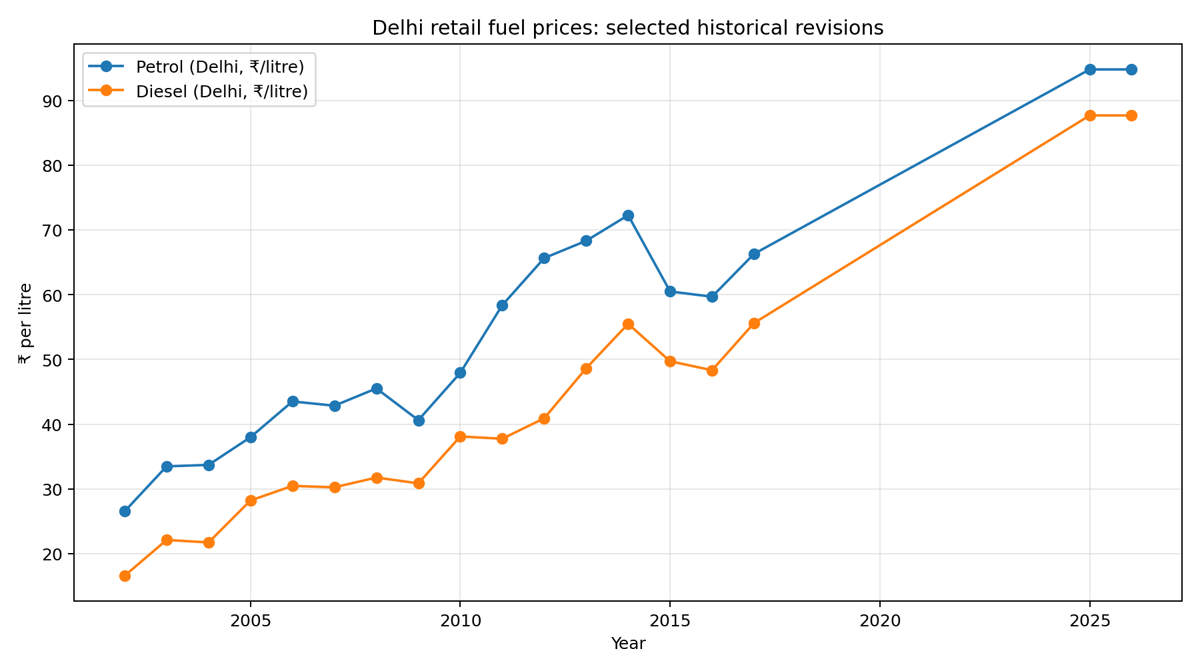 Selected historical Delhi petrol and diesel retail prices based on PPAC revisions and later official Delhi RSP references.
One of the most useful ways to read this graph is to separate structural increase from short-term volatility. Structural increase reflects taxes, inflation, changing global oil regimes, and the long-run shift in energy costs. Short-term volatility reflects crude cycles, tax changes, exchange-rate moves and policy intervention. In other words, the chart should not be read as one clean market line. It is a history of global oil, domestic taxes, and public policy interacting over two decades.
The chart also helps explain why public memory around fuel is often emotionally strong. Retail consumers do not experience price series as economists do. They remember thresholds: 50, 70, 90 and above. Each threshold changes behaviour slightly — from daily commuting decisions to vehicle choice to delivery pricing and cab economics.
6) Recent 2026 shock: crude spiked, but the retail story was more complex
The 2026 West Asia shock is a good case study in how India’s fuel system works. Official PPAC references showed the Indian basket moving from around the low 60s per barrel at the end of December 2025 to much higher levels in March and early April 2026, with some readings above 120 and even 140 dollars per barrel in late March. Yet retail fuel pain did not translate one-for-one into immediate pump-price volatility because policy and supply responses intervened.
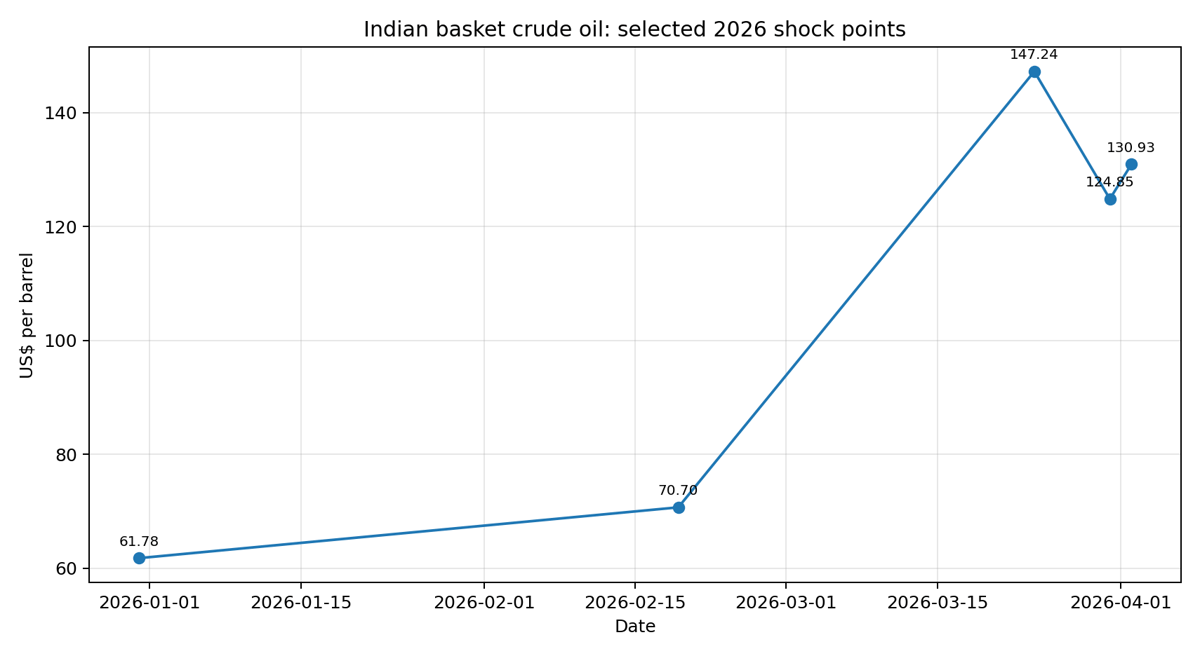 Selected 2026 shock points for the Indian basket illustrate how quickly global crude risk can change India’s energy calculus.
This matters because it shows the distinction between wholesale energy stress and visible retail pricing. In late March 2026, India cut special excise duties on petrol and diesel to shield consumers, while also adjusting export windfall taxes. At the same time, Reuters reported that Indian refiners delayed some maintenance shutdowns to protect local supply, and later that retailers were buying discounted diesel to avoid retail hikes. This is exactly the kind of layered policy-market response that makes India’s fuel story more complex than a simple crude-price chart.
7) Why global crude does not translate line-for-line into pump prices
There are four big reasons. First, taxes make the retail stack sticky. Second, the rupee matters because crude is bought in dollars. Third, refining and marketing economics can absorb or release some pressure. Fourth, governments may intervene directly or indirectly to smooth politically sensitive moves.
Consider the rupee. If crude is stable but the rupee weakens, the landed cost in rupees rises. Conversely, if crude falls but the rupee weakens sharply, part of the relief disappears. That means crude and the exchange rate should be read together, not separately. This also explains why oil shocks can spill over into the current account, imported inflation and bond-market expectations even before consumers notice a large change at the pump.
Consider taxes. A high-tax structure creates a buffer effect in both directions. When crude falls, governments may retain revenue or lower excise more slowly than crude declines. When crude rises, governments may cut duties to soften the consumer blow. This creates asymmetry. Retail prices feel sticky on the way down and politically managed on the way up.
8) Fuel, household budgets and behavioural change
For households, fuel is both a direct and indirect cost. A family with two two-wheelers or one car sees direct pressure immediately in monthly expense. But even a family that uses public transport feels fuel through bus fares, taxi prices, goods delivery charges and the general price level of transported items. Diesel, in particular, has a wider pass-through effect because it is embedded in freight and commercial movement.
That is why fuel inflation often feels larger than its direct weight in the CPI basket. It creates an expectation effect. When households hear that oil has surged, they begin to anticipate price increases more broadly. That expectation changes spending behaviour, savings choices and even vehicle planning. Some households delay discretionary drives, others shift to CNG or EV consideration, and fleet operators recalculate routes and idling behaviour more aggressively.
These are not abstract effects. They change the composition of demand in autos, two-wheelers, ride-hailing, public transport and the used-vehicle market. Fuel is one of the few consumer expenses that can alter both budgets and capital purchases.
9) Fuel and inflation: why central banks care
Fuel matters to inflation through direct basket weight and through second-round transmission. RBI publications on supply shocks repeatedly emphasise that food and fuel occupy a larger role in India’s consumption basket than in many developed economies, which makes price spikes a policy challenge. The inflation effect can arrive through transport, power, logistics and business pricing decisions. In some episodes, oil shocks have contributed heavily to revisions in inflation projections.
This is one reason monetary policy has to interpret oil carefully. If the shock is clearly temporary and politically buffered, policymakers may choose to “look through” some of it. If the shock becomes persistent and begins influencing expectations and broader pricing, the policy challenge becomes much harder. In that sense, oil shocks are not just external shocks; they are expectation-management problems.
10) Fuel, fiscal math and the government budget
Fuel is one of the most important fiscal balancing tools in India because excise and state VAT provide revenue. When crude rises sharply, governments have three broad options: leave prices higher and protect revenue; cut taxes and reduce consumer pain but take a fiscal hit; or lean on marketing companies and refiners to absorb some of the pain through margin compression and internal rebalancing.
Each choice has a cost. Leaving prices high raises inflation and public pressure. Cutting taxes weakens fiscal room. Freezing prices hurts the economics of downstream companies. That is why fuel policy in India is almost always a balancing act among inflation, politics, fiscal space and corporate viability. It is not simply an energy decision.
11) Import dependence and energy security
India’s crude-import dependence is a structural vulnerability. Recent World Bank and Reuters reporting put the import share at around 90 percent, which means external shocks matter disproportionately for India. A supply disruption through major shipping routes, a geopolitical conflict in oil-producing regions, or a rupee move at the wrong moment can quickly turn into an Indian macro story.
That is why energy security in India is not only about finding cheaper crude. It is about diversifying supply sources, maintaining refinery flexibility, building strategic reserves, strengthening domestic gas and renewable alternatives, improving efficiency and reducing the economy’s oil intensity over time. Fuel security is really economic resilience with an energy label.
12) Comparing petrol, diesel, CNG and EVs for consumers
Consumers often ask the question in a much more practical way: which option is best for me? There is no universal answer, but the trade-off structure is fairly clear.
| Option | Advantages | Weaknesses | Best fit |
|---|---|---|---|
| Petrol | Wide availability, smoother private use, easy ownership | High running cost in prolonged price spikes | Lower annual driving, urban personal users |
| Diesel | High torque, strong for commercial use | Policy risk, emissions restrictions, variable urban desirability | Freight and commercial heavy use |
| CNG | Usually lower running cost than petrol | Network limits, queue and refuelling convenience | Urban fleet and heavy city commuters |
| EV | Low running cost, quiet use, policy tailwind | Higher upfront cost, charging and range considerations | Predictable daily routes and home-charging users |
This comparison matters because fuel prices do not only affect monthly budgets. They affect the next vehicle purchase. Sustained fuel stress can reshape the market through migration toward CNG, hybrids and EVs.
13) What households and small businesses should monitor
There are five numbers that matter more than the rest: retail petrol price, retail diesel price, Indian basket crude, rupee-dollar exchange rate, and whether governments are changing excise or VAT. For households, these numbers indicate whether monthly budgets are likely to tighten. For transport-heavy small businesses, they indicate whether pricing, delivery charges and working capital need adjustment.
Small business owners often focus too much on pump price alone. The better approach is to track both pump price and the external variables behind it. When crude rises sharply but retail stays unchanged, that usually signals deferred pressure somewhere in the system — whether in taxes, marketing margins, or future pricing.
14) Frequently asked questions
Why do petrol and diesel prices differ across states?
Because state-level VAT and local levies differ. Dealer density, local logistics and state tax design all contribute to visible price variation across cities.
Why does petrol sometimes stay high even when crude falls?
Because crude is only one part of the retail price. Taxes, dealer commission, exchange rate, refining/marketing economics and policy decisions all matter. In addition, price cuts may lag or be partially absorbed by the tax structure.
Why is diesel so important to inflation?
Because diesel powers trucks, buses, generators, equipment and large parts of freight and commercial transport. It therefore affects the cost of moving goods across the economy.
Does India control fuel prices fully?
Not in a simple sense. India has moved toward deregulation, but because fuel is politically and fiscally sensitive, prices are often influenced by tax changes, margin absorption and policy smoothing.
16) Four historical eras that shaped fuel pricing in India
A useful way to read Indian fuel history is through four broad eras rather than one continuous line. The first era, from the early 2000s to roughly 2008, was the era of rising global commodity pressure and gradual domestic price adjustment. Retail prices were lower in absolute terms, but the system was still managing the after-effects of a world in which oil was becoming more central to growth and public finances. The second era, from the global financial crisis through the early 2010s, was the era of sharp volatility and politically difficult adjustments. This was the period in which the public memory of fuel inflation became especially sticky.
The third era, from around 2014 into the late 2010s, benefited at times from softer global crude, but this did not always translate into proportionate retail relief because tax policy and fiscal priorities also changed. This is the period that taught many consumers the lesson that lower crude does not automatically mean sharply lower pump prices. The fourth era, from the pandemic years into 2025–26, has been defined by disruption, supply-chain stress, changing mobility patterns, inflation shocks, fiscal intervention and the rise of alternatives like EVs and city-gas mobility. In other words, the system is no longer simply about oil cycles; it is also about energy transition and resilience.
17) Fuel and freight: why diesel matters more than many consumers realise
For the average urban consumer, petrol is the visible price because it is the one encountered by a bike or car owner. But for the economy, diesel is often the more important number. Diesel sits underneath trucks, buses, construction equipment, generators and several supply-chain activities. When diesel is expensive for a sustained period, goods movement becomes more expensive. Companies may try to absorb the cost initially, but over time some of that burden finds its way into transport charges and product pricing.
This is why diesel is often called a “wider economy” fuel. Food distribution, e-commerce movement, raw-material transport, inter-city freight, and local business distribution all feel its effect. The pass-through can be slow, partial or uneven, but it is rarely zero. Understanding diesel is therefore central to understanding why fuel shocks can affect inflation even if a household does not personally buy large volumes of diesel.
18) Agriculture, irrigation and rural sensitivity
Fuel in India also has a rural story. Agriculture is not only about fertilizer and rainfall; it is also about diesel in many areas, whether for pumps, tractors, transport, harvest movement or local market connectivity. The degree of dependence varies across states and crop systems, but when diesel prices remain elevated for long enough, they can influence rural working capital and farm economics. The effect may not always show up as a dramatic line item in a farm ledger, but it can still change margins and timing decisions.
That is one reason fuel policy and agricultural sentiment can overlap politically. High diesel stress can complicate rural cost structures even when MSP or output price dynamics are moving separately. This does not mean fuel alone determines agricultural outcomes, but it does mean fuel remains part of the rural operating environment.
19) City gas, LPG and the broader transition question
When people debate “fuel prices,” the conversation usually remains trapped inside petrol and diesel. But India’s transition path is broader. City-gas distribution has made CNG important in several urban markets for taxis, fleets, buses and private users. LPG remains central to household cooking and welfare. Electricity is emerging as a transport fuel through EVs. In policy terms, this means the future of mobility cost is likely to become more segmented than the past.
For consumers, the practical implication is that fuel choice is increasingly part of asset planning. The question is no longer only “what is the pump price today?” It is also “what type of fuel lock-in am I choosing for the next five years?” A buyer selecting a petrol car, CNG vehicle or EV is effectively placing a bet on future running costs, convenience and infrastructure. That is another reason fuel literacy matters more today than it did a decade ago.
20) Common myths about fuel prices in India
Myth 1: crude falls, so petrol should fall immediately
Not necessarily. Taxes, exchange rates, freight, dealer commission and policy decisions all matter. Crude is a major input, but not the full retail equation.
Myth 2: fuel prices are purely political and have nothing to do with markets
Also not true. Fuel in India is market-linked, but its pass-through is often mediated by tax policy, state levies and political sensitivity. It is best described as market-linked but policy-managed.
Myth 3: only car owners care about fuel prices
Wrong. Fuel affects freight, bus systems, food transport, ride-hailing, deliveries, industrial costs and inflation. Even households without a vehicle feel fuel indirectly.
Myth 4: EVs automatically solve the fuel problem
EVs can reduce exposure to petrol and diesel, but they introduce their own questions around charging, grid mix, upfront cost, battery replacement economics and resale assumptions. They are a major part of the answer, but not the whole answer for every user today.
21) Practical consumer checklist before buying a vehicle in a fuel-sensitive environment
- Estimate your annual kilometres realistically, not optimistically.
- Compare total monthly running cost, not just the headline mileage figure.
- Ask whether your city has reliable CNG or EV charging access.
- Think about resale and regulation risk for diesel in your specific use case.
- Separate “inter-city family use” from “daily commute use” before choosing fuel type.
- Track fuel-price trends over months, not just one day before purchase.
22) Extended FAQ
Why are petrol and diesel still outside GST?
Because fuel taxation is a major revenue source for both the Union and states. Moving fuel into GST would change that revenue-sharing structure and could create winners and losers across governments depending on the chosen rate and compensation design.
Why do news headlines often focus on Delhi prices?
Delhi is often used as a benchmark reference because it is widely quoted and relatively easy to compare historically, but it should not be mistaken for a universal national price.
Can India fully insulate itself from global oil shocks?
No. It can diversify suppliers, manage reserves, reform taxes and improve efficiency, but a large oil-importing economy cannot fully avoid global oil stress.
What should I watch most closely during a geopolitical oil shock?
Watch the Indian basket crude, the rupee, government tax announcements, retail price changes and evidence of supply-management steps like maintenance postponements or discounting arrangements.
15) Final conclusion
Fuel in India is a system, not just a product. It is built at the intersection of global crude, refinery economics, tax policy, exchange rates, logistics and politics. That is why fuel analysis often feels confusing to consumers: the pump price on the station board is the last number in a long chain of economic decisions.
The most useful way to understand fuel in India is to hold three ideas together at once. First, crude matters. Second, taxes and policy matter a lot. Third, the true impact of fuel goes far beyond private motorists and into inflation, freight, corporate margins and the budget. Once those three points are understood, the everyday fuel story becomes much clearer.
Bottom line: fuel in India is not just about what drivers pay today. It is about how an import-dependent economy manages risk, inflation, revenue and mobility at the same time.