For years, "Delhi to Dehradun by road" meant blocking out a full day — six hours or more of Modinagar, Muzaffarnagar and Roorkee traffic before the hills finally appeared. That changed on 14 April 2026, when the Delhi–Dehradun Expressway opened. The same journey is now a roughly 3-hour, mostly single-sitting drive on a six-lane, access-controlled corridor that ends almost at Dehradun's doorstep.
That one change reshapes how you should plan this trip. Dehradun is now a genuine weekend destination from Delhi-NCR — close enough to leave after an early breakfast and be checking into your hotel before lunch. It's also the natural launch pad for Mussoorie, Rishikesh and Haridwar. But the new road comes with new rules: patchy fuel and food stops, a forest stretch you can't treat like a racetrack, and a toll that's far higher than older estimates suggest.
This guide is built around Fuelprice's own route data for the trip, cross-checked against 2026 driving reviews and traveller reports, so you can plan the drive and the destination properly. You can always check the latest New Delhi → Dehradun toll and fuel estimate before you leave.
Trip at a Glance
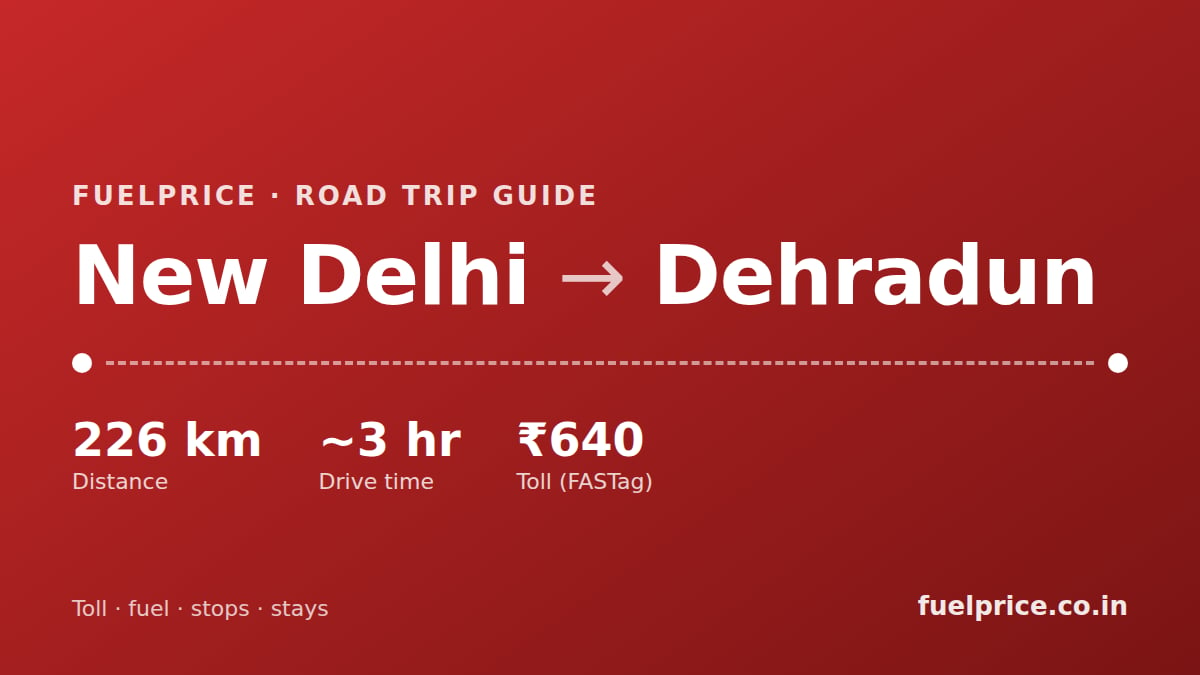
| Distance | ~226 km |
| Driving time | ~3 hours (2.5–3 h typical on the expressway) |
| Toll (one-way, car) | ~₹640 via FASTag (~₹1,280 cash / round trip) — verify live before you leave |
| Estimated fuel (one-way) | ~₹1,206 (petrol car, ~18 kmpl) |
| Ideal departure | 6:00–7:00 AM from Delhi/NCR |
| Recommended duration | 2 days / 1 night (1 day is possible but tiring) |
| Best months | October–February and March–June; avoid peak monsoon |
| Best for | Weekend breaks, families, couples, hill-station launch pad |
A note on the toll: the expressway now has multiple toll plazas and a car pays around ₹640–₹670 one-way via FASTag. Rates on new expressways are still being finalised, so check the live toll estimate and keep your FASTag topped up to at least ₹1,000 for a round trip.
Best Time to Make the Trip
Dehradun sits in a valley below Mussoorie, so its weather is milder than the hills above it — but the reason you're driving up matters as much as the month.
- October to February — the sweet spot for sightseeing. Clear skies, crisp air, and no monsoon risk on the roads. From late December through February, Mussoorie can get snow, which is the main draw for many Delhi families — but that also means cold nights in Dehradun and possible fog on the expressway in the early morning. Carry warm layers and don't push a pre-dawn start in dense fog.
- March to June — pleasant, but peak season. This is when Delhi bakes and everyone escapes to the hills. Dehradun and especially Mussoorie get crowded; hotels fill and prices climb. Weekends are busiest. Book your stay in advance and start early to beat both traffic and heat.
- July to September — the monsoon. Think twice. The valley turns lush, but the roads up to Mussoorie and across to Rishikesh are landslide-prone, and the expressway's forest stretch sees more elephant movement at dawn and dusk. Dehradun city itself is manageable, but hill day-trips can be disrupted. If you go, keep the itinerary flexible and check road advisories before any ghat drive.
Bottom line: for a first trip, aim for October–November (green after the rains, clear roads) or February–March (snow tail-end plus warming days).
When Should You Leave?
The drive itself is short now — your real enemy is getting out of Delhi-NCR onto the expressway. The corridor starts near Akshardham and feeds off the Delhi–Meerut Expressway, so if you leave during the morning office rush you can lose 45–60 minutes just reaching the entry point.
Travellers consistently recommend an early start — on the road by 6:00–7:00 AM. Leave by 6, clear NCR before traffic builds, and you can realistically be in Dehradun by 9:30–10:00 AM with one short break. That gives you a full first day at the destination instead of arriving tired in the afternoon.
Avoid arriving late: Dehradun's city traffic around the Clock Tower and the climb toward Rajpur Road get busy by evening, and you don't want to be hunting for hotel parking after dark on your first day.
Recommended Route
Use Fuelprice's route — it already reflects the current fastest alignment. In plain terms: Delhi (Akshardham) → Delhi–Meerut Expressway → Baghpat → Shamli → Saharanpur → elevated forest stretch through Rajaji National Park → Asharodi → Dehradun.
A few things worth knowing about this road specifically:
- It's access-controlled: you enter and exit only at designated interchanges. You cannot casually pull over for a roadside dhaba the way you could on the old NH-58.
- The 12 km elevated stretch through Rajaji National Park near Dehradun is the highlight — an engineering set-piece over the Shivalik forest. But driving reviews note blind curves and lane shifts here; keep speeds moderate and stay alert.
- The surface is good asphalt in most parts, but some concrete-slab sections feel bouncy, and potholes were reported within a couple of months of opening. Don't assume "new expressway = flawless."
If you specifically want the old-highway dhaba experience (Cheetal Grand at Khatauli, the Namaste Midway food court), note that these sit on the older NH-58/NH-334 route through Muzaffarnagar and Roorkee — the expressway bypasses them. You'd have to take the old route or exit for them, trading roughly 2–3 hours of extra driving for the nostalgia.
Journey Plan
A realistic weekend-morning schedule (adjust for traffic and weather):
- 06:00 — Leave Delhi/NCR (well-fuelled, FASTag topped up)
- 06:45 — On the expressway past Akshardham / Delhi–Meerut Expressway
- 08:15 — Short break at an operational wayside amenity (restroom / tea)
- 09:00 — Elevated forest stretch — slow down, enjoy the Shivaliks
- 09:45 — Reach Dehradun (Asharodi → city)
- 10:15 — Hotel check-in / drop bags, head out for Robber's Cave
Actual timings depend on how quickly you clear NCR and on the wildlife-corridor speed limits. Treat this as a template, not a promise.
Best Stops Along the Route
The honest truth about the new expressway: it is not yet a road full of great stops. Through 2026, many of the planned 14 wayside amenities (fuel, food courts, restrooms, some with EV fast-charging) were still under construction, and drivers reported fuel gaps and no working EV chargers en route. Plan around that rather than expecting a stop every 15 km.
1. Fuel + food before you hit the expressway
Why stop: the most important "stop" of the trip. Because on-road fuel is unreliable, fill your tank in Delhi/NCR and have breakfast before you commit to the corridor.
Best for: full tank, full stomach, clean restroom.
Practical note: EV drivers — charge to full in the city; do not count on chargers on the way yet.
2. An operational wayside amenity (mid-route)
Why stop: a short leg-stretch and restroom break roughly halfway.
Best for: tea/coffee, restroom, quick snack.
Approximate stop duration: 15–20 minutes.
Practical note: use whichever amenity is actually open — availability is still improving.
3. The Rajaji elevated stretch (drive-through, not a stop)
Why it matters: the scenic and engineering highlight of the whole drive.
Practical note: this is a no-stopping forest zone. Slow down for blind curves, watch for wildlife at dawn/dusk, and simply enjoy it from the car.
For the classic dhaba run (old route only)
If you deliberately take the older highway: Cheetal Grand (Khatauli, ~100 km) is the long-standing favourite — clean, family-friendly, good parathas and omelettes — and the Namaste Midway food court (McDonald's, Haldiram's, Starbucks) nearby is a reliable family pit-stop. Neither is on the expressway.
Where to Eat Along the Route
Because the expressway's own food courts are still filling in, plan meals at the ends rather than the middle:
- Breakfast: eat before you leave, or at a Delhi/NCR stop.
- Mid-route tea: whatever wayside amenity is operational.
- Real meal: save it for Dehradun — you'll arrive by late morning anyway.
On the old route, the Cheetal Grand / Namaste Midway cluster near Khatauli remains the go-to.
Reaching Dehradun
The expressway drops you at Asharodi on the western edge, and it's a short run into the city from there. A few practical notes:
- City traffic builds around the Clock Tower, Paltan Bazaar and Rajpur Road by mid-morning and again in the evening. Time your entry for before ~11 AM if you can.
- Rajpur Road (the artery toward Mussoorie) is where most of the nicer hotels and cafés are — but it's also the busiest stretch.
- Parking is tight in the central Clock Tower/Paltan Bazaar area. Choose a hotel with its own parking, and for the crowded attractions plan to park and walk.
Where Should You Stay?
Pick your area first — it matters more than the specific hotel.
Rajpur Road (and Mussoorie Road side)
Choose this if: you want cafés, better hotels, and an easy exit toward Mussoorie and Robber's Cave.
Advantages: best concentration of good restaurants and mid-to-premium hotels; closer to the hill attractions; more relaxed than the old city.
Downsides: traffic-heavy; the nicer places cost more.
Clock Tower / Paltan Bazaar (central)
Choose this if: you're on a budget, arriving late/leaving early, or want to be in the middle of the action and street food.
Advantages: walkable to the market, bus stand and railway station; lots of budget hotels; the cultural heart of the city.
Downsides: noisy — the bazaar is active from before 7 AM to ~9 PM. Light sleepers should ask for an upper-floor or rear-facing room. Parking is difficult.
Sahastradhara Road / outskirts
Choose this if: you want a quieter, resort-style stay with easy parking.
Advantages: calmer, greener, easier to park; good for families who'll drive to sights.
Downsides: you'll drive for most things; less walkable.
Suggested stays
Rather than pretend to know live availability, here's the shape of a good shortlist — use a live booking source to confirm current prices and reviews:
- Budget (₹): a well-reviewed hotel just off Rajpur Road or near the Clock Tower. Good for short stays, late arrivals, walking to the market.
- Mid-range (₹₹): a reputable business/leisure hotel on Rajpur Road with in-house parking. Good for couples and families who want comfort plus an easy Mussoorie run.
- Premium (₹₹₹): a branded property or hill-view resort on the Mussoorie Road / Sahastradhara side. Good for a relaxed weekend where the hotel is part of the experience.
Specific property names, facilities and prices change frequently — confirm before you commit.
Places You Definitely Should Visit
Robber's Cave (Guchhupani)
Why it's worth visiting: a narrow limestone gorge where a stream vanishes underground and re-emerges — you walk through the cold, knee-deep water between the rock walls. It's Dehradun's signature outing and genuinely fun.
How much time to allow: 1.5–2 hours.
Best time: go early — by about 10 AM — to beat the crowds, which get heavy on weekends.
Practical advice: wear water shoes or sandals with grip; the rocks are slippery. Not ideal for frail elderly travellers or very small children because of the cold water and uneven footing.
Forest Research Institute (FRI)
Why it's worth visiting: a magnificent 1929 Greco-Roman/colonial building set in vast lawns, with six forestry museums inside. It's part heritage architecture, part museum, and very photogenic.
How much time to allow: 2–3 hours.
Best time: daytime; note the museums are closed on weekends — go on a weekday if the museums matter to you.
Practical advice: small entry fee (around ₹15, plus a modest charge for a guide). Photography is restricted inside; the grounds are flat and easy — good for elderly visitors who can manage some walking.
Mindrolling Monastery & the Great Stupa
Why it's worth visiting: one of India's largest Tibetan Buddhist centres — a huge, beautifully painted stupa, gardens, and a calm atmosphere that's a genuine contrast to the busier sights.
How much time to allow: 1–1.5 hours.
Best time: late morning or afternoon; peaceful most days.
Practical advice: dress modestly; it's an easy, mostly flat visit suitable for all ages.
Places Worth Visiting If You Have More Time
- Tapkeshwar Temple — a cave Shiva temple by a stream; atmospheric, but can get very crowded on Mondays and around Shivratri.
- Malsi Deer Park / Dehradun Zoo — an easy, shaded outing that kids enjoy.
- Lachhiwala — a forest-and-stream picnic spot on the way in from the Haridwar side; nice for a relaxed few hours.
Places You Can Skip If You're Short on Time
Sahastradhara is the one to be honest about. It's heavily promoted, but recent visitors repeatedly describe it as overcrowded and not very clean, with murky water, especially on weekends. If you're curious, go very early on a weekday; otherwise, with limited time, prioritise Robber's Cave and FRI instead.
Generic "city viewpoints" and mall stops are fine if you have spare hours, but not worth reshuffling your plan for.
What to Eat at Dehradun
Dehradun's food is a mix of Garhwali roots (millets like jhangora and mandua, lentils, milk-based sweets), strong Tibetan influence (momos, thukpa), and cosmopolitan cafés. A few long-standing names travellers consistently recommend:
- Ellora's Bakery (Rajpur Road) — a Dehradun institution since 1953. Famous for milk rusks, plum and fruit cakes, and cheese sandwiches. Budget–moderate; great for a chai-time stop or takeaway for the drive back.
- Kumar Sweet Shop / Kumar Foods (Clock Tower & Rajpur Road) — trusted for sweets, kulfi-falooda, and North Indian vegetarian thalis. Budget–moderate; family-friendly.
- Amritsar Walon Ki Rasoi (Tyagi Road) — hearty, authentic Punjabi vegetarian food. Moderate.
For local flavour, try a Garhwali thali somewhere it's freshly made, and grab momos from a busy Tibetan stall rather than a fancy restaurant.
Suggested Itineraries
1 Day (long, doable, tiring)
Leave by 5:30–6:00 AM, reach ~9:30. Robber's Cave (early) → FRI → lunch → Mindrolling, then leave Dehradun by ~4:00 PM to be home by ~7:30–8:00 PM. Realistic, but it's ~6 hours of driving bookending a packed few hours — better as a taster than a proper trip.
2 Days / 1 Night (recommended)
- Day 1: early drive → check in → Robber's Cave → lunch on Rajpur Road → FRI (grounds) → evening at Paltan Bazaar / Ellora's.
- Day 2: Mindrolling Monastery in the morning → early Sahastradhara only if you're curious, or a relaxed café morning → drive back after lunch.
3 Days / 2 Nights (add the hills)
Add a day for Mussoorie (35 km, ~1–1.5 hours up the ghat) or Rishikesh (~45–55 km). For Mussoorie, park at your hotel and use local transport — the town's traffic and parking are the real challenge, not the distance. Consider staying overnight in Mussoorie rather than doing it as a rushed day-trip, especially on weekends.
Travelling With Family or Kids
- Robber's Cave means walking in cold water over slippery rocks — fun for older kids, tricky for toddlers. Bring a change of clothes and grippy footwear.
- Malsi Deer Park and FRI's lawns are easy, low-stress options for children.
- Break the drive at an operational wayside amenity; carry water and snacks since food stops are patchy.
- Ask your hotel for a room away from bazaar-facing noise if you're central.
Travelling With Elderly Family Members
- FRI and Mindrolling are the most senior-friendly: flat, walkable, no scrambling.
- Skip or minimise Robber's Cave for anyone unsteady on their feet — the wet, uneven gorge is genuinely slippery.
- On any Mussoorie add-on, factor in steep roads and steps; keep the pace gentle and avoid weekend crowds.
Road Trip Budget
Indicative, one car, two people, weekend. You can fine-tune the fuel figure with the Fuelprice fuel cost calculator.
| Item | Estimate | Assumptions |
|---|---|---|
| Fuel (round trip) | ~₹2,400 | Based on ~₹1,206 one-way, petrol car |
| Toll (round trip) | ~₹1,280 | ~₹640 one-way FASTag; verify live before leaving |
| Stay (1 night) | ₹2,000–4,000 budget/mid · ₹6,000–12,000+ premium | Varies sharply by season/weekend |
| Food (2 days, two people) | ₹1,500–3,000 | Local eateries to mid-range cafés |
| Activities / entries | ₹300–1,000 | FRI, Robber's Cave, optional Mussoorie ropeway |
| Parking / miscellaneous | ₹200–500 | City + attraction parking |
Ballpark for a 2-day weekend for two: roughly ₹9,000–16,000, driven mostly by your choice of hotel and season. Fuel and toll are the fixed part; everything else is a lever. You can plan the full trip with the Road Trip Planner.
Common Mistakes Travellers Make
- Assuming the expressway has fuel and food everywhere. It doesn't yet — tank up before and carry water/snacks.
- Under-loading the FASTag. The toll is ~₹640 each way; keep at least ₹1,000 on your tag for a round trip.
- Treating the forest stretch like a racetrack. Blind curves, lane shifts and possible wildlife — ease off.
- Driving the Mussoorie ghat or into the hills after dark, especially in monsoon.
- Visiting Robber's Cave or Sahastradhara at midday on a weekend — go early or don't bother.
- Underestimating Mussoorie's parking and traffic — park and use local transport.
Before You Leave — Checklist
- FASTag topped up (₹1,000+ for a round trip)
- Full fuel tank before the expressway (EV: charge fully in the city)
- Tyre pressure checked (nitrogen filling is scarce en route)
- Offline maps downloaded
- Water + snacks in the car
- Hotel confirmation + parking sorted
- Weather / road advisory checked (essential in monsoon)
- Some cash for parking and small charges
- Vehicle documents (RC, insurance, licence, PUC)
Final Recommendation
If it were my family heading up next weekend, I'd treat this as a relaxed two-day, one-night trip, not a one-day dash. Leave Delhi by 6 AM with a full tank, enjoy the new expressway (slowing right down for the Rajaji forest stretch), and be checked in by mid-morning. I'd spend the first day on Robber's Cave (early) and FRI, keep the evening for Rajpur Road cafés and Ellora's, and use day two for Mindrolling and the drive home — adding a Mussoorie night only if I had a third day and could avoid a weekend crush. I'd skip Sahastradhara unless someone specifically wanted it, and I'd budget the toll at the real ~₹640 each way, not the old low figure. The road has made Dehradun genuinely easy; the trick now is planning around a highway whose petrol pumps and rest stops are still catching up to it.
Ready to cost it out? See the live New Delhi → Dehradun toll and fuel estimate or build your full road-trip plan.