Public EV charging in India is easiest to plan as a compatibility, availability and bill check—not as a search for the nearest pin. Before leaving, match your vehicle’s connector and maximum accepted power to the station listing, confirm live status and price in the operator app, and keep a reachable backup. A charger’s headline power is not a guarantee of the speed your particular vehicle will receive.
This guide explains the process for Indian city and highway trips, including a dated cost example. It also separates a confirmed government charging rule from a company’s planned network expansion, so a map pin is not mistaken for a live, compatible bay.
Key takeaways
- Check the connector first: CCS, CHAdeMO, Type-2 AC and Bharat-standard chargers do not answer the same vehicle or charging need.
- Read the vehicle’s maximum AC or DC input alongside the station’s rated kW; the lower practical limit usually determines the session.
- A public charging bill can contain electricity supply, service charge, land cost and GST. The visible service charge is not automatically the full price.
- As of 20 Mar, 2025, the Ministry of Power’s published framework listed AC service-charge ceilings of ₹3/₹4 per kWh and DC ceilings of ₹11/₹13 per kWh for solar and non-solar hours, subject to the stated rules and review.
- The reported CHARGEZONE–Ador-Quench plan for 1,000 new locations is a future rollout; it does not make all 1,000 sites live today.
Why public EV charging needs a checklist
On 05 Nov, 2026, Autocar Professional and Motoring Trends reported that CHARGEZONE and Ador-Quench plan to deploy DC fast-charging equipment at 1,000 new locations in India. The reported hardware range is 120 kW to 480 kW, with passenger cars, buses and trucks in scope. The reports did not publish a complete site list, opening schedule, connector at every site or consumer tariff. This is therefore a reported company plan, not a confirmed change to the charging map for a particular route.
FuelPrice’s report on the CHARGEZONE expansion explains what is known about the announcement. The lasting lesson for an EV driver is broader: charging capacity matters only when a station is open, compatible, reachable and priced clearly. A trip plan should test those four conditions separately.
Step 1: Choose the station by connector, not distance
Start with the charging port shown in the vehicle manual or manufacturer app. A nearby station can still be unusable if its connector is wrong, its cable is captive to another standard, or the vehicle supports only AC when the available bay is DC.
- Type-2 AC: The station supplies alternating current and the vehicle’s onboard charger controls how much it can accept. A station listing that says 22 kW does not mean every car will take 22 kW.
- CCS: The Combined Charging System is a DC fast-charging option listed for four-wheelers. Confirm that the car has a compatible CCS port and check its maximum DC input.
- CHAdeMO: This is another DC connector listed for four-wheelers. It is not interchangeable with CCS simply because both are fast-charging standards.
- Bharat AC-001 and Bharat DC-001: These standards appear in the official Indian charging-specification table and can cover two-wheelers, three-wheelers and four-wheelers depending on the charger and vehicle.
- Vehicle-side limit: A high-power dispenser can serve a compatible vehicle without delivering that full rating to every car. Battery temperature, state of charge, the vehicle’s software and load sharing can reduce the actual power.
The Ministry of Power and Bureau of Energy Efficiency specification table gives the following rated figures. They describe the charger standard, not a promise that every vehicle will charge at that speed.
| Charger or connector | Official rated figure | Vehicle category listed | What to check before driving |
|---|---|---|---|
| CCS DC | Minimum 50 kW | Four-wheelers | Vehicle DC input and CCS compatibility |
| CHAdeMO DC | Minimum 50 kW | Four-wheelers | Vehicle port and network support |
| Type-2 AC | Minimum 22 kW | Four-, three- and two-wheelers | Onboard AC limit and cable requirement |
| Bharat DC-001 | 15 kW | Four-, three- and two-wheelers | Vehicle support and plug arrangement |
| Bharat AC-001 | 10 kW; three 3.3 kW guns | Four-, three- and two-wheelers | Socket, cable and vehicle charging protocol |
Source note: figures are from the BEE electric-mobility specification table and the Ministry of Power charging guidance, checked on 06 Nov, 2026. “Minimum” or “rated” is a station specification; it is not the same as a vehicle’s accepted power.
Step 2: Verify live status and the actual price
Use FuelPrice’s state-wise EV charging station directory to identify possible stops, then open the operator’s own listing or app before committing to one. The Ministry of Power’s 2024 guidelines describe user-facing information such as location, AC or DC type, kW capacity, number of available chargers, charging rates and additional fees. In practice, availability can change between the map search and arrival.
- Check whether the bay is shown as available, occupied, out of service or under maintenance.
- Confirm the connector and gun number, not just the station brand or city name.
- Read the current price per kWh and look for service, parking, idle-time, convenience or session fees.
- Check the payment method, app login, QR flow, wallet requirement and whether a phone signal is needed at the bay.
- Confirm access hours and whether the station is genuinely public rather than limited to residents, employees, a fleet or a private parking facility.
- Save the address and operator contact details. A station can be listed correctly but have a blocked entrance, a broken cable or a temporary power problem.
Do not treat a government planning target or a network’s total location count as proof of live availability. The 2024 guidelines suggest an urban 1 km × 1 km grid by FY2030 and charging stations every 20 km on both sides of highways, expressways and major roads. These are network-planning directions; they do not remove the need to verify today’s station status and access.
Step 3: Estimate the charging bill in rupees
For a public session, begin with the energy shown in the vehicle or charger record. A useful working formula is:
Estimated bill = energy charged × electricity supply tariff + energy charged × service charge + land or parking charges + applicable GST.
The Ministry of Power’s 20 Mar, 2025 Lok Sabha answer says the total customer fee can comprise electricity supply tariff, service charge, land cost and applicable GST. The same answer refers to the 2024 guidelines: the supply tariff for EV charging stations should not exceed the Average Cost of Supply until 31 Mar, 2028, with a possible 0.7-times ACoS charge during solar hours from 9 a.m. to 4 p.m. and 1.3-times ACoS during the remaining hours. The actual state tariff and operator bill still need to be checked.
| Charging service | Solar hours, 9 a.m.–4 p.m. | Non-solar hours, 4 p.m.–9 a.m. | Scope of the figure |
|---|---|---|---|
| AC service-charge ceiling | ₹3 per kWh | ₹4 per kWh | Excludes GST and land cost; subject to annual review |
| DC service-charge ceiling | ₹11 per kWh | ₹13 per kWh | Excludes GST and land cost; subject to annual review |
These are the ceilings and time bands stated in the Ministry’s published 2024 framework and its 20 Mar, 2025 parliamentary answer; they are not a universal all-in public-charger tariff.
Worked example: a 20 kWh DC session
For an illustration only, take a 20 kWh DC session in Andhra Pradesh during solar hours. The Ministry’s 20 Mar, 2025 annexure listed an Andhra Pradesh LT public-EV supply tariff of ₹6.70 per kWh. Applying the published DC service-charge ceiling of ₹11 per kWh gives:
- Electricity component: 20 kWh × ₹6.70 = ₹134.
- Service-charge component: 20 kWh × ₹11 = ₹220.
- Illustrative subtotal: ₹134 + ₹220 = ₹354, before land cost and applicable GST.
This is a dated calculation, not a current quote from a named operator. State tariff orders, station pricing, land arrangements, GST treatment and other fees can change the app total. Use the displayed station rate for the final decision and keep the receipt if the charged amount differs from the preview.
Step 4: Estimate time without trusting the charger label
The ideal arithmetic is simple: energy needed divided by delivered power. If a vehicle could accept 50 kW continuously and needed 20 kWh, the theoretical time would be 20 ÷ 50 = 0.4 hour, or 24 minutes. That is a calculation, not a promise.
Real sessions can take longer because the vehicle may reduce power as the battery fills, arrive with a hot or cold battery, limit DC input below the station rating, or share a dispenser with another vehicle. A 120 kW station can still be a poor choice for a car whose maximum DC input is lower than that, while an available lower-rated charger may be more useful if it matches the vehicle and the route timing.
- Use the vehicle’s own charging curve or manufacturer guidance when available.
- For a short top-up, compare the energy required with the time you actually have, not only the station’s maximum kW.
- For a full or near-full session, allow more time than the ideal division suggests.
- Check whether a station shares power between two guns; the listing or operator can show this.
Step 5: Build a primary stop and a backup stop
Before a city commute, the backup may be another nearby station. On a highway trip, it should be a reachable alternative on the same corridor or in the next town—not a point that requires a long detour after the battery is already low. FuelPrice’s road-trip planner can help compare the route and travel time; the charging stop still needs a separate compatibility and live-status check.
- Record the trip distance and the vehicle’s expected energy use for the route.
- Choose a primary station with the correct connector and a stated power level within the vehicle’s accepted range.
- Check live status, opening hours, payment method, current price and any parking or idle rule just before departure.
- Identify a backup station that can be reached without relying on the primary station being free.
- Save the two addresses, network names and phone numbers offline or in a screenshot.
- At the bay, inspect the connector and cable before starting; stop if the equipment, plug or socket looks damaged or wet.
- After the session, check the kWh, time, rate and final amount in the app or receipt before leaving.
If the comparison is between an EV and a petrol or diesel vehicle, use FuelPrice’s fuel cost calculator for the combustion-vehicle reference, then add the EV’s electricity and charging fees separately. A lower energy price alone does not capture charging time, detours, parking or the availability of a home charger.
Frequently asked questions
Is a 120 kW charger always faster for every EV?
No. The vehicle’s maximum DC input, battery temperature, state of charge, connector and shared station load can all limit the delivered power. Compare the vehicle specification with the charger listing and treat the headline kW as a site capability, not a guaranteed session speed.
How much does public EV charging cost in India?
There is no single all-India all-in price. The bill can include electricity supply, a service charge, land or parking costs and GST. The Ministry’s published service-charge ceilings are useful for understanding the components, but the current station app or display is the amount to check before charging.
Can every EV use a public fast charger?
No. The port, charging protocol and vehicle’s AC or DC capability must match. A Type-2 AC point, CCS DC point, CHAdeMO point and Bharat-standard point should be treated as different options until the vehicle manual or operator listing confirms compatibility.
Does the 20 km highway guideline mean a live charger is available every 20 km?
No. The Ministry’s 2024 document gives a network-planning direction for stations on both sides of highways, expressways and major roads. It is not a live-availability guarantee for every route segment, so a driver still needs current status and a backup stop.
Sources
- Autocar Professional, “CHARGEZONE Partners With Quench Chargers To Deploy DC Fast Chargers At 1,000 New Locations” — 05 Nov, 2026
- Motoring Trends, “CHARGEZONE Partners Ador-Quench To Deploy Fast-Charging Infrastructure Across 1,000 Stations” — 05 Nov, 2026
- Ministry of Power, “Guidelines for Installation and Operation of Electric Vehicle Charging Infrastructure-2024” — 17 Sep, 2024
- Ministry of Power, Lok Sabha answer on “Public Charging Stations for EVs” — 20 Mar, 2025
- Bureau of Energy Efficiency, “Frequently Asked Questions on Electric Vehicles” — accessed 06 Nov, 2026
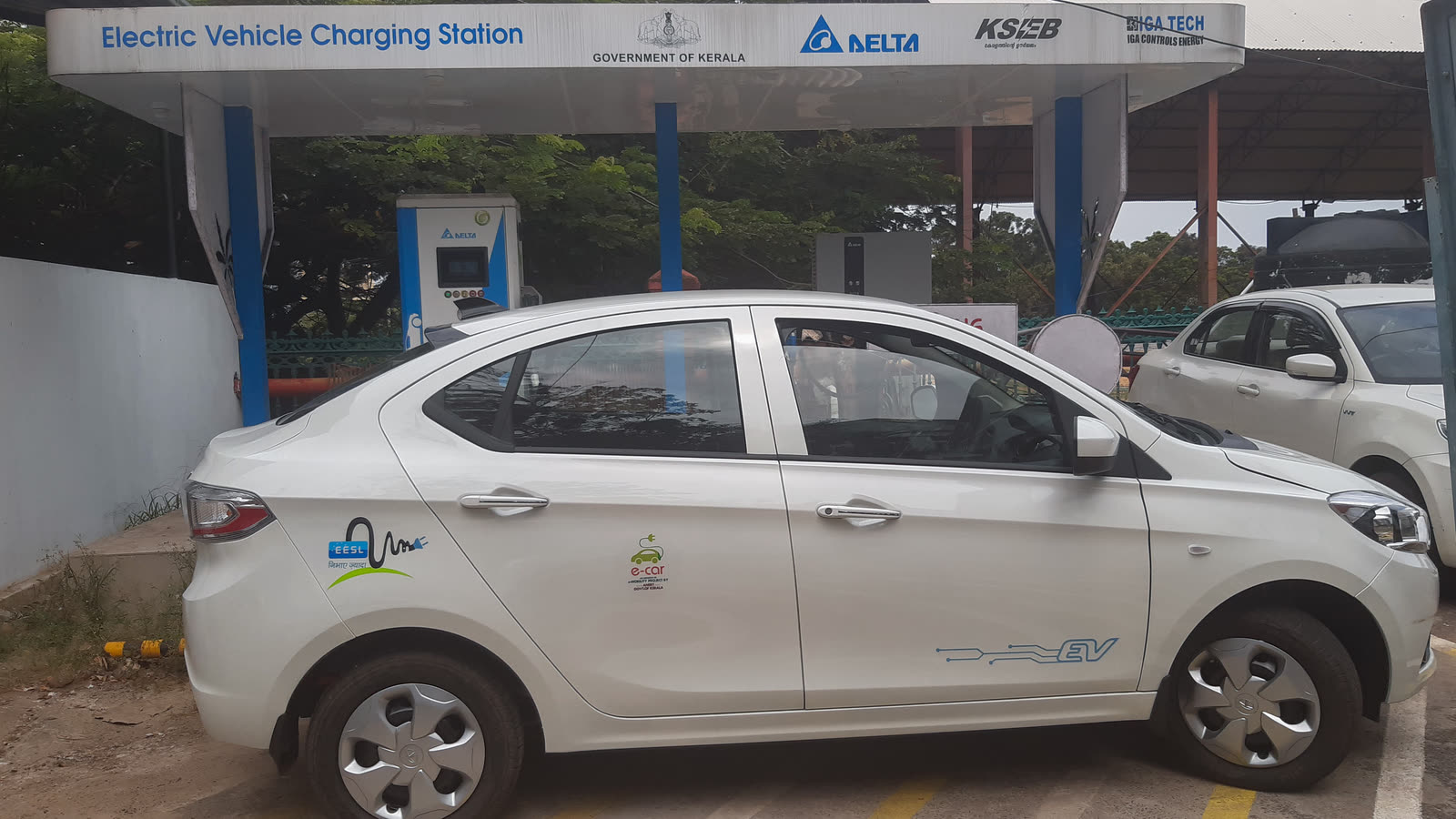
- Wikimedia Commons, “Electric Car and Electric Vehicle Chargin Station at Government Secretariat, Thiruvananthapuram” — photograph uploaded 26 Aug, 2020; CC BY-SA 4.0