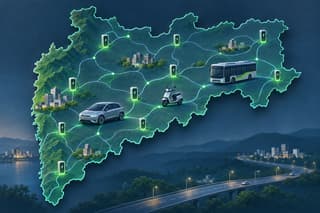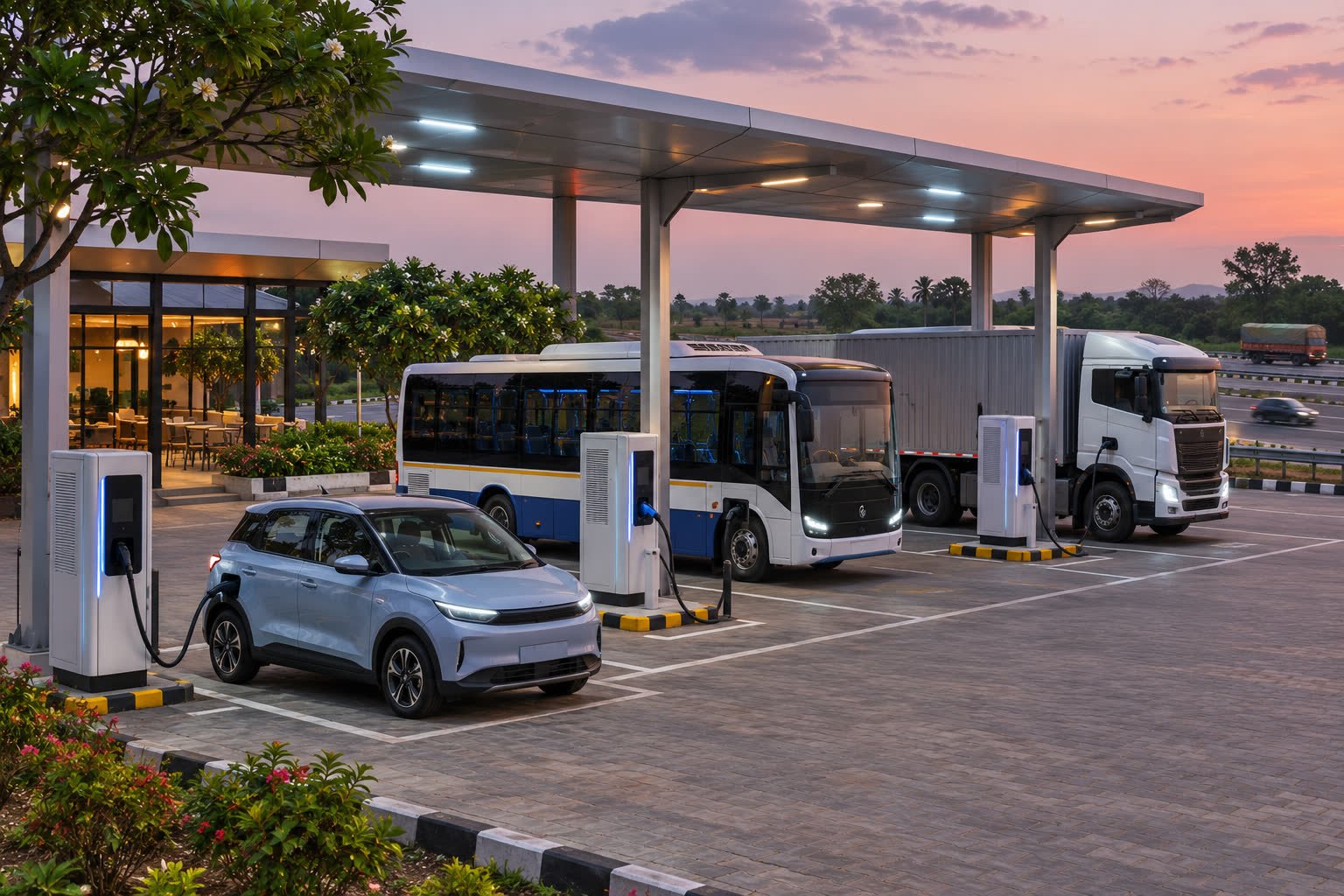
CHARGEZONE has announced an expanded partnership with Ador-Quench to deploy Made-in-India DC fast-charging systems at 1,000 new locations in India, according to reports published on 5 Nov 2026. The plan covers passenger electric vehicles, buses and commercial trucks, but the reports do not yet name the first sites or a commissioning date, so drivers should treat it as a planned expansion rather than an immediate change to the charging map.
Key takeaways
- CHARGEZONE plans 1,000 new Indian charging locations with Ador-Quench fast-charging equipment.
- The reported hardware range is 120 kW to 480 kW, with different configurations aimed at cars, buses and trucks.
- CHARGEZONE is targeting 300 MW of cumulative network capacity after the expansion.
- The companies say the chargers will be integrated with ChargeCloud for monitoring, load management and diagnostics.
- The rollout is not the same as 1,000 live stations today: locations, opening dates, connector availability and user pricing still need to be confirmed.
What CHARGEZONE and Ador-Quench announced
Autocar Professional reported on 5 Nov 2026 that CHARGEZONE had expanded its collaboration with Ador-Quench, the charging business of Ador Powertron, to deploy DC fast-charging infrastructure at 1,000 new locations in India. Motoring Trends reported the same announcement on 5 Nov and described the sites as new supercharging locations. Both reports identify the deployment as a company plan, not a government-mandated rollout or a statement that all locations are already operational.
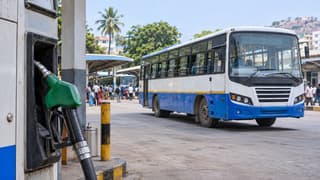
The reported expansion is intended to serve three different use cases: passenger EVs travelling between cities, electric buses operating on fixed schedules, and commercial trucks that need high energy throughput. That mix matters because a private car making one highway stop has a different charging pattern from a bus or truck that must repeat the same route every day.
Autocar Professional said CHARGEZONE currently operates more than 15,000 charging points across over 1,200 locations in India and the UAE, while Quench Chargers has deployed more than 1,500 DC fast chargers across India. Those are company figures reproduced in the 5 Nov 2026 report and should not be read as a count of the new locations.
What the 120 kW to 480 kW range means
The announcement covers Ador-Quench systems from 120 kW chargers to 480 kW dispenser systems. The 120 kW units are intended for passenger vehicles on highways and intercity routes, according to the two reports. The 360 kW and 480 kW systems are aimed at buses, trucks and other commercial fleets, where several vehicles may need to charge at the same hub.
The equipment is based on a modular 30 kW AC-DC converter architecture that can be configured from 30 kW to 480 kW. The companies also claim energy efficiency above 96 per cent, along with forced-air cooling, front-access servicing and a digital CAN interface for monitoring voltage, current, temperature and diagnostics. The chargers are expected to connect with CHARGEZONE's ChargeCloud platform for real-time monitoring, dynamic load management and predictive maintenance.
A higher station rating does not automatically mean that every car will charge at that speed. The vehicle's maximum DC input, battery state, temperature, connector compatibility and the load shared at the site can all affect the actual session. A 480 kW dispenser is therefore more relevant to the capacity of a hub and its ability to serve high-demand fleets than to a guaranteed charging time for every private EV.
What it could change for EV road trips
For private EV owners, the useful outcome would be more high-power options on intercity routes, especially if the 120 kW sites are placed where existing charging gaps create long detours or queues. That benefit will arrive only as individual sites are commissioned. The 5 Nov reports did not publish a corridor-by-corridor map, opening schedule or consumer tariff, so it is too early to calculate a saving in minutes or rupees for a specific trip.
Before a long drive, use the state-wise EV charging station directory to check the available network around your route, then verify the connector and live status in the operator's app. A charger listed on a map may still be occupied, under maintenance or unable to deliver the full advertised output to a particular vehicle.
Route planning also needs a buffer. The road-trip planner can help compare distance and travel time, but the charging stop should be checked separately for access, opening hours, payment method and backup options. For buyers comparing an EV with a petrol car, the fuel-cost calculator can provide a fuel-running-cost reference; electricity tariffs, charging fees and vehicle efficiency still need to be entered or checked separately.
Why fleets are central to the rollout
CHARGEZONE and Ador-Quench are positioning the largest systems around buses and trucks because commercial operators lose productive time when a vehicle waits for a charger or has to detour to reach one. The reports link charging speed and infrastructure uptime with fleet utilisation and operating costs. For a fleet, the important measure will not be the headline charger rating alone. It will be whether the station is on the planned route, has enough dispensers at busy times, can maintain service under local grid conditions and supports the vehicle's connector and payment workflow.
What to watch next
The next useful confirmation will be station-level information: the first cities or highway corridors, the number of bays at each site, the connector types, live availability, public tariffs and the date each location starts service. Until those details are published, the 1,000-location figure should be read as an announced network target. It signals a larger charging build-out, but it does not by itself change today's route plan or guarantee a faster stop on a particular journey.
Sources
- Autocar Professional: CHARGEZONE Partners With Quench Chargers To Deploy DC Fast Chargers At 1,000 New Locations — 5 Nov 2026.
- Motoring Trends: CHARGEZONE Partners Ador-Quench To Deploy Fast-Charging Infrastructure Across 1,000 Stations — 5 Nov 2026.
- CHARGEZONE: official charging network website — accessed 5 Nov 2026.