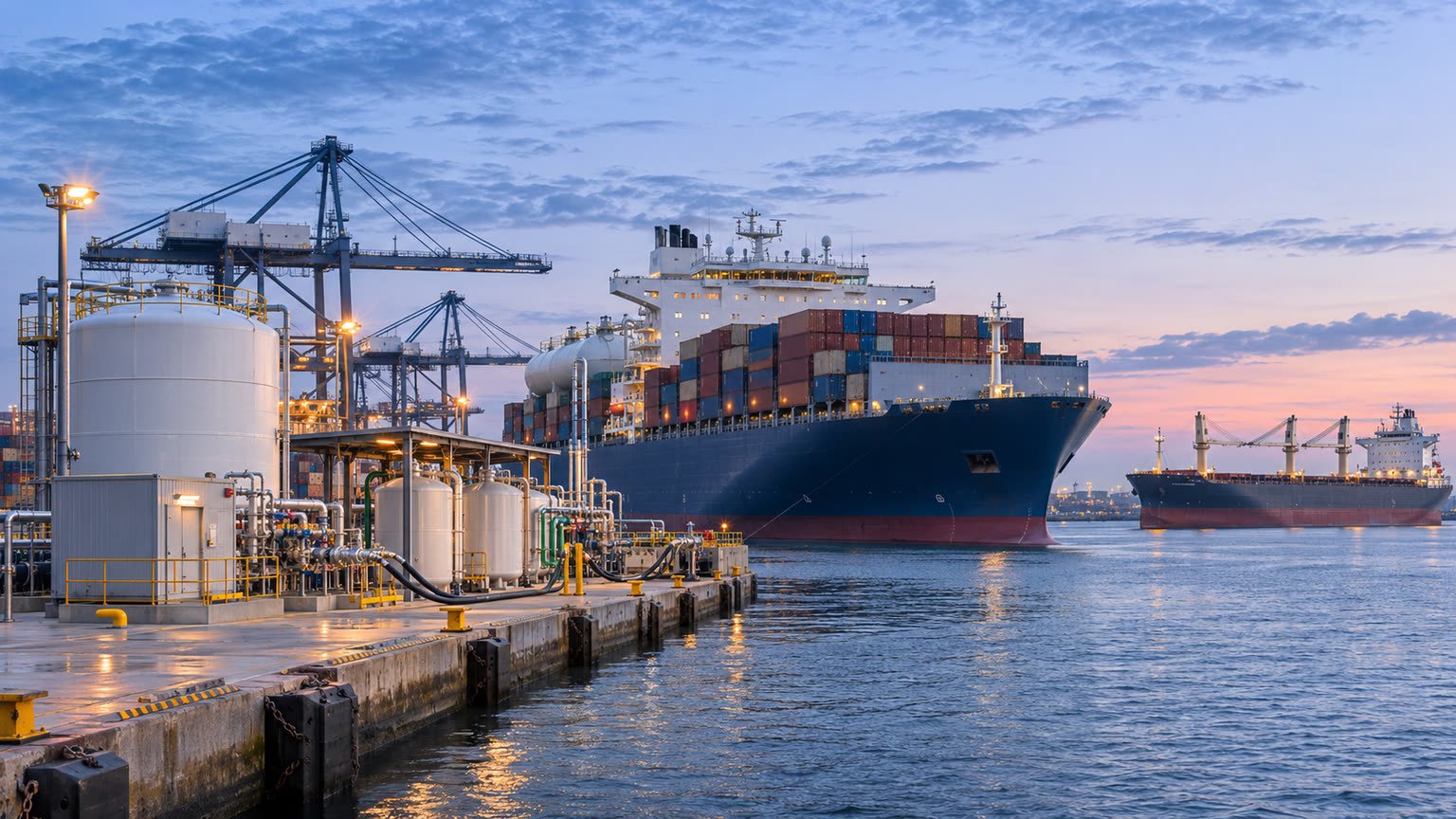
A new Lloyd’s Register global study says the merchant fleet is ordering alternative-fuel-capable ships faster than ports are building facilities to fuel them. The mismatch matters beyond shipping: fuel availability on a vessel’s route can affect freight costs, delivery reliability and how quickly lower-emission fuels reach global supply chains.
Key takeaways
- Lloyd’s Register said 1,942 alternative-fuel-capable vessels were on order in January 2026, equal to 47% of global orderbook tonnage.
- Its 2 Nov 2026 release counted LNG bunkering at 222 ports, compared with 25 ports actively offering methanol.
- Commercial ammonia bunkering had been recorded at only one port, Ulsan in South Korea, after an operation in April 2026.
- The transition is concentrated in Northern Europe, North Asia and Singapore, so a ship’s trade route matters as much as its engine capability.
What Lloyd’s Register found
In its Fuel for Thought: Ports report released on 2 Nov 2026, Lloyd’s Register said the shipping industry’s investment in alternative-fuel vessels is moving ahead of the shore-side network needed to supply them. The 1,942-vessel figure covers ships capable of using fuels such as LNG, methanol or ammonia that were on order in January 2026; the 47% share is measured by global orderbook tonnage, not by the number of ships already operating.
The gap is widest for newer fuels. The report identified 385 methanol-capable vessels and 45 ammonia-capable vessels on order, while active methanol bunkering was available at 25 ports and commercial ammonia bunkering had been recorded at one. Independent maritime outlet gCaptain reported the same figures on 2 Nov 2026, citing the Lloyd’s Register study.
That distinction is important. A vessel being technically able to burn a fuel does not mean the fuel can be bought on every route, at a predictable price or with the safety systems required for routine operations. Shipowners therefore have to match propulsion choices with the ports a vessel is actually expected to visit.
Why a ship order is not a fuel network
LNG has the strongest starting position. Lloyd’s Register’s 2 Nov 2026 summary said LNG bunkering was available at 222 ports, giving shipowners a wider operating map than they have for methanol or ammonia. That does not make LNG a zero-emission solution: the climate result depends on the fuel’s production, engine performance and methane leakage, including methane slip.
Methanol is further along than ammonia in commercial availability, but the 25-port network remains geographically narrow beside the number of methanol-capable ships being ordered. Ammonia is earlier still. The Ulsan operation shows that commercial handling is possible, yet one active location cannot support a global trading pattern without additional supply points, trained crews, emergency planning and clear permissions.
Biofuel blends offer a different route because many can use existing bunker equipment. Lloyd’s Register said its Fuel Oil Bunker Analysis and Advisory Service recorded drop-in biofuel deliveries at 90 ports worldwide in the 12 months before its 2 Nov 2026 release. But the 13 leading ports represented 77.5% of recorded quantities, showing that even the more deployable option is not evenly distributed.
Why this can matter to freight and fuel users
For cargo owners, the infrastructure gap creates a route-planning issue. A ship may need to carry conventional fuel as a fallback, make a special bunkering call, wait for supply or limit the routes on which its alternative-fuel capability can be used. Those choices can change operating costs and schedule resilience. The effect is a commercial possibility, not a forecast of an immediate global freight surcharge.
For households and road users, the link is indirect. Marine fuel is not the same as the petrol or diesel sold at a roadside station, and this report does not announce a pump-price change. But ships move crude, refined products, vehicles, machinery and consumer goods, so fuel availability and shipping efficiency can influence delivered costs over time. Readers can check current pump prices through live fuel prices and estimate a personal journey with the fuel-cost calculator.
The practical takeaway is to watch the full chain: port availability, fuel certification, safety readiness, route length and the price difference between the alternative fuel and conventional marine fuel. For a wider view of mobility and energy developments, readers can follow the latest FuelPrice news.
What happens next
Lloyd’s Register says ports do not need to prepare for every fuel at once. It recommends investment that follows credible demand, supported by named vessel programmes and green shipping corridors. That approach can reduce the risk of building expensive facilities that see little use, while giving shipowners more confidence that a new vessel can refuel where it works.
The next milestones are likely to be practical rather than symbolic: more ports moving from trials to routine supply, common safety and licensing frameworks, trained emergency-response teams and better information about fuel quality and carbon intensity. The report’s central warning is therefore about timing. New ships can be delivered years before a dependable fuel network exists for them.
Questions readers may have
Does alternative-fuel capable mean zero-emission?
No. It means the vessel is designed or equipped to use a fuel other than, or in addition to, conventional marine fuel. Actual emissions depend on the fuel’s source, the engine and how the fuel is handled and used.
Will this immediately change petrol or diesel prices?
No direct one-for-one change follows from the Lloyd’s Register report. Road-fuel prices also reflect crude markets, refining, taxes and local distribution. The near-term issue identified here is whether shipping can use lower-emission fuels reliably across trade routes without adding avoidable delays or costs.
For the global energy transition, the message is straightforward: ordering cleaner-capable ships is only one part of the change. Ports, fuel suppliers, regulators and shipowners must build the network that lets those ships use the fuel as intended.