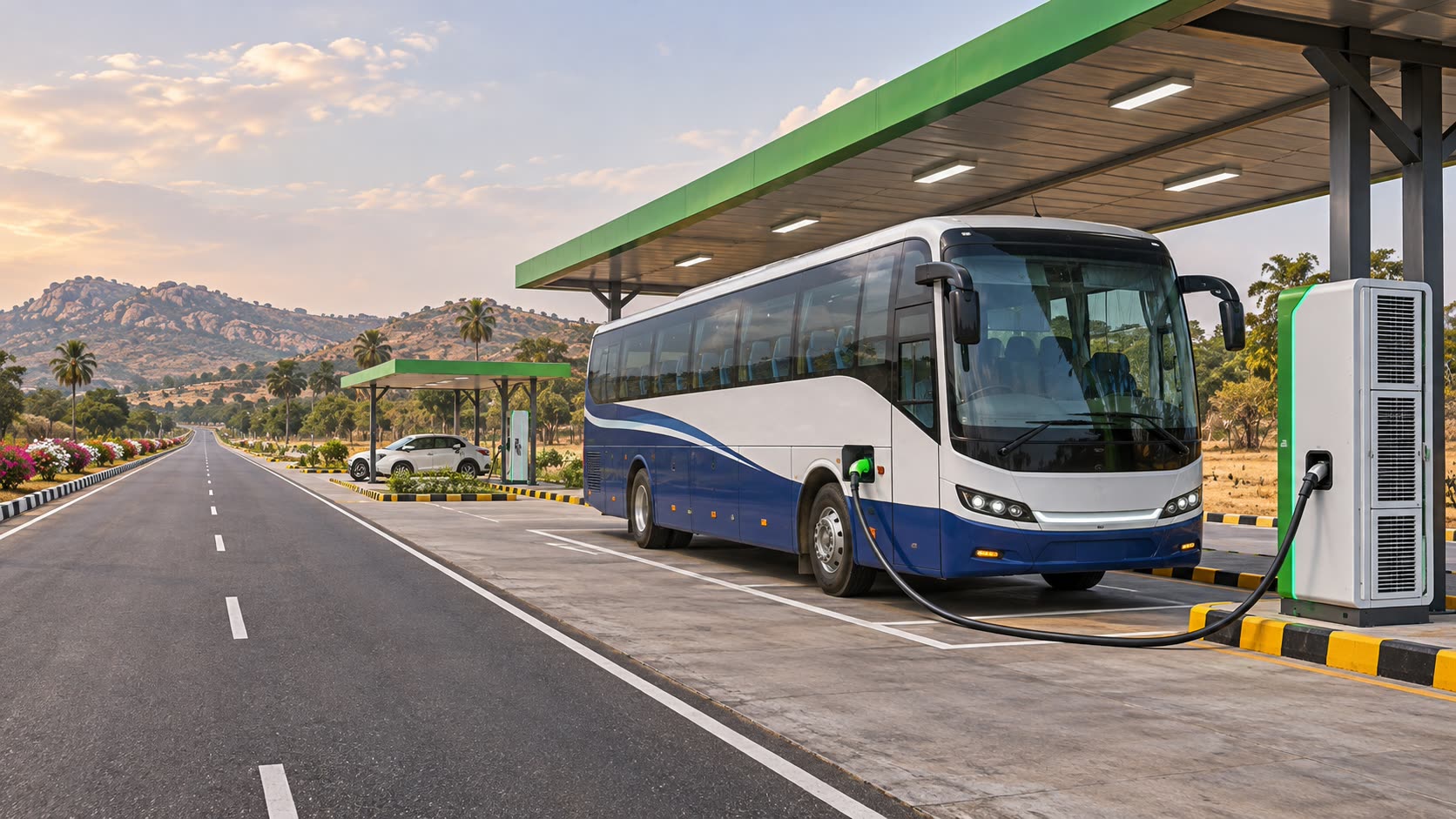
Atria Mobility has commissioned two 1.5 MW highway charging sites on the Bengaluru–Hyderabad NH 44 corridor for long-distance electric buses. The update matters to EV travellers because the same corridor also lists CCS2 fast-charging access for compatible passenger vehicles, although drivers still need to confirm the live location, connector and bay status before setting out.
Key takeaways
- Atria Mobility says two charging sites are operational on NH 44 between Bengaluru and Hyderabad.
- Each site has a 1.5 MW bus-charging bay; the operator also lists CCS2 DC fast charging for cars.
- The corridor is designed to support electric buses on journeys of more than 600 km, a distance that has traditionally required careful charging planning.
- Atria's site lists C K Palli and Kurnool as the live locations, while the independent commissioning report names the second site as Undavelly. Check the operator's live map before travelling.
- This is a charging-infrastructure update, not a change to petrol, diesel or toll charges.
What Atria Mobility has put into operation
Atria Mobility's live website says its first highway sites are operational on the Bengaluru–Hyderabad corridor and identifies two locations on NH 44. It lists C K Palli in Chennekothapalli, Andhra Pradesh, and a second site at Kurnool, Andhra Pradesh. Both entries show a 1.5 MW bus bay, CCS2 DC fast charging, round-the-clock staffing and basic traveller facilities such as restrooms, food and covered seating.
That location information needs a small but important qualification. EMobility+, in its 17 Nov 2026 commissioning report, described the two stations as CK Palli in Andhra Pradesh and Undavelly in Telangana. Because the two sources use different names for the second station, the operator's own live map and availability screen should be treated as the final reference for a trip. The mismatch does not change the broader confirmed point: two high-power sites are operating along the NH 44 Bengaluru–Hyderabad route.
Why a 1.5 MW bus charger matters
Long-distance electric buses face a different operating problem from private cars. A scheduled coach cannot easily absorb a long, uncertain charging stop without affecting passenger arrival times, crew hours and the next departure. The independent report says conventional charging stops can take materially longer than a normal passenger break and that longer routes have often been constrained by charging availability. A high-power en-route stop is intended to bring the charging window closer to an ordinary passenger break.
The sources describe the charging time slightly differently. Atria says a working charge for an intercity coach takes about 20 minutes, while EMobility+ reported a full charge in approximately 15 minutes. These are not necessarily the same measure: actual time depends on the battery's state of charge, pack size, temperature and the vehicle's charging system. The useful confirmed takeaway is the scale of the equipment and its purpose—supporting scheduled electric-bus operations beyond a city route.
Fresh Bus's own company release also described the Hyderabad–Bengaluru corridor as an early long-haul application for rapid-charging electric buses, supported by 1.5 MW charging infrastructure. That earlier announcement provides route context, while the Atria and EMobility+ material confirms the current highway charging deployment.
What it means for private EV drivers
The bus equipment does not mean a passenger car will charge at 1.5 MW. Atria's FAQ says the vehicle's own limit, battery condition and state of charge affect the power it can draw. For car owners, the immediate benefit is more practical: the sites are presented as highway stops with CCS2 DC charging, so compatible vehicles may have another option on this corridor rather than relying only on urban or depot chargers.
Compatibility and availability still matter. Before leaving, check the car's connector, the charger power it can accept, the operator's current price and whether the bay is online. Atria says bays are first come, first served and that the app shows live status. FuelPrice's EV charging directory can help with wider state-wise station planning, but the operator's own live status should be checked for this specific site.
What bus and fleet operators need to assess
For a fleet, a shorter and more predictable charging stop can improve timetable planning and vehicle utilisation. It does not by itself prove that an electric route will cost less than a diesel route. Operators still have to compare the charging tariff, demand charges where applicable, vehicle financing, battery warranty, driver schedule, passenger load and the availability of a backup stop if a bay is busy or offline.
The same distinction matters for logistics fleets. A charging corridor can remove one infrastructure constraint, but it does not remove the need to match the vehicle's battery, payload, route length and charging plan. The route's tolls and other trip costs should be assessed separately through the toll-charge calculator, while energy assumptions can be compared with a fuel-cost calculator for a diesel or petrol benchmark.
What to check before using the corridor
- Confirm the live station: use the operator's map or app immediately before departure because the two published sources differ on the second location's name.
- Match the connector: check that the vehicle can use the available CCS2 point and confirm the car's maximum DC charging rate.
- Allow a backup: do not plan the trip around a single bay without checking the next usable stop, especially for a time-sensitive journey.
- Separate the costs: include charging, tolls, parking and any detour in the trip estimate; a faster stop is not automatically a cheaper trip.
- Plan the return: verify the charging options in both directions rather than assuming the outbound stop will be available on the way back.
Drivers planning the full journey can also use the road-trip planner to review route stops and travel assumptions before departure.
What changes now and what to watch next
For the Bengaluru–Hyderabad corridor, the development moves high-power electric-bus charging from a proposed solution into an operating highway service. It may make long-distance electric-bus scheduling more practical and gives compatible passenger EVs another charging option. It should not be read as proof that every route in India now has equivalent coverage, or that every car will receive the same charging speed.
The next useful signals will be reliability, public availability for non-bus users and whether similar sites become operational on other intercity corridors. Atria says it is expanding beyond this first corridor, but future locations and commissioning dates should be treated as plans until the operator lists them as live. For now, the reader takeaway is simple: the infrastructure is a meaningful route-specific step, but an EV trip still depends on live status, connector fit and a backup plan.
Sources
- Atria Mobility — Charging every EV. Reliably. / live Bengaluru–Hyderabad corridor sites — accessed 17 Nov 2026
- Atria Mobility — FAQ: 1.5 MW bus charging, CCS2 access and live-site guidance — accessed 17 Nov 2026
- EMobility+ — Atria Mobility Commissions World’s First Megawatt-Scale EV Charging Corridor For 600+ Km Intercity Bus Travel — 17 Nov 2026
- CMV360 — Fresh Bus Launches Bengaluru-Hyderabad Electric Sleeper Bus Service — 17 Sep 2026
- Fresh Bus — India’s Long-Haul Travel Goes Electric: Fresh Bus and Exponent Energy Launch the First All-Sleeper Electric Bus Fleet with Rapid Charging — company release, accessed 17 Nov 2026