A Ludhiana District Consumer Disputes Redressal Commission has ordered Equitas Small Finance Bank and a vehicle-recovery yard operator to jointly pay ₹5 lakh after a truck was seized over dues linked to another vehicle, according to a Times of India report dated 17 Nov 2026. The case matters to commercial-vehicle borrowers because the commission found that the loan agreement did not permit repossession of the truck when instalments for that particular asset were being paid.
Key takeaways
- The Ludhiana commission’s order is dated 3 Nov 2026 and was reported by The Times of India on 17 Nov 2026.
- The commission ordered ₹5 lakh in joint compensation, payable within 30 days of the parties receiving the order.
- Delay can add ₹500 per day, subject to a maximum additional amount of ₹2 lakh, according to the reported order.
- The bank’s defence was that dues on another truck loan were linked to the borrower’s account; the commission said the repossession clause applied to the asset described in that loan agreement.
- The ruling is case-specific. It does not mean a lender loses the contractual right to recover a genuine default, but recovery still has to follow the agreement and lawful, non-coercive process.
What happened in the Ludhiana case
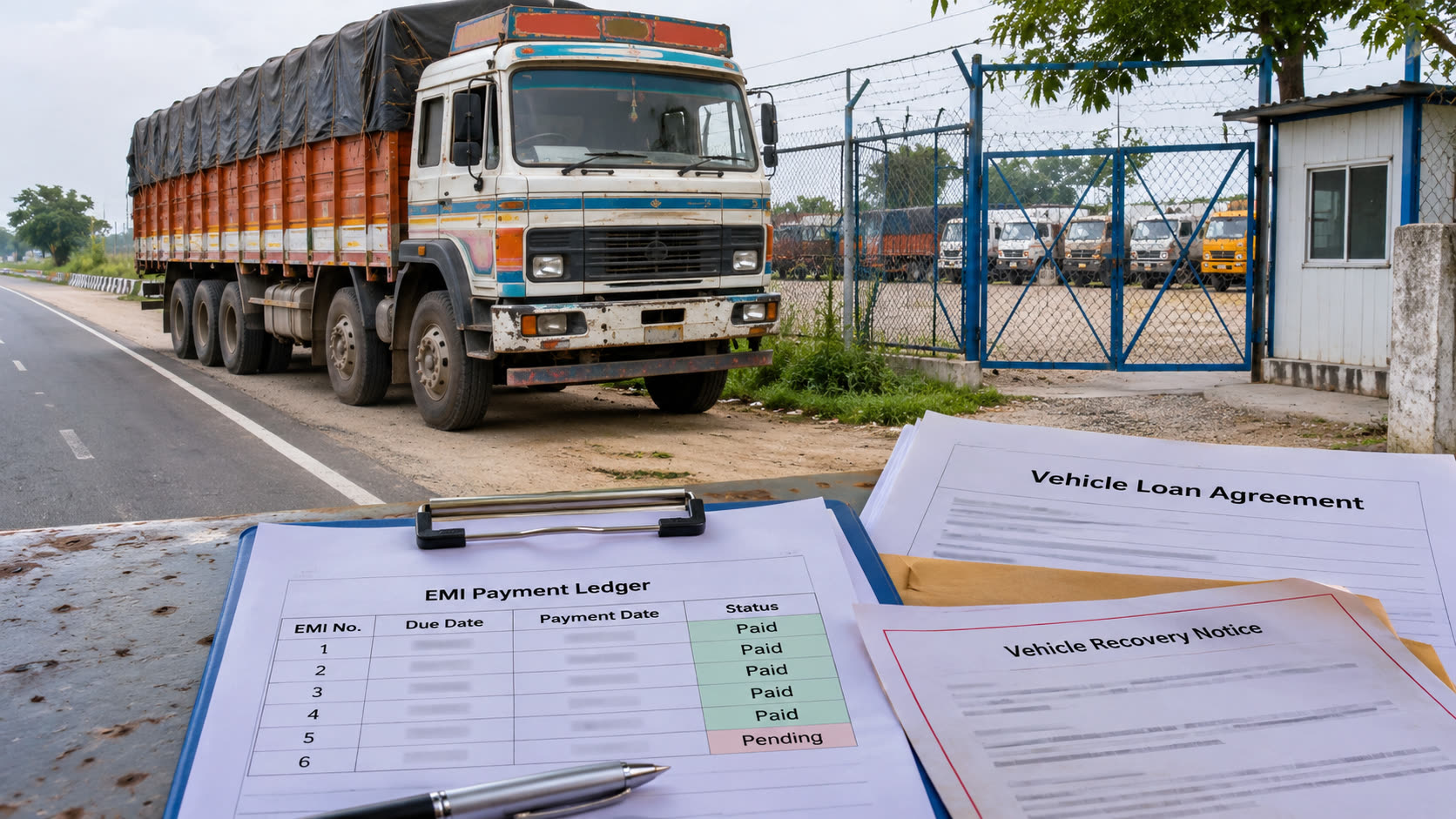
The report says the borrower took a ₹5.5 lakh loan from Equitas Small Finance Bank in January 2018 to buy a second-hand Tata 2518 truck. The loan was to be repaid in 63 monthly instalments, and the borrower said he had regularly paid the instalments for that vehicle until August 2021.
On 14 Sep 2021, while carrying goods from Ludhiana to Siliguri, the truck was stopped near Karnal and taken to a recovery yard. The borrower alleged that he showed payment records but the vehicle was still seized. He also alleged losses connected with diesel and missed freight work. Those allegations are reported claims in the case, not findings that need to be treated as independently established facts.
Equitas’s position, as described in the report, was that the borrower had defaulted on another truck loan of ₹10 lakh taken in July 2019. The bank said the other vehicle had been surrendered in March 2021, but its sale proceeds were not enough to clear the outstanding dues. Because the two loan accounts were linked to the same borrower, the bank argued that it could take the first truck as well. The yard operator said it had only provided parking space for vehicles brought by recovery agents.
Why the commission held the repossession improper
The commission examined the wording of the loan agreements and held that repossession, sale after possession and termination could be initiated only against the asset described in the relevant schedule. It found that the truck whose instalments were being paid was the hypothecated asset for that agreement, and that the bank had not proved the required default position for both accounts.
In other words, the dispute was not decided on the principle that a vehicle can never be repossessed. It turned on the connection between the particular asset, the payment record and the event of default written into the contract. The commission also held that the recovery-yard operator could not avoid responsibility simply by describing itself as a parking provider, because it had not produced an agreement showing that it was authorised to perform that role.
The order directed the bank and the yard operator, jointly and severally, to pay ₹5 lakh for financial loss, mental hardship and harassment. The amount was to be paid within 30 days of receiving a copy of the order. If payment is late, the report says the order adds ₹500 per day, capped at ₹2 lakh. No separate litigation-cost amount was awarded.
What the wider recovery-law context says
The ruling comes after repeated court warnings that a lender’s security interest is not a licence to use force. In a September 2026 Supreme Court ruling involving a commercial truck, the court said a financier’s contractual right to take possession must be balanced with notice, fairness and due process. The Supreme Court also directed the Reserve Bank of India to take steps to improve compliance with its recovery guidelines.
A separate Allahabad High Court order dated 26 Oct 2026 involved a linked loan account and a vehicle that the borrower said had been kept current. The court record said a repossession clause could be enforced through a court or an arbitrator, but not by private force. It directed the vehicle’s return while leaving the underlying account dispute open for the proper forum. That is a different case from the Ludhiana order, but it shows why linked-loan clauses and recovery-agent conduct are receiving close judicial scrutiny.
Equitas’s own published policy says its collection and repossession process is intended to be fair, transparent and lawful. It also says authorised representatives should identify themselves and show their authority letter when a borrower asks. The policy is the bank’s stated framework; the courts still decide whether conduct in a particular case complied with the contract and law.
What this means for fleet and truck operators
For a commercial vehicle, a disputed stoppage can affect more than the vehicle’s market value. It can interrupt a freight booking, leave cargo and fuel arrangements unsettled, and remove the asset that generates the next instalment. Operators assessing a missed run can use the fuel cost calculator to separate the direct fuel expense from the wider revenue impact, rather than treating the EMI as the only cost of a stoppage.
Route costs can also continue to matter when a vehicle is diverted, delayed or moved between yards. The toll charge calculator can help estimate the toll component of a planned freight route; it does not calculate compensation or decide a loan dispute.
Records that matter in a disputed recovery action
The case points to a basic documentary trail for any commercial-vehicle loan dispute. The relevant records include the loan agreement and asset schedule, the vehicle registration details, instalment receipts or bank statements, notices issued by the lender, the latest loan-account statement, and the identity and authority details of any recovery agent. A dated inventory of the vehicle and its contents can also matter when possession changes.
Where a borrower has more than one loan with the same lender, the clauses worth reading closely are the provisions on cross-collateralisation, guarantors, linked accounts, events of default and the specific asset that secures each facility. Those clauses do not override court orders or lawful recovery standards, but they can determine what the lender says it is entitled to do and what a commission or court must examine.
What the order changes now
For the parties in this case, the immediate change is the compensation direction and the payment timetable. For other borrowers, the order is a reminder to keep payment records and to distinguish a dispute over one vehicle from an alleged default on another. It is not a new nationwide RBI rule, and it does not cancel valid loan terms.
The useful takeaway is precision: a lender may have remedies when a borrower defaults, but the asset, account, notice and recovery method still matter. A commercial vehicle is often the borrower’s working tool as well as security for the loan, which is why courts continue to examine whether repossession followed the contract and due process rather than treating seizure as an automatic remedy.
Sources
- The Times of India — “Truck owner keeps paying EMIs, but bank seizes vehicle over default on another loan; consumer commission holds bank and parking yard liable, orders Rs 5 lakh compensation” — 17 Nov 2026
- Allahabad High Court — WRIC No. 36407 of 2026, Sadab Ahmad v. State of U.P. and Others — 26 Oct 2026
- The Indian Express — “Banks, NBFCs cannot use force to seize vehicles in loan default cases: Supreme Court” — 17 Sep 2026
- Equitas Small Finance Bank — “Policy on Collection of Dues and Repossession of Security” — accessed 17 Nov 2026
This article is for general information only and is not financial, insurance or legal advice.