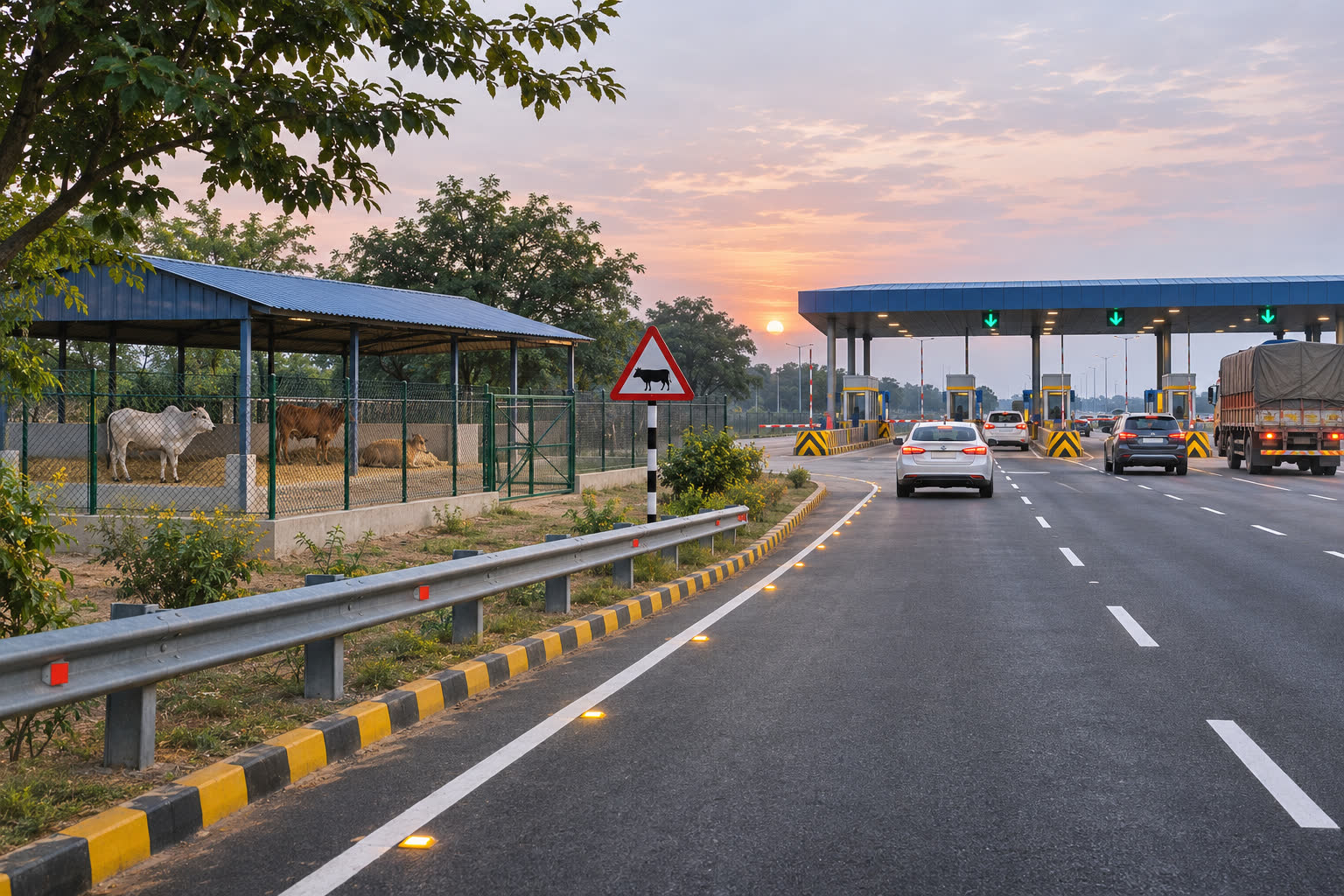
According to The New Indian Express's report from the hearing, the Supreme Court on 17 Nov 2026 asked the National Highways Authority of India (NHAI) to consider setting up shelters for stray cattle near toll plazas and suggested that the authority contribute through its corporate social responsibility (CSR) funds. For people using national highways, this is a fresh safety discussion—not a new toll, FASTag or nationwide shelter programme already in force.
The hearing followed an NHAI application seeking clarity on how the court's earlier directions for removing stray cattle and other animals from highways should be implemented. The immediate reader takeaway is that the court is pressing for a workable safety mechanism, while the roles of NHAI, state governments and local authorities are still being worked out.
Key takeaways
- The Supreme Court has asked NHAI to consider supporting cattle shelters near toll plazas, including through CSR contributions.
- The suggestion is not an announcement that shelters will be built at every toll plaza or that a new toll rule has started.
- The court's earlier highway-safety directions call for removal of stray animals, relocation to suitable shelters and continuous response arrangements.
- Drivers should continue to treat cattle on high-speed roads as an active hazard, especially in darkness, fog and low-visibility conditions.
- The NHAI application will be discussed with the court-appointed amicus, with the matter posted for a further hearing in January 2027.
What happened in the Supreme Court hearing
A bench of Justices Vikram Nath, Sandeep Mehta and N V Anjaria was hearing NHAI's request for clarification. NHAI's side said the authority faces practical difficulties because it does not acquire land for animal shelters and argued that state governments should have the primary responsibility for constructing such facilities.
The bench's response was narrower than a direction to fund a nationwide network. It said the court had not asked NHAI to bear the entire cost and suggested that the authority contribute from its CSR corpus towards shelters for cattle found on roads. The court's focus was the safety consequence: cattle entering a high-speed carriageway can create a sudden collision risk for cars, buses, trucks and, particularly, two-wheelers.
The Solicitor General sought time to discuss a legally and practically workable solution with amicus curiae Gaurav Agarwal. The bench asked the amicus to file a response and posted the matter for January 2027. That means the proposal remains under consideration; motorists should not assume that a shelter, removal team or new warning system is already operating at every toll plaza.
What is already required on national highways
The court's official 19 May 2026 judgment had already placed a wider coordination task on highway and state authorities. It directed the relevant authorities, including NHAI, to identify stretches where stray cattle or other animals are frequently found, remove them from the road and relocate them to appropriate shelters, gaushalas or cattle pounds with food, water and veterinary care.
The same judgment also called for dedicated highway patrol teams or existing road-safety units to respond to animals obstructing the carriageway. It said helpline numbers should be displayed at regular intervals on national and state highways and expressways, with links to local police, NHAI and district control rooms. The court's May directions therefore cover more than the construction of a shelter: they also point to detection, removal, reporting and monitoring.
That distinction matters for drivers. A shelter near a toll plaza could provide a practical holding location, but it will not by itself prevent cattle from reaching a road. Safe transport, regular patrols, fencing or other local measures, prompt response and action against repeated releases may all be needed. The court's current hearing is about making those responsibilities workable.
What this means for drivers and fleet operators
There is no immediate change to toll rates, FASTag deductions or the way a motorist crosses a fee plaza because of this hearing. The practical change is awareness: a well-lit toll plaza or a divided highway does not guarantee that animals will be absent from the approach road. Drivers should reduce speed when visibility drops, keep a safe following distance and avoid sudden swerves if an animal appears.
For a long trip, the FuelPrice road-trip planner can help organise the route and likely stopping points. It is useful to review the route before departure rather than treating a toll plaza as the only safety checkpoint.
Where a route includes several fee plazas, use the toll-charge calculator to estimate the toll component separately. The Supreme Court hearing does not revise those charges, so a displayed or calculated toll remains a different question from the safety measures being discussed.
Fuel is another separate cost. A route's distance, traffic and repeated slowdowns can affect consumption, so the fuel cost calculator can be used alongside the toll estimate when planning a car, bus or truck journey.
What to watch next
The next meaningful update should clarify whether NHAI will make a limited CSR contribution, how states and local bodies would provide land and shelters, and which agency would handle animals picked up from a particular highway stretch. It should also show whether the court accepts a shared model rather than placing the entire operational burden on one authority.
Until that process produces a further order or an official implementation notice, the proposal should be described as expected or under consideration. It is not evidence that every toll plaza will receive a cattle shelter, and it does not replace the existing responsibility of authorities to keep highways safe and respond to animals already on the road.
Reader takeaway
The court's intervention connects toll-plaza infrastructure with a problem that starts before the toll lane: stray cattle can turn an otherwise routine highway trip into a sudden braking or swerving event. Watch for official safety notices on the route, use any displayed helpline to report an obstruction, and slow down near known animal-prone stretches—particularly after dark and during fog.