Autocar India's 5 Oct 2026 real-world test took the Bajaj Chetak C2501 86.5 km in Sport mode, while Bajaj's official product page lists a 113 km IDC range. For a buyer, the useful reading is not that one number replaces the other: the test shows how riding mode, traffic and battery reserve can bring an electric scooter's usable distance below its certified figure.
Key takeaways
- Autocar India recorded 86.5 km in a Sport-mode test through mixed South Mumbai riding conditions in its report published 5 Oct 2026.
- Bajaj's official Chetak page, accessed 5 Oct 2026, lists a 2.5 kWh battery and 113 km IDC range; IDC is a certified test figure, not a universal owner-range promise.
- The 5 Oct 2026 Autocar test reported 34.6 km/kWh efficiency. At that rate, an illustrative 30 km day would use about 0.87 kWh before charging losses.
- Team-BHP's 17 Jan 2026 review described around 95 km as a believable real-world range but said it had not completed a formal full-range test, underlining the effect of test conditions.
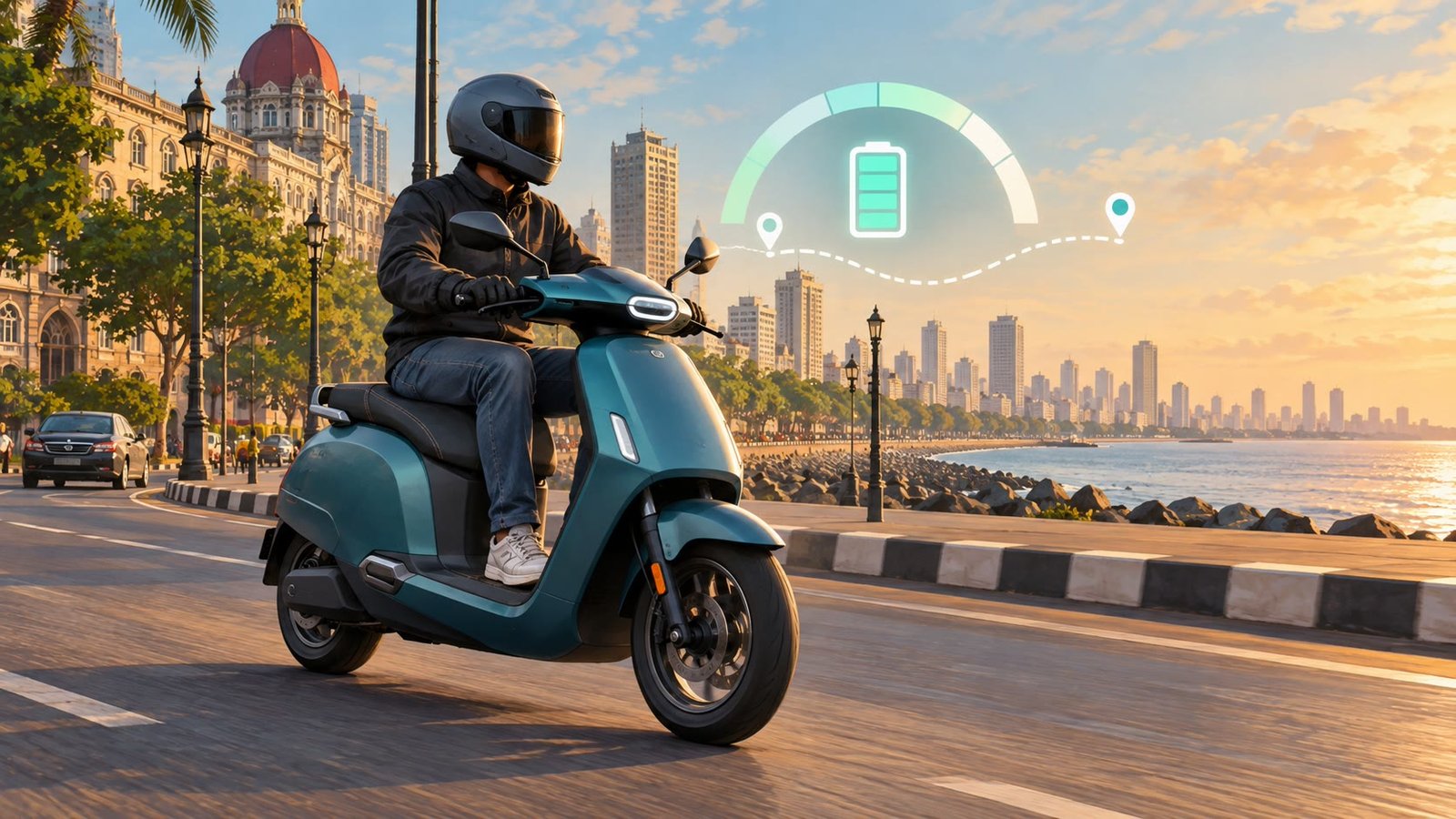
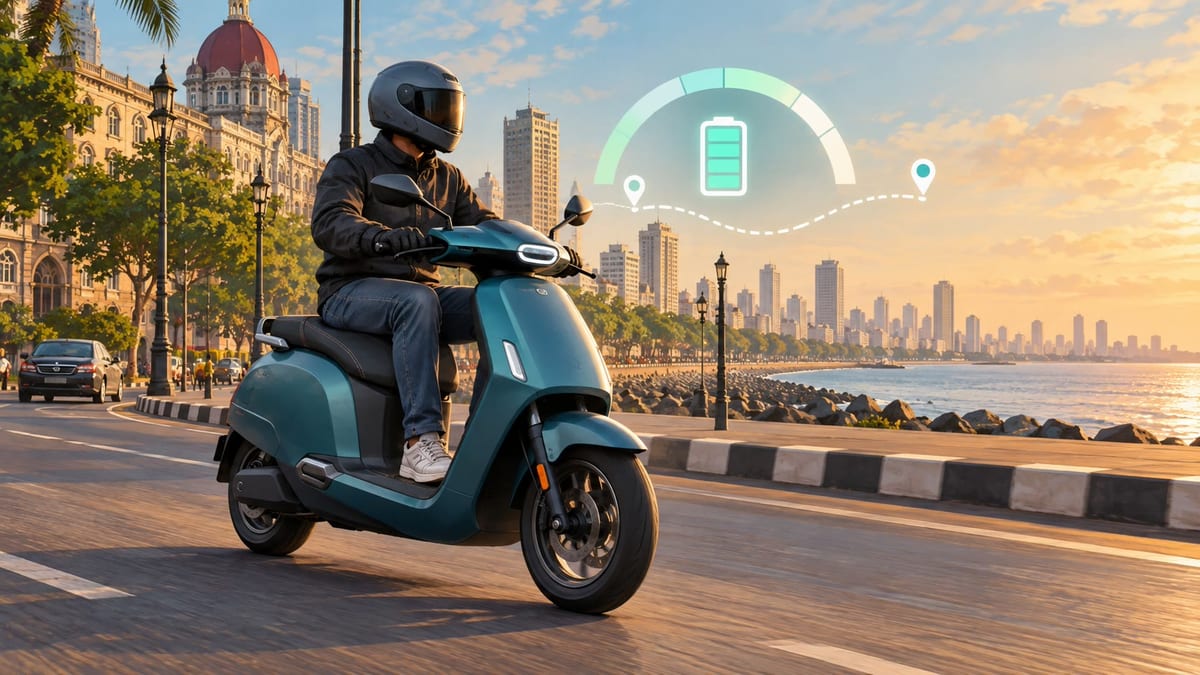 Illustrative range-test visual; this is not a photograph of the Bajaj Chetak C2501. Image: FuelPrice editorial illustration.
What the 5 October range test found
Autocar India's 5 Oct 2026 report says it ran the test in Sport mode on a loop through South Mumbai, using a mix of road and riding conditions. The scooter started fully charged with the range indicator showing 112 km. After a little over 52 km, the battery reading had fallen to 40 percent. The test vehicle entered a reduced-performance limp mode at about 5 percent battery, and the test ended at 86.5 km after the display had reached zero.
That result should be read as a single independent test, not as a warranty of how every C2501 will perform. In the same 5 Oct 2026 report, Autocar said the scooter returned 34.6 km/kWh efficiency and that the 750W charger took 3 hours 18 minutes to go from empty to full in its test. The exact result can move with speed, traffic, temperature, tyre pressure, rider weight, gradients and how much battery reserve a rider is willing to use.
| Measure | Figure | Source and context |
|---|---|---|
| Certified IDC range | 113 km | Bajaj Chetak product page, accessed 5 Oct 2026 |
| Battery capacity | 2.5 kWh | Bajaj Chetak product page, accessed 5 Oct 2026 |
| Sport-mode test distance | 86.5 km | Autocar India test, published 5 Oct 2026 |
| Measured efficiency | 34.6 km/kWh | Autocar India test, published 5 Oct 2026 |
| Official 0–80 percent charging time | 2 hours 25 minutes | Bajaj Chetak product page, accessed 5 Oct 2026 |
Why the 113 km claim and 86.5 km test can both be true
The 113 km figure is the manufacturer's IDC range shown on the Chetak C2501 product page. Certified-cycle figures allow like-for-like comparison between vehicles, but they are not a promise that an owner will see the same distance in daily traffic. Bajaj's own product information says actual range depends on riding conditions.
The fresh test covered 86.5 km, which is 26.5 km below the listed IDC figure, or about 23.5 percent lower when calculated from the 5 Oct 2026 Bajaj listing and the 5 Oct 2026 Autocar report. That gap is meaningful for planning, but it is still not a fixed correction factor for every rider. Autocar kept the scooter in Sport mode for the test, while a rider who uses more Eco mode, carries less load or travels at lower speeds may see a different result.
An earlier Team-BHP review published on 17 Jan 2026 called around 95 km a believable real-world range for the Chetak C25/C2501, while also noting that it had not conducted a proper full-range test. Its estimate sits between the official cycle figure and Autocar's Sport-mode result, which is a useful reminder that test method matters as much as the headline range.
What the result means for daily running cost
Autocar's 5 Oct 2026 figure of 34.6 km/kWh gives a practical way to translate range into electricity use. For example, a rider covering 30 km in a day would consume about 0.87 kWh at that measured efficiency, calculated before charging losses. The rupee cost depends on the local electricity tariff and whether charging is done at home or through a paid public point, so a national cost figure would be misleading.
For a petrol-scooter comparison, use the current petrol price and the vehicle's observed mileage rather than comparing one scooter's claimed range with another vehicle's tank distance. FuelPrice's fuel-cost calculator can help make that comparison with the reader's own city price and daily distance.
Checks for a Chetak C2501 buyer
The first check is the distance that must be covered between reliable charging opportunities. A routine commute that fits comfortably inside the lower test result leaves more room for traffic detours and battery reserve than one planned around the 113 km IDC figure. That is a planning distinction, not a recommendation to buy or avoid the scooter.
The second check is the equipment and charging setup. Bajaj's product page, accessed 5 Oct 2026, lists Eco and Sport modes with TecPac, so a buyer should confirm which features and mode access are included in the quoted variant. The same page lists 0–80 percent charging in 2 hours 25 minutes; actual time can vary with the charger, battery state and conditions.
For longer city or intercity journeys, check the route and charging options before leaving. FuelPrice's state-wise EV charging directory can help locate public charging points, while the road-trip planner can be used to map distance and stops. Public charger availability and waiting time should be treated as separate from the scooter's laboratory range.
What to watch next
The next useful evidence will be more independent tests under different modes and longer-term owner logs. Until then, the most defensible conclusion is narrow: the Chetak C2501's 113 km IDC figure describes the certified claim, while Autocar's 86.5 km Sport-mode result is a fresh real-world benchmark from one route and one test vehicle.
For Indian commuters, the takeaway is to size the daily trip against the lower practical figure, keep a charging buffer, and calculate electricity cost using the tariff that actually applies at home or at the chosen charging point. That turns a headline range into a more realistic ownership check.