India's Unified Bharat e-Charge platform will not move to a nationwide rollout yet, with the Ministry of Heavy Industries keeping it in a five-region pilot after early transaction failures. The Hindu BusinessLine reported on 29 Nov 2026 that only 9 of 148 attempts recorded between 3 and 13 Sep ended as completed charging sessions, a result that matters to EV drivers expecting one interface to work across charging networks.
Key takeaways
- The national expansion is being held back until reliability problems in the pilot are addressed, according to the latest report.
- The reported pilot covers Maharashtra, Karnataka, Delhi-NCR, Haryana and Rajasthan, with around 12 charging network operators onboard.
- Moneycontrol's earlier data showed 9 completed sessions from 148 attempts between 3 and 13 Sep; that small sample is not a measure of India's entire public-charging network.
- EV drivers should still verify operator coverage, connector compatibility, live availability and a fallback payment or charging option before a long trip.
What the rollout delay means
The Hindu BusinessLine's 29 Nov 2026 report says the Ministry of Heavy Industries will not take Unified Bharat e-Charge nationwide until issues found during pilot testing are resolved. The platform remains limited to five reported regions: Maharashtra, Karnataka, Delhi-NCR, Haryana and Rajasthan. Around 12 charging network operators are onboard, but the report does not give a date for a wider rollout.
That is a material change from the earlier expansion plan. FuelPrice's earlier Bharat e-Charge update described the Centre's intention to expand beyond the five-region pilot as the network became more robust. The new development is that reliability has become the condition for expansion, rather than a nationwide launch being treated as an immediate next step.
For drivers, the practical message is simple: being listed in a common interface does not yet mean every public charger is available through it, or that a charging session will complete without a problem. Drivers outside the pilot should not assume that the platform can replace every operator's app or payment route. The EV charging directory can help locate charging options, but the selected operator's own live status and access rules still need to be checked.
Why the pilot's conversion rate matters
Moneycontrol reported on 21 Sep 2026 that the platform recorded 148 transaction attempts between 3 and 13 Sep, of which only 9 became completed charging sessions. That is a completion rate of about 6.1% in the reported sample. The outlet also cautioned that the number of transactions was too small to judge the platform's overall performance, so it should be read as an early warning about the user journey, not as a national charger-success rate.
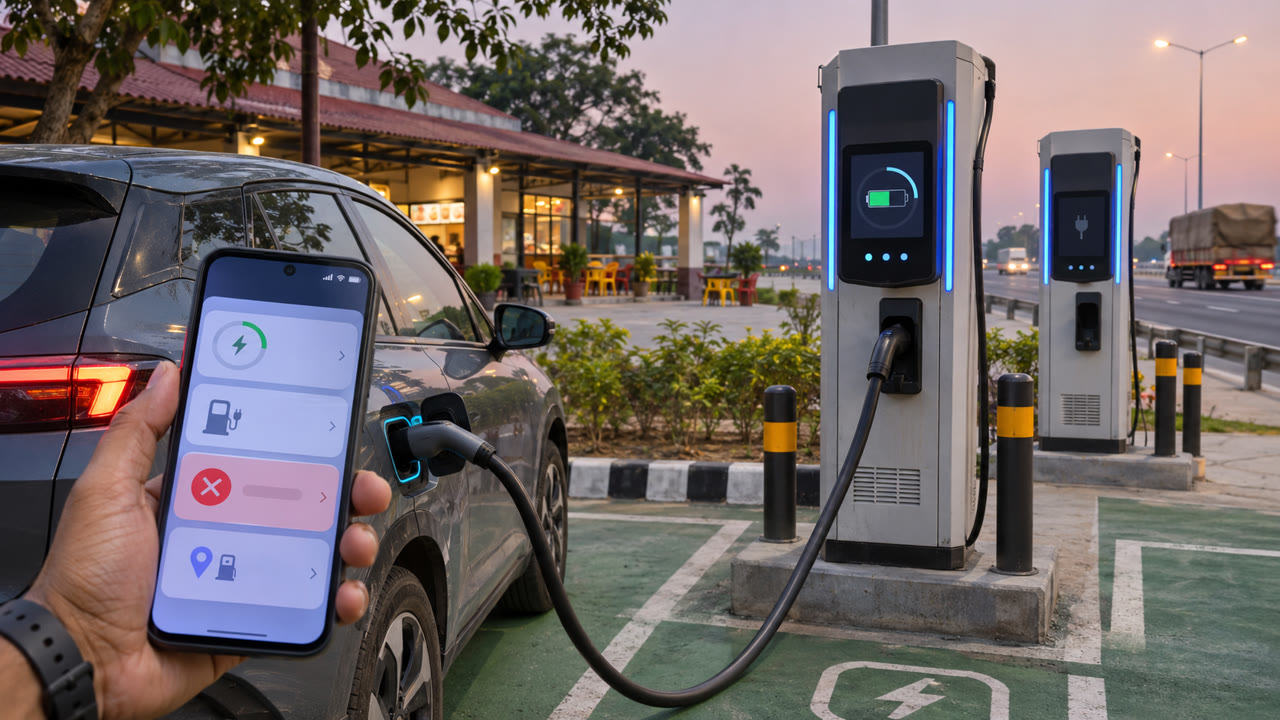
Moneycontrol's report also recorded cancellations and no-shows linked to chargers not working, incompatible connectors, power cuts and difficulty identifying the charging gun. The latest BusinessLine report points to the same type of operational friction. These details show why interoperability is not only a payment problem: a driver needs the charger to be discoverable, reachable, technically compatible and operational at the moment of use.
One app cannot fix a broken charging session
The Ministry of Heavy Industries' 12 May 2026 PIB release described Unified Bharat e-Charge as a single trusted interface through which EV users could discover, access and pay across multiple charging networks. The digital layer can reduce app switching, but it cannot by itself repair a faulty charger, restore a power supply or resolve a connector mismatch. The pilot's reported failures therefore matter because they test the complete session, not just whether a charger appears on a map.
The same PIB release said ₹2,000 crore had been earmarked under PM E-DRIVE for public EV charging infrastructure. That makes the pilot relevant beyond one app: as more public charging capacity is supported, drivers need the discovery and payment layer to reflect real-world availability. A common platform that shows a charger but cannot reliably start or complete the session would leave the main trip-planning problem unresolved.
What EV drivers should check now
- Confirm coverage. Check whether the chosen station and its operator are actually supported in the app or service being used. Participation by around 12 operators does not mean every charger in India is covered.
- Check the physical fit. Verify the connector type, charging capability and current availability before setting the route. A listed location is not a guarantee that the required gun is free or working.
- Keep a fallback. Carry the relevant operator app or payment method where available, and note another charging stop rather than relying on one untested location.
- Plan the journey around stops. Use the road-trip planner to map the trip and leave room for an alternate stop if the first charging attempt fails.
What to watch next
The next useful update will be a clear Ministry of Heavy Industries timeline or set of conditions for moving beyond the pilot, along with evidence that completed sessions improve. Moneycontrol reported in September that officials were considering access through Google Pay, PhonePe and Paytm in addition to BHIM, while the latest BusinessLine report still describes BHIM as the access route. Wider payment access may reduce one source of friction, but charger uptime, accurate status data and connector compatibility will decide whether the platform works on an actual inter-city trip.
Until a nationwide rollout date is officially announced, EV owners should treat Bharat e-Charge as a developing pilot rather than a guaranteed single-app charging network. The immediate reader takeaway is to verify the specific station and keep an alternative ready, especially when the trip depends on reaching the next reliable charging point.
Sources
- The Hindu BusinessLine — EV charging interoperability push hits hurdles; MHI delays Bharat e-Charge national rollout (29 Nov 2026)
- Moneycontrol — Government to expand digital payment options for unified EV charging platform (21 Sep 2026)
- Open Magazine — One App to Find and Pay for EV Charging? Seven Things to Know About Bharat e-Charge (20 Nov 2026)
- Press Information Bureau, Ministry of Heavy Industries — Prime Minister Modi's EV Vision Gains Momentum: HD Kumaraswamy Announces ₹123.26 Crore EV Charging Boost for Karnataka, Bengaluru Hosts National EV Charging Conference (12 May 2026)