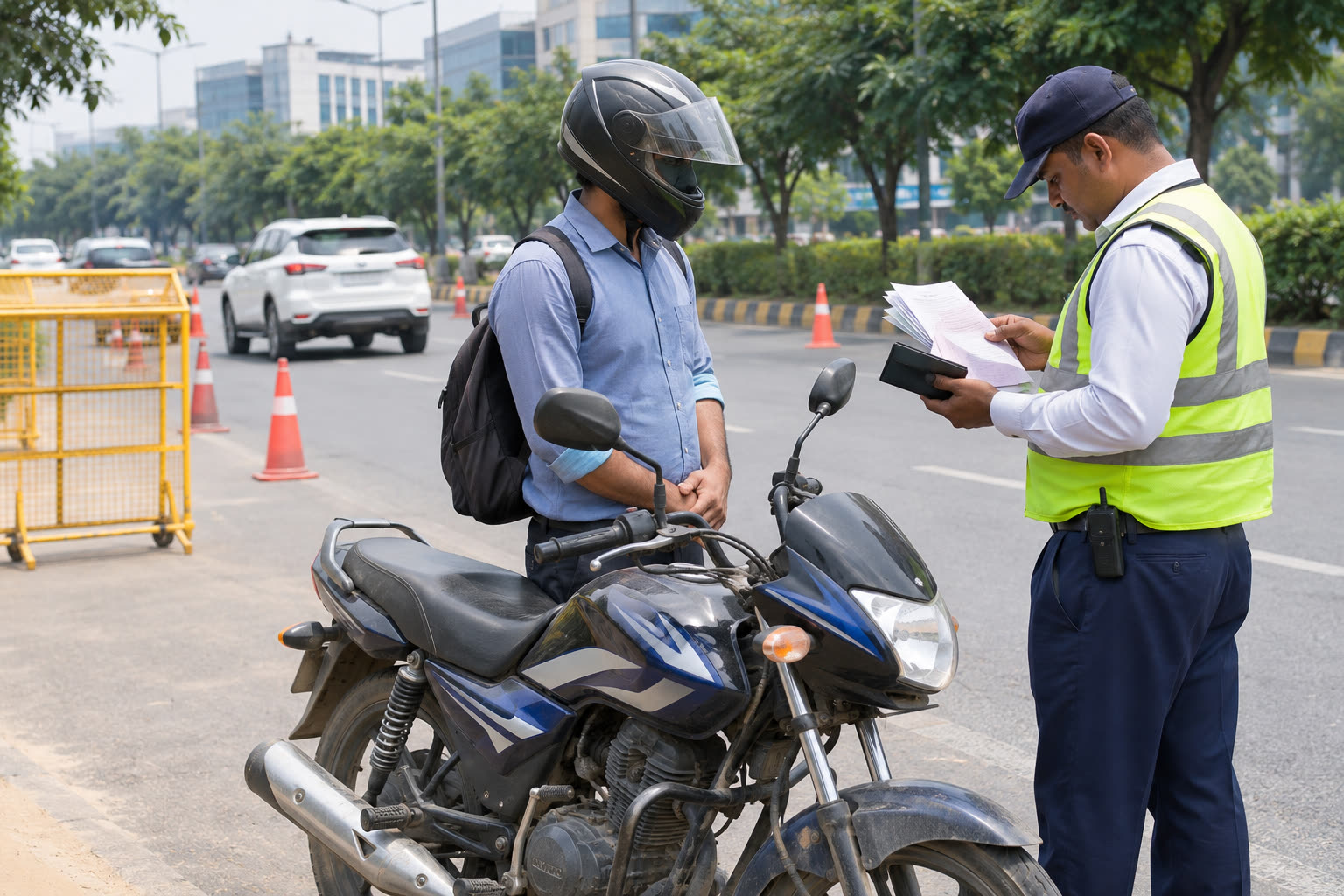
Gurugram Traffic Police impounded a motorcycle after finding 47 pending traffic challans worth ₹1,20,000 during a check near Wazirabad Chowk on Friday, 27 Nov 2026. The incident matters to riders because the police said the major violations included riding without a helmet and without valid vehicle insurance, while the rider could not produce the requested documents.
The action was reported by PTI and also described in a post from the official Gurugram Traffic Police account. It is a specific enforcement case, not an announcement of a new city-wide fine schedule. But it shows how unresolved challans and missing vehicle papers can become a problem during a routine stop.
Key takeaways
- Police reported 47 pending challans with a combined value of ₹1,20,000 on one motorcycle checked near Wazirabad Chowk on 27 Nov 2026.
- The major violations cited were helmet non-compliance and driving without valid vehicle insurance, among other offences.
- The rider could not produce the required vehicle documents, and the motorcycle was moved to a designated storage facility.
- Central rules now provide a process to pay or contest a challan online and allow vehicle detention in specified circumstances, subject to court orders.
What happened near Wazirabad Chowk
According to the police account carried by PTI, a traffic team led by Wazirabad Chowk zonal officer ASI Yudhvir stopped the motorcycle during a checking operation on 27 Nov 2026. A record check showed 47 outstanding challans carrying a combined penalty of ₹1,20,000. The police said the rider was unable to provide the requested vehicle-related documents, after which the motorcycle was impounded and parked at a designated facility.
The total works out to roughly ₹2,553 per challan on average, calculated from the police-reported ₹1,20,000 divided by 47. That is only an average: individual challan amounts depend on the offence and the applicable rule, so it should not be read as a standard rate for a particular violation.
The report says the major violations included riding without a helmet and driving without valid insurance, but it does not say that every one of the 47 challans was issued for those two reasons. Riders should therefore treat the case as a reminder to review their complete record rather than assume that one type of violation explains the entire balance.
Why insurance and documents matter
Section 146 of the Motor Vehicles Act, 1988 requires a motor vehicle used in a public place to have an insurance policy that meets the requirements of the Act. This is the statutory third-party liability requirement; it is separate from optional own-damage protection and other add-ons. The differences between third-party, own-damage and personal-accident cover are explained in this motor insurance cover guide.
A valid insurance certificate is only one part of a rider’s document set. The registration certificate, driving licence and pollution certificate can also matter during enforcement, depending on what is being checked. A rider whose policy has expired should not assume that an old certificate, a renewal payment screenshot or a policy quotation is the same as an active policy certificate.
For a broader explanation of the consequences of driving without required motor cover, readers can review FuelPrice’s motor insurance penalty rules guide. The relevant cover and penalty position can depend on the vehicle, the offence and the applicable state enforcement process.
What the current e-challan rules say
The Central Motor Vehicles (Third Amendment) Rules, 2026, notified by the Ministry of Road Transport and Highways on 20 Jan 2026 and published in the Gazette on 21 Jan 2026, set out a digital process for challans. Under Rule 167, a vehicle owner generally gets 45 days from issue to accept and pay the challan or contest it on the portal with documentary evidence.
If a challan is not contested within that 45-day period, the rules treat it as accepted. The amount is then to be paid within the next 30 days. If the prescribed steps are still not taken, applications relating to the driving licence or vehicle registration can be held and the vehicle can be flagged on the portal until the challan is disposed of. Rule 167(13) also allows an authorised officer to detain a vehicle involved in a violation, subject to orders of the court.
The same Gazette adds five or more offences or contraventions in a one-year period beginning 1 Jan 2026 as a ground under Rule 21 for licensing-authority action. The Gurugram report does not provide the dates of all 47 challans, so it would be wrong to conclude from the number alone that a licence-disqualification process applies in this case.
What riders can check before the next ride
- Insurance status: Confirm the policy’s active period and keep the current certificate accessible. Check the policy number and vehicle registration against the vehicle record.
- Challan record: Review the official e-challan record for the vehicle and separate paid, disputed and unpaid entries. Keep payment receipts and any contest documents.
- Core documents: Check that the registration certificate, driving licence and pollution certificate details match the motorcycle and the person using it.
- Helmet and equipment: Use a properly fastened helmet that meets the applicable safety requirement. The Gurugram case specifically identified helmet-related violations among the major offences.
- Before a longer trip: Complete the document check before departure, then use the road-trip planner to organise the route and stops.
What this case does not mean
The 27 Nov 2026 action does not, by itself, create a new universal ₹1,20,000 penalty for riders or make every unpaid challan an automatic seizure. The amount was the combined balance recorded against one motorcycle, and the impoundment followed the police’s account of that vehicle’s documents and pending violations.
The practical lesson is narrower and more useful: an outstanding challan record should not be left unchecked, and an active insurance certificate and basic vehicle documents should be available before riding. Resolving or contesting an entry through the prescribed channel is different from ignoring it until a roadside inspection.
Reader takeaway
For Indian riders, the Gurugram case is a document-check story as much as a challan story. Checking insurance validity, helmet compliance and e-challan records takes less time than dealing with an impounded vehicle, but the reported ₹1,20,000 balance should not be treated as a standard penalty or a new rule.
Sources
- Gurugram Traffic Police — Motorcycle impounded at Wazirabad Chowk with 47 pending challans — 27 Nov 2026
- The Tribune / PTI — Gurugram biker’s motorcycle impounded over 47 unpaid challans worth Rs 1.2 lakh — 28 Nov 2026
- Gazette of India, Ministry of Road Transport and Highways — Central Motor Vehicles (Third Amendment) Rules, 2026, G.S.R. 48(E) — 21 Jan 2026
- India Code — The Motor Vehicles Act, 1988, Section 146 — current text accessed 29 Nov 2026
This article is for general information only and is not financial, insurance or legal advice.