Reports published on 3 November 2026 say Bolt.Earth has commissioned a reported 1.5 MW electric-vehicle charging station at P Qube Solutions near NH-16 Cross in Nunna, Vijayawada, Andhra Pradesh. The site is designed for cars, trucks, buses, two-wheelers and three-wheelers, giving intercity EV users a new high-capacity stop on the corridor, although tariffs, operating hours and live availability have not been published in the reports reviewed.
Key takeaways
- The reported station is at P Qube Solutions near NH-16 Cross in Nunna, Vijayawada.
- Its announced site capacity is 1.5 MW, with high-power DC chargers aimed at cars, trucks and buses.
- The listed equipment also includes charging options for electric two-wheelers and three-wheelers.
- The 1.5 MW figure should not be read as a promise that every vehicle will charge at that speed; the vehicle, connector and site load-management system still matter.
- Drivers should check current access, pricing, connector compatibility and charger status before making a detour.
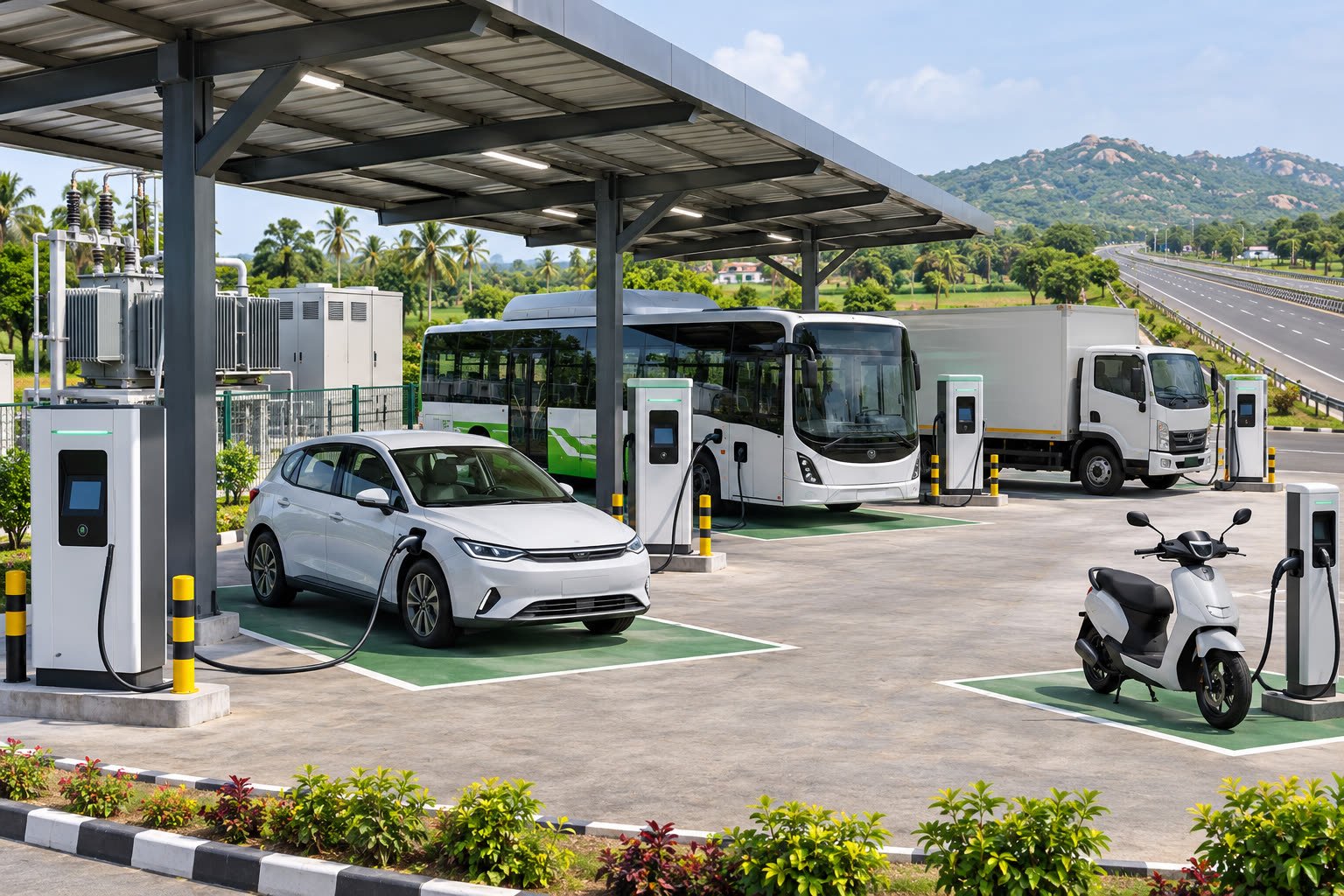
Image note: The hero is an illustrative editorial visual of a multi-vehicle EV charging hub; it is not a photograph of the reported Vijayawada facility.
What changed in Vijayawada
Autocar Professional reported that Bolt.Earth commissioned the facility at P Qube Solutions to serve local charging demand as well as intercity traffic along the highway corridor. A separate report from Entrepreneurs News Room described the same installation as an inauguration and carried the company's description of it as Andhra Pradesh's largest EV charging station.
The “largest” wording should be treated as a company claim rather than an independently audited state-wide ranking. Neither report publishes a comparison with every public charging site in Andhra Pradesh. The more useful confirmed detail for drivers is the location and the mix of charging hardware: the station is positioned near NH-16 and is intended to handle several vehicle categories at one site.
That matters because a highway charging stop has a different job from a low-power charger in a residential parking area. A passenger-car driver may need a predictable DC top-up during a long trip, while a bus, delivery truck or shared-mobility vehicle needs a site that can handle larger batteries and repeated use. The reported layout tries to cover both use cases, but the public reports do not say whether every bay is open to every vehicle at all times.
Reported charger mix
The two 3 November reports list the following equipment. The ratings are the stated maximum power of the charger or socket, not a guarantee of the power that a particular vehicle will draw.
| Vehicle use | Reported equipment | What it is intended to support |
|---|---|---|
| Cars, trucks and buses | Two 240 kW DC chargers | High-power DC charging |
| Cars, trucks and buses | Three 180 kW DC chargers | High-power DC charging |
| Cars, trucks and buses | One 60 kW DC charger | DC charging at a lower rating |
| Three-wheelers | One 6 kW fast charger | Dedicated smaller-EV charging |
| Two-wheelers | Two 3 kW DC fast chargers | Dedicated smaller-EV charging |
| Two- and three-wheelers | Four 3.3 kW AC sockets | AC top-ups |
What the 1.5 MW headline means for EV users
The announced 1.5 MW figure describes the station's headline capacity. It does not mean a passenger EV will accept 1.5 MW, or that a 240 kW charger will always deliver 240 kW from the first minute to the last. Charging power is constrained by the vehicle's maximum DC input, battery temperature, state of charge, connector compatibility and the station's power allocation when several vehicles are connected.
There is also a useful distinction between total site capacity and individual charger ratings. The reports call the project a 1.5 MW station while separately listing named chargers and sockets with lower combined ratings. They do not explain whether the headline includes electrical infrastructure, unlisted equipment or managed capacity. Until Bolt.Earth or P Qube Solutions publishes a technical specification, a driver should use the 1.5 MW figure to understand the scale of the site, not to calculate a guaranteed charging time.
For a route planner, the practical question is whether the charger matches the vehicle. A car with a lower DC limit will not charge faster simply because the bay is rated at 180 kW or 240 kW. Conversely, a fleet vehicle may need a bay that can accommodate its dimensions, connector and dwell time. These checks are more important than the headline number when estimating a stop.
Why the NH-16 location matters
Nunna's position near NH-16 gives the project a corridor angle rather than a purely city-only one. A station that can serve multiple EV categories may help drivers who are travelling through Vijayawada, while the same site could support local commercial vehicles between scheduled runs. The benefit will depend on road access, turning space, queue management and whether the chargers are operational when a vehicle arrives.
The reports do not publish a tariff, payment method, opening hours, reservation rule or uptime record. They also do not identify the connector standard for each listed unit. That means an EV owner should not assume that the station is a suitable stop solely because the power rating looks high. Check the latest listing in the operator's app or a current state-wise EV charging directory, then confirm that the connector and vehicle category match.
What drivers and fleet operators should check now
- Compatibility: confirm the connector type and the vehicle's maximum AC or DC input before setting the route.
- Access: check whether the bay is reachable from the intended carriageway and whether a bus or truck can enter and exit without a tight turn.
- Cost: wait for the current tariff and any session or parking fee before estimating the rupee cost of a charge.
- Time: use the vehicle maker's charging curve and expected state of charge; the charger's maximum rating alone is not a time estimate.
- Backup: keep an alternative charging stop in the plan in case the station is busy, offline or unsuitable for the vehicle.
For longer journeys, the road-trip planner can help compare route distance and travel time, while the toll-charge calculator can keep highway fees separate from the charging budget. Those estimates should be updated with live station status and the operator's current tariff before departure.
What to watch next
The next useful update will be operational detail: the station's public opening status, pricing, connector list, access directions and live availability. A later update may also show whether the site attracts passenger EVs, electric buses and freight vehicles in meaningful numbers, or whether different vehicle groups need separate booking and queue arrangements.
For now, the Vijayawada installation is a confirmed infrastructure deployment reported by two outlets, with a company-stated 1.5 MW capacity and a broad vehicle mix. It expands the charging option set near NH-16, but it does not by itself guarantee a faster or cheaper trip. The reader benefit is to know what is reported, what remains unconfirmed and which checks prevent a wasted detour.