The Commission for Air Quality Management (CAQM) has removed exemptions for older goods vehicles from Delhi-NCR’s strictest GRAP stages, according to a 29 Sep 2026 report by Hindustan Times. For fleet operators, the practical message is to recheck a vehicle’s category, emission standard and route before sending it into Delhi when Stage III or Stage IV actions are invoked.
Key takeaways
- The reported change removes the earlier essential-goods relief for light and medium goods vehicles under GRAP Stage III.
- Under Stage IV, the change covers trucks and heavy goods vehicles that would previously have relied on an exemption.
- CAQM’s official Direction 88 sets 31 Oct 2026 as the end of the transition for BS-IV commercial goods vehicles entering Delhi from outside the city.
- BS-VI diesel, CNG, LNG and electric goods vehicles remain the cleaner-compliance categories identified in the official framework.
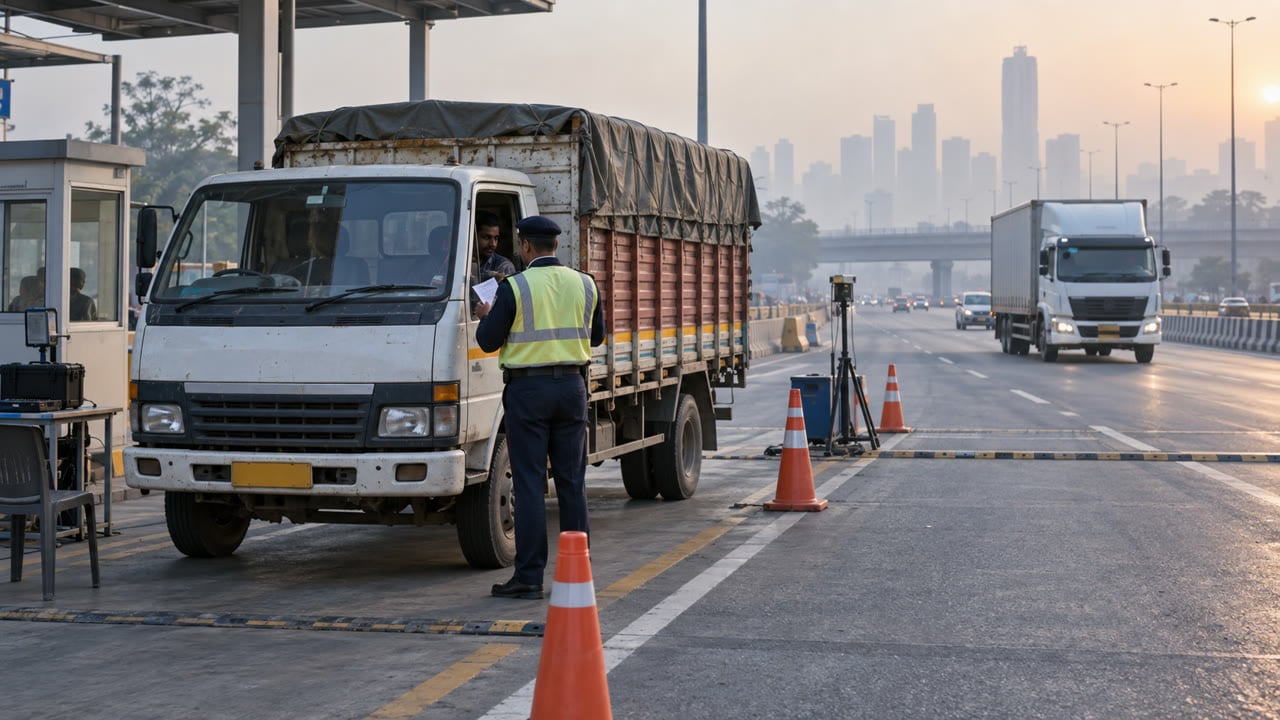
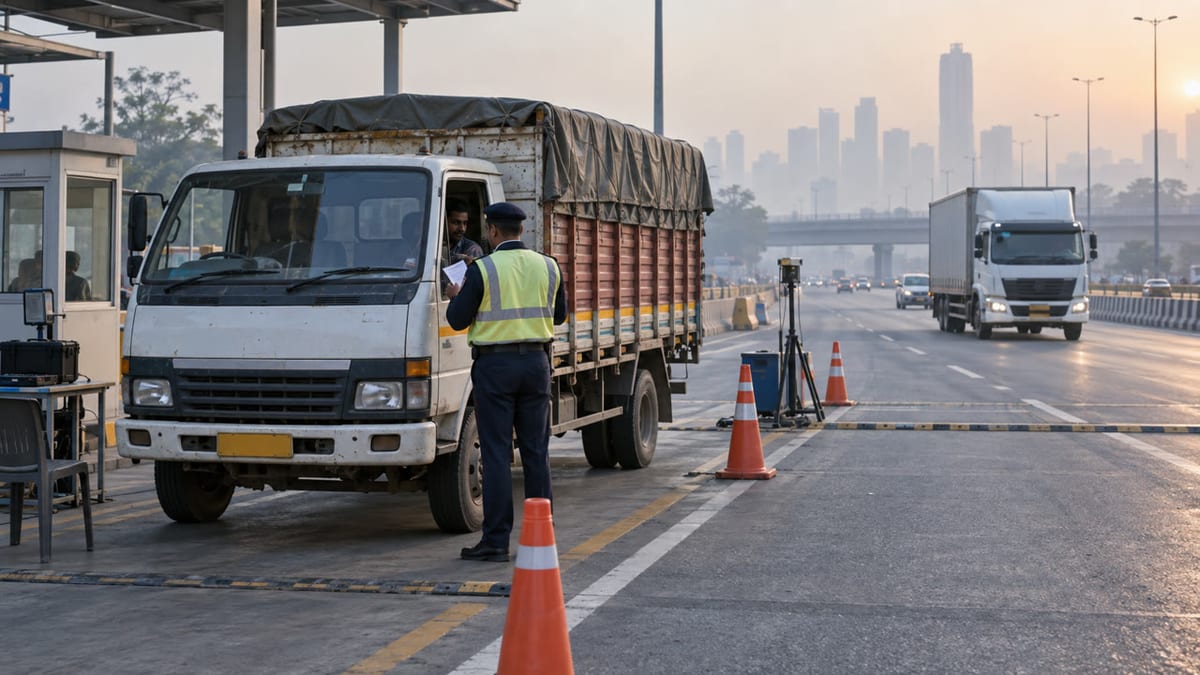 FuelPrice illustration, AI-generated representative visual; not an official enforcement photograph.
What CAQM’s reported change means
Hindustan Times reported on 29 Sep 2026 that CAQM’s Full Commission approved a revised GRAP schedule at its Monday meeting. The report says the schedule now removes the exemption for light and medium goods vehicles (LGVs and MGVs) at Stage III, and for trucks and heavy goods vehicles (HGVs) at Stage IV, including vehicles carrying essential commodities.
That distinction matters because GRAP restrictions are triggered by air-quality conditions and official invocation, not by a fixed daily calendar. A goods vehicle that is allowed to operate during normal conditions can face a different entry or plying rule when the relevant stage is announced. The update therefore affects dispatch planning, delivery windows and the choice of vehicle assigned to an NCR route.
The report also says the revised schedule has 48 actions across the four stages: 25 under Stage I, eight under Stage II, 10 under Stage III and five under Stage IV. Those figures describe the structure of the schedule; they do not mean that all 48 measures apply to every vehicle at the same time.
Why 31 October 2026 is an important checkpoint
CAQM’s existing framework already points to a tighter baseline. In an official 17 Oct 2025 release, the regulator said it had amended Direction 88 to restrict entry into Delhi of commercial goods vehicles other than BS-VI, CNG, LNG and electric vehicles from 1 Nov 2025, with BS-IV LGVs, MGVs and HGVs allowed as a transitional measure until 31 Oct 2026.
That means the reported GRAP change and the annual direction work together. Before 31 Oct 2026, an operator of an older goods vehicle may have had a limited transition under Direction 88, but the reported Stage III or Stage IV restriction can remove the practical benefit of an essential-goods exemption when those stages are active. From 1 Nov 2026, the separate transition described in Direction 88 is scheduled to end for BS-IV commercial goods vehicles entering Delhi from outside the city.
CAQM’s official GRAP schedule classifies Stage III as “Severe” and Stage IV as “Severe+”. The Commission’s November 2025 schedule is the reference point for the stage structure, while the latest invocation or enforcement order should be checked before each affected trip.
Who should treat this as an immediate planning issue
- Fleet and transport operators: map every Delhi-bound vehicle by LGV, MGV or HGV category, registration location, fuel type and Bharat Stage certification.
- Distributors carrying essential goods: do not assume that the cargo description alone guarantees entry once the revised strict-stage restrictions are invoked.
- Delivery and service contractors: check whether a scheduled trip crosses Delhi’s border or only uses roads within another NCR district, because the applicable direction can depend on the vehicle and location.
- Small operators using older diesel vehicles: build a contingency around an eligible cleaner vehicle, a permitted hand-off point or a different delivery window rather than relying on a last-minute border decision.
What to check before a Delhi-NCR trip
- Confirm the vehicle’s registration state, goods-vehicle category and BS emission standard from the registration and fleet records.
- Check the latest CAQM or local enforcement notice for the stage in force and whether the planned entry point is covered.
- Separate the vehicle rule from the cargo rule. Carrying an essential commodity may not restore an exemption under the reported stricter stages.
- Review the route in the road-trip planner and compare any longer alternative with the fuel cost calculator.
- If a cleaner electric vehicle is being considered for a route, check the relevant state-wise EV charging directory and confirm that charging capacity suits the vehicle and load.
What it could mean for trip costs and supply chains
The immediate cost is not a new toll or fuel levy. It is the risk of a rejected, delayed or rerouted movement. An alternative corridor can add kilometres, driver time, fuel use and toll charges, so operators should compare the full trip cost rather than looking only at the road distance. The toll-charge calculator can help compare a changed route where toll plazas are involved.
For consumers, this is not a blanket restriction on every private car. The reported update is focused on commercial goods vehicles under GRAP stages, while separate directions may apply to other vehicle categories. For vehicle makers and fleet buyers, the direction adds to the pressure to shift commercial fleets towards BS-VI, CNG, LNG and electric options, although actual replacement timing will depend on route economics, financing and charging or refuelling access.
What to watch next
The current change is reported by Hindustan Times; the CAQM online schedule and the official 2025 Direction 88 records establish the underlying categories and transition dates. Operators should look for the updated CAQM schedule or a stage-specific enforcement order before treating the reported revision as a live, route-wide ban. The next fixed date to monitor is 31 Oct 2026, when the official transition for BS-IV commercial goods vehicles is scheduled to end.
Reader takeaway: before dispatching an older goods vehicle into Delhi-NCR, check the vehicle class, emission standard, registration location, current GRAP stage and the exact border or corridor being used. A valid route plan should include a compliant backup vehicle or a costed alternative route.
This article is for general information only and is not financial, insurance or legal advice.
Sources
- Hindustan Times — “Older goods vehicles lose GRAP exemptions in Delhi-NCR as CAQM revises air curbs” — 29 Sep 2026
- Press Information Bureau / CAQM — “CAQM reviews preparedness to Check Air Pollution during the Upcoming Winter Season” — 17 Oct 2025
- CAQM — “Revised Graded Response Action Plan (GRAP) for NCR November, 2025” — 21 Nov 2025
- Press Information Bureau / CAQM — “CAQM revises GRAP schedule, making it more stringent to Prevent further Deterioration of Air Quality in Delhi-NCR” — 22 Nov 2025