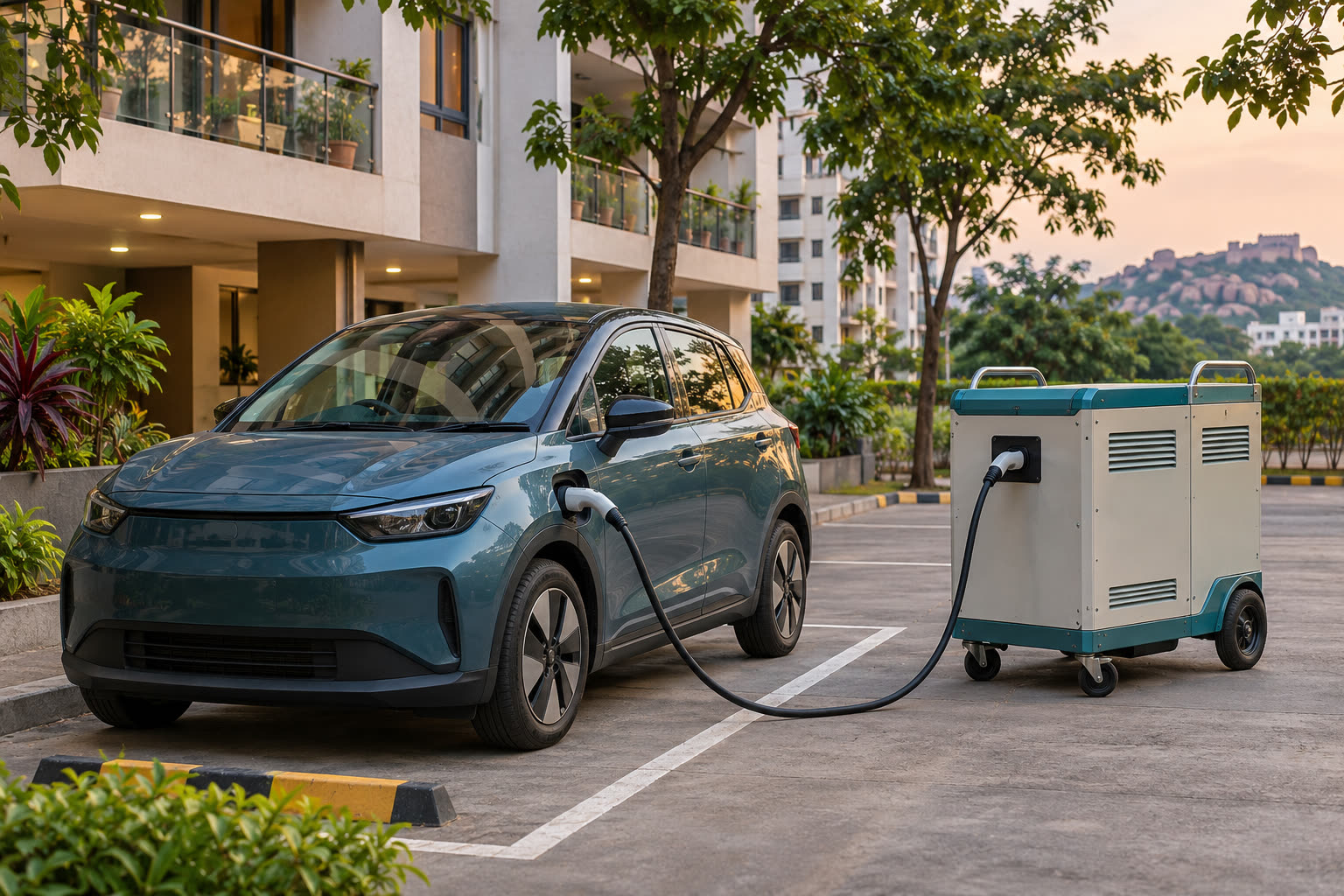
Charger on Wheels says it will begin doorstep DC fast-charging services in Hyderabad in November 2026, with the first rollout planned across agreed Aparna Constructions residential projects. The reported plan matters to EV owners in apartment communities where parking, wiring and transformer capacity can make a fixed home charger difficult to install—but Hyderabad drivers should treat it as an announced rollout, not proof that the service is already open across the city.
Key takeaways
- Two reports dated 12 Nov 2026 say the Gurugram-based company will bring bookable, self-powered mobile charging units to Hyderabad residential projects this month.
- Those reports describe a unit with a 92 kWh battery-storage system, a 60 kW DC charger and dual CCS2 connectors that can charge two vehicles at the same time.
- Charger on Wheels has also started physical incubation at T-Works in Hyderabad, with demonstrations reported at the ISB and IGBC offices.
- The company is targeting more than 70 mobile charging units by March 2027; that is a stated goal, not a count of units already operating.
- Availability, pricing, booking hours and the first project list have not been published in the reports, so the rollout should not be treated as city-wide access.
What Charger on Wheels has announced
TimesTech and Energetica India, in separate reports published on 12 Nov 2026, said Charger on Wheels is set to launch doorstep EV charging in Hyderabad during November. The service uses mobile, self-powered equipment that is brought to a parked vehicle instead of requiring the driver to travel to a fixed charging station.
The Hyderabad plan is tied to a business collaboration with Aparna Constructions and Estates. The reports say charging services will be rolled out across agreed Aparna projects, allowing residents to request a session without installing an individual fixed charger. That wording is important: the announcement covers the partner projects named in the plan, not every apartment complex or every public parking area in Hyderabad.
The company’s own website currently lists Gurugram as live and Hyderabad as “Soon”. It also describes the service as app-scheduled mobile charging that works with CCS2 and Type 2 connections. That supports the direction of the announcement, while also confirming that Hyderabad availability should be checked before a driver relies on it.
What the mobile unit can do
In their 12 Nov 2026 coverage, TimesTech and Energetica India described the latest unit as having a 92 kWh battery-storage system and a 60 kW DC fast charger with dual CCS2 connectors. The reports say the setup can serve two vehicles simultaneously.
The 60 kW figure is the charger’s rated output, not a guaranteed charging speed for every car. A vehicle’s own maximum DC input, its battery state of charge, temperature, connector compatibility and the power shared between vehicles can all affect the energy delivered in a session. Drivers should therefore compare the unit’s connector and quoted service conditions with the vehicle manual rather than assume that every car will charge at the headline rating.
Mobile charging also does not remove the need for safe parking, an available booking slot and an operator who can position the equipment correctly. It is a flexible way to add charging where a fixed installation is difficult; it is not the same as a permanent public charging station with guaranteed round-the-clock access.
Why apartment communities are the target
Many apartment developments were built before EV ownership became a routine planning issue. A society may need to allocate parking bays, route cables through a basement, upgrade electrical equipment or decide how energy use is metered between residents. Those decisions can take time, especially when several residents want chargers but the building has limited electrical capacity.
Charger on Wheels is presenting a mobile battery-backed unit as a way to serve vehicles without first carrying out the full fixed-charger installation. The approach could be useful for residents who have a suitable parking arrangement but no dedicated wall box. It may also give a developer or residents’ welfare association a way to test demand before committing to permanent infrastructure.
That benefit remains conditional. The company and its partners still need to disclose which projects are included, how residents book a slot, what happens during peak demand and how the service is priced. Until those details are available, the announcement is best understood as an additional charging option being introduced in stages.
What Hyderabad EV owners should check
- Project eligibility: confirm whether the service is available at the driver’s society or only at the agreed Aparna projects. “Hyderabad rollout” does not by itself mean every neighbourhood is covered.
- Connector and vehicle limits: the reports describe dual CCS2 connectors, while the company website also lists Type 2 compatibility. Check the exact connector, charging power and vehicle limit before booking.
- Price and session terms: the 12 Nov reports do not state a public tariff, minimum booking, cancellation rule or any separate access fee. Ask for the final amount and the energy or time basis before the session starts.
- Operating window: confirm the booking hours, expected arrival time and support process. A mobile service is useful only if it can reach the vehicle when the driver needs it.
- Trip backup: keep a fixed-station option in the plan for a longer journey. The state-wise EV charging directory can help identify alternatives, but drivers should confirm live status, connector type, opening hours and pricing with the operator.
What it means for EV trips and fleets
For a Hyderabad resident, doorstep charging could reduce the need for a detour to a public station when the vehicle is parked at home or in a managed residential complex. For an EV fleet, a mobile unit may be useful for overflow charging or locations where permanent electrical work is not yet ready. Neither use case guarantees a lower charging bill or faster turnaround; the result will depend on the booking schedule, energy tariff and vehicle demand.
The service is also local in its announced form. It should not be read as evidence that a Hyderabad-to-other-city corridor has gained new fast-charging coverage. Drivers planning an inter-city trip can use the road-trip planner to compare time and stops, then verify each charging point independently before leaving.
What to watch next
The next useful update would identify the first residential projects, publish booking and pricing details, and state when the service is open to non-residents or other fleet customers. Those details will show whether the model is a limited partner rollout or a wider Hyderabad service.
In reports dated 12 Nov 2026, the company also said it aims to deploy more than 70 mobile charging units by March 2027. That target could expand the usefulness of the model if units are placed across several cities, but it should not be confused with commissioned or available chargers today.
Reader takeaway
Charger on Wheels’ Hyderabad announcement is relevant mainly to EV owners who lack a practical fixed charger in an apartment setting. The company’s website still marks Hyderabad as “Soon”, so the sensible next step is to verify project coverage, connector compatibility, booking terms and the backup charging route before depending on the service.