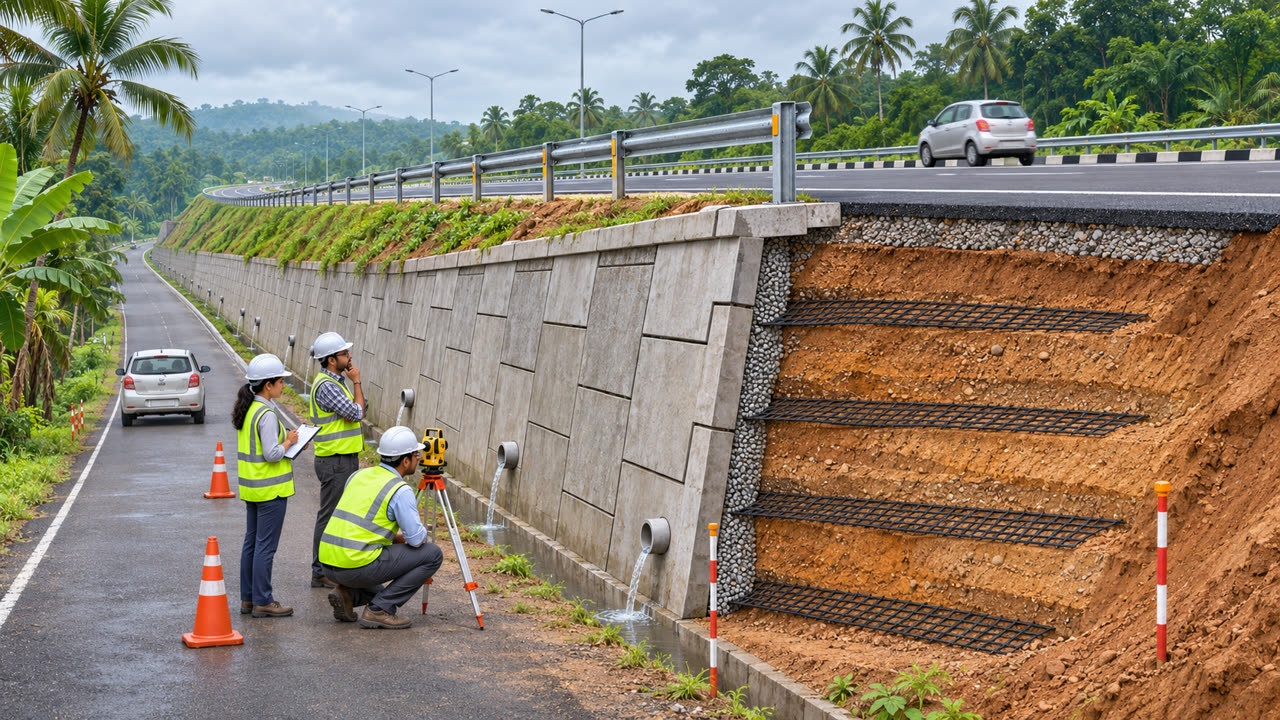
Fresh reporting on Kerala’s NH-66 says an expert review had flagged 351 reinforced-soil (RS) retaining walls as potentially unsafe, while the extent of corrective work remains contested. The sources reviewed do not announce a change in toll rates, so the immediate issue for drivers is road safety and route reliability rather than a new charge.
Key takeaways
- Onmanorama reported on 14 Nov 2026 that an expert committee had flagged 351 RS retaining walls along the Kasaragod–Thiruvananthapuram stretch as potentially unsafe because of load-bearing concerns.
- The report says the committee’s findings were submitted in August 2025 but have not been made public, and that follow-up has largely involved soil testing.
- An official Ministry of Road Transport and Highways release from 10 Dec 2025 described testing at 378 structure or RS-wall locations across 18 NH-66 projects, using 18 geotechnical agencies.
- Because the reported and official figures differ, they should not be merged into one total. The confirmed position is that NHAI has ordered investigations and design reviews after repeated wall and embankment failures.
- No source reviewed announces a corridor-wide closure or a new NH-66 toll fee. Drivers should check section-level traffic instructions before travelling.
What the fresh report says
The new report from Onmanorama revisits a safety review that followed the collapse of a retaining wall at Kooriyad in Malappuram. It says the Centre formed a four-member expert committee on 24 May 2025 to examine reinforced-soil walls and slope-protection work along NH-66 in Kerala. The committee inspected locations between 11 June and 14 July 2025 and submitted its report on 4 Aug 2025.
According to the report, the committee identified 351 walls between Kasaragod and Thiruvananthapuram as potentially unsafe because their load-bearing capacity required further scrutiny. Onmanorama also reported that the committee’s document had not been released publicly and that the response had remained focused mainly on soil testing. Those are reported findings, not a government declaration that every wall in the group is unsafe.
That distinction matters. A retaining-wall review can identify a need for testing, design changes or local repairs without meaning that the entire highway is unfit for use. The current report does not establish that all 351 locations have failed, or that a single restriction applies across Kerala’s full NH-66 corridor.
What the official record confirms
The Ministry’s official 10 Dec 2025 release gives a broader account of NHAI’s response after another reinforced-soil wall failure at Mylakkadu in Kollam. It said 18 geotechnical agencies had been appointed to conduct soil sampling and testing at 378 structure or RS-wall locations across 18 projects on NH-66 in Kerala. The release said each wall would be rechecked for design and construction quality, with remedial work—including dismantling and reconstruction where necessary—to follow the findings.
A Rajya Sabha answer dated 17 Dec 2025 also said NHAI was deploying independent geotechnical investigation agencies at reinforced-soil wall locations across NH-66. It recorded that the design and construction of each wall would be reviewed and remedial action taken on the basis of soil and ground properties. The same answer referred to earlier failures at Kooriyad and Mylakkadu and said corrective action at Mylakkadu had allowed traffic to be restored.
The figures in the documents are not identical: Onmanorama’s 14 Nov report refers to 351 walls and 10 agencies, while the earlier official Ministry release refers to 378 locations, 18 projects and 18 agencies. The difference may reflect a change in project scope or the stage of the investigation, but the available sources do not explain it. It is therefore safer to report both figures with their dates and attributions.
What this means for NH-66 drivers
For people using the corridor, the practical risk is local rather than automatically route-wide. Work near a wall, embankment, service road or drainage structure can produce a diversion, lane restriction or slower movement at a particular site. None of the sources reviewed announces a new blanket closure, a new toll schedule or a change to FASTag rules.
Before a long journey, check the latest NHAI or state traffic advisory for the section you plan to use and allow time for a possible diversion where construction or inspection work is active. Treat any message about a closure or route change as confirmed only when it comes from the highway authority, police or another credible official channel.
It is also useful to keep the road-fee and fuel parts of a trip separate. The toll-charge calculator can help estimate the fee for the planned route, while the fuel cost calculator can estimate the vehicle’s running cost. If a diversion changes distance or travel time, the road-trip planner can help compare the revised route before departure.
What to watch next
The next meaningful update would be the public release or official summary of the expert review, followed by a location-wise status of testing and corrective work. Drivers should also watch for specific notices covering a wall, bridge approach, service road or lane on their planned section. A confirmed diversion is more actionable than a general claim that the entire corridor is unsafe.
For now, the evidence supports a cautious but limited conclusion: safety concerns on Kerala’s NH-66 are credible and have been under official investigation, but the sources do not establish that every retaining wall is unsafe or that the whole highway is closed. Route-specific advisories and a clear distinction between reported concerns and completed remedial work are the details that matter most to travellers.
Sources
- Onmanorama, “351 retaining walls of NH 66 flagged as unsafe a year ago; NHAI yet to act”, 14 Nov 2026
- Press Information Bureau / Ministry of Road Transport and Highways, “NHAI takes Firm Action following Reinforced Soil Wall Failures in Projects on NH-66 in Kerala”, 10 Dec 2025
- Rajya Sabha, “Collapse of Certain Sections of National Highway-66 in Kerala”, 17 Dec 2025