Delhi’s non-BS-VI vehicle curbs start on 1 Nov
Delhi will restrict the entry of vehicles registered outside the capital that do not meet BS-VI emission standards from 1 Nov 2026, with CNG and electric vehicles exempt under the announced winter protocol. The change matters immediately to commuters from Gurugram, Faridabad, Noida, Ghaziabad and other NCR districts, as well as bus and goods-vehicle operators whose routes pass through Delhi.
The Union environment ministry’s Press Information Bureau (PIB) said in a 28 Sep 2026 release that the restriction was decided as part of Delhi’s winter air-pollution plan. A Delhi Traffic Police advisory, reported by NDTV on 30 Oct 2026, adds checks for a valid Pollution Under Control Certificate (PUCC), non-compliant interstate buses, through-trucks and other categories. Drivers should verify the vehicle’s emission standard, registration details and PUCC before leaving.
Key takeaways
- The restriction takes effect on 1 Nov 2026 and is scheduled to run until 31 Jan 2027, subject to applicable exemptions and later orders.
- Petrol and diesel vehicles registered outside Delhi that are below BS-VI will not be allowed to enter under the announced rule.
- CNG and electric vehicles are exempt from this specific BS-VI restriction, but a valid PUCC and other applicable requirements still matter.
- Interstate buses below BS-VI face restrictions, while trucks not destined for Delhi are advised to use the Eastern or Western Peripheral Expressways.
- Indian Express reported on 1 Nov that about 48 lakh pre-BS-VI vehicles are registered in NCR districts adjoining Delhi, so the practical effect will extend beyond the city’s borders.
What changes from 1 Nov 2026
The primary government position is clear on the core restriction: the PIB release says vehicles registered outside Delhi and below BS-VI will face entry restrictions from 1 Nov 2026, except CNG and EV vehicles. The Indian Express, in its 31 Oct explainer, described the affected private-vehicle group as non-BS-VI petrol and diesel vehicles registered outside Delhi and said the restriction is expected to continue until 31 Jan 2027.
The traffic-police advisory broadens the practical checklist. NDTV reported that the advisory also flags vehicles without a valid PUCC, non-compliant interstate buses, tractors and jugaad vehicles, wherever the applicable rule covers them. It also directs trucks that are only passing through and are not headed for Delhi to use peripheral expressways rather than entering the capital.
That means a vehicle should not be treated as cleared solely because it is newer or has a compliant fuel type. BS-VI, CNG and electric vehicles are described as allowed subject to applicable rules, and the advisory specifically says that motorists should check eligibility before travel. Stage-wise GRAP measures can continue to apply when a higher pollution-control stage is invoked.
Who is likely to feel the impact
The largest affected group is expected to be daily NCR commuters using older petrol or diesel two-wheelers and cars. The Indian Express reported on 1 Nov 2026 that 48 lakh pre-BS-VI vehicles are registered in adjoining NCR districts of Haryana, Uttar Pradesh and Rajasthan. Around 36.5 lakh are two-wheelers, while cars and cabs account for about 7.26 lakh; goods vehicles, buses and tractors together account for about 2.9 lakh, according to that report.
The same report said more than 60% of the adjoining-NCR total—30.65 lakh vehicles—are registered in NCR districts of Haryana, including Gurugram, Faridabad, Rohtak and Sonipat. For a worker or student crossing a Delhi border every day, the rule can turn an ordinary commute into a vehicle-eligibility question. For a transporter, it affects dispatch planning, driver instructions and the route chosen before a truck reaches a border checkpoint.
Commercial operators should also distinguish a Delhi destination from a Delhi transit movement. Hindustan Times reported on 31 Oct 2026 that Gurugram traffic police advised trucks and other goods vehicles merely passing through the capital to use the Eastern Peripheral Expressway, Western Peripheral Expressway or another suitable route. The alternative route may change both trip time and running cost, so operators can use the fuel cost calculator and the toll-charge calculator to estimate the effect for a specific journey.
Vehicle and route checklist before entering Delhi
| Vehicle or trip | Position under the announced curbs | What to check |
|---|---|---|
| Outside-Delhi petrol or diesel vehicle below BS-VI | Entry restricted from 1 Nov to 31 Jan, subject to official exemptions or later orders | Emission standard, registration and alternate travel plan |
| CNG or electric vehicle | Exempt from this specific outside-Delhi BS-VI restriction | Valid PUCC and any route, permit or stage-wise GRAP condition |
| BS-VI vehicle | Allowed subject to applicable rules | Valid PUCC, registration and required papers |
| Interstate bus below BS-VI | Entry restricted under the traffic advisory | Fuel type, emission standard and permit documents |
| Through-truck not destined for Delhi | Use the Eastern or Western Peripheral Expressway or another approved alternative | Destination, route, tolls and extra fuel distance |
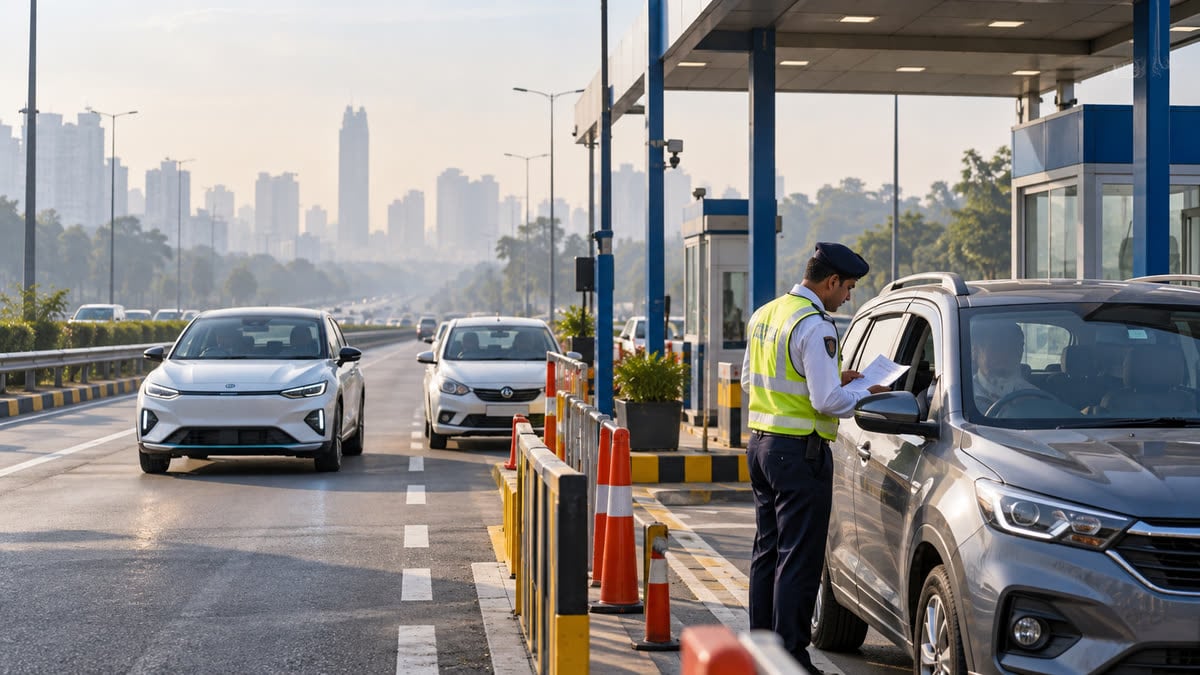
The practical step is to check the registration certificate and PUCC before starting, and to keep the relevant papers available in physical or accepted digital form. Indian Express reported that border checks would focus on emission standards, PUC certificates and permit papers. A driver who discovers a problem only at the border may have limited options to turn around safely or reach the destination without a delay.
What the rule changes for trip planning
For commuters from the adjoining NCR, the immediate question is not only whether a vehicle can enter but also whether the journey still works if it cannot. A non-compliant petrol or diesel car may need to be left at a border, replaced by an eligible vehicle or avoided for that trip. The rule does not announce a uniform extra travel time or a common rerouting distance; those will depend on the origin, destination, border point and enforcement conditions.
For freight operators, using a peripheral expressway can add kilometres and tolls but may reduce the risk of reaching a restricted entry point with a non-compliant vehicle. Compare the route before dispatch, confirm the vehicle category with the relevant authority and avoid assuming that an exemption for CNG or EV vehicles removes other documentation or stage-wise restrictions. Private travellers can use the road-trip planner to compare a Delhi-bound itinerary with a route that stays outside the capital.
EV owners and fleet managers who depend on the exemption should also check charging availability along the revised route rather than treating eligibility as a complete trip plan. The state-wise EV charging directory can help identify charging options before a longer NCR diversion.
What to watch next
The restriction is scheduled through 31 Jan 2027, but the operating details can change through later Delhi government, CAQM or traffic-police orders. Watch for official updates on exemptions, border enforcement, stage-wise GRAP measures and the treatment of commercial vehicles. The PIB release also described a separate ‘No PUCC, No Fuel’ enforcement campaign at ANPR-enabled fuel stations, so PUCC validity is relevant beyond the border journey itself.
For now, the reader takeaway is simple: before driving into Delhi from another NCR district, confirm the vehicle’s BS standard, registration status and PUCC; if the vehicle is not eligible, plan the replacement or alternate route before setting out. Treat media explainers as guidance and check the latest official traffic advisory for the specific journey.
Sources
- Press Information Bureau — Union Environment Minister reviews Delhi’s Air Pollution Mitigation Plan with CM Smt. Rekha Gupta; Calls for Time-bound, Coordinated Action and Public Participation — 28 Sep 2026
- NDTV — Delhi Announces Fresh Vehicle Curbs Under Revised GRAP From November 1 — 30 Oct 2026
- The Indian Express — Delhi pollution curbs from Nov 1: What’s banned, what’s allowed under revised GRAP rules? — 31 Oct 2026
- The Indian Express — 48 lakh non-BS-VI vehicles in NCR districts next door, police have task cut out as restrictions kick in today — 1 Nov 2026
- Hindustan Times — Delhi to bar non-BS-VI vehicles from November 1; Gurugram commuters advised to check norms — 31 Oct 2026