The Commission for Air Quality Management (CAQM) revoked Stage III of the Graded Response Action Plan (GRAP) across Delhi-NCR with immediate effect on 17 Nov 2026 after Delhi’s air quality improved to an AQI of 204. That removes the temporary Stage III restriction on Delhi-registered BS-III petrol and BS-IV diesel light motor vehicles, but it does not open Delhi to every older outstation car: the separate winter entry rule still bars below-BS-VI petrol and diesel vehicles registered outside Delhi until 31 Jan 2027.
Key takeaways
- CAQM’s Stage III order has been withdrawn across the NCR; Stage I and Stage II measures remain active.
- Delhi-registered BS-III petrol and BS-IV diesel four-wheelers can resume travel in Delhi, subject to a valid PUC and other applicable rules.
- The withdrawn restriction also covered Gurugram, Faridabad, Sonipat, Ghaziabad and Gautam Budh Nagar, according to reporting on the CAQM decision.
- Non-Delhi-registered petrol and diesel vehicles below BS-VI remain barred from entering Delhi under the separate winter action plan.
- Air-quality restrictions can be tightened again if AQI and weather forecasts worsen, so the relaxation is not permanent.
What changed on 17 November
CAQM’s order dated 17 Nov 2026 revoked the 6 Nov order that had invoked GRAP Stage III, which is the “Severe” air-quality stage. The CAQM order said Delhi’s AQI was 204 on 17 Nov and that the IMD and IITM forecasts pointed to “Poor/Very Poor” conditions in the following days. CAQM therefore returned the region to Stage I and Stage II, while asking agencies to keep monitoring the situation.
Stage III had restricted light motor vehicles, including private four-wheelers, running on BS-III petrol, BS-IV diesel or older emission standards. The restriction applied in Delhi and the five high-vehicle-density NCR districts named above. The Times of India reported that the vehicle restriction was lifted in those areas when Stage III was revoked.
Which cars can move now?
The practical effect depends first on the vehicle’s registration location and then on its emission standard. The Delhi Traffic Police advisory dated 18 Nov says Delhi-registered BS-III petrol and BS-IV diesel vehicles are permitted with a valid PUC, while non-Delhi BS-IV-and-below vehicles remain banned. The table below separates the two rules.
| Vehicle situation | Position after Stage III was revoked |
|---|---|
| Delhi-registered BS-III petrol four-wheeler | Stage III’s temporary restriction is withdrawn; it may ply with a valid PUC, subject to Stage I/II and other rules. |
| Delhi-registered BS-IV diesel four-wheeler | Stage III’s temporary restriction is withdrawn; it may ply with a valid PUC, subject to Stage I/II and other rules. |
| Vehicle registered outside Delhi and below BS-VI on petrol or diesel | The separate winter entry restriction still applies for entry into Delhi until 31 Jan 2027. |
| BS-VI outstation vehicle, or CNG/electric vehicle | Not covered by the below-BS-VI outstation ban, but the driver must still follow PUC, age, permit, parking and traffic requirements that apply. |
This means a Delhi-registered BS-IV diesel car that was parked during Stage III may be used again, but its owner still needs a current PUC and cannot treat the change as a waiver of every pollution-control rule. The update is about the Stage III vehicle restriction on light motor vehicles; it does not cancel separate age-based, permit, commercial-vehicle or enforcement requirements.
Why outstation owners need a separate check
The important distinction is between the GRAP system and Delhi’s winter action plan. GRAP Stage III was a temporary, air-quality-triggered restriction operating across the NCR. The winter plan is a separate entry rule that has continued since 1 Nov and keeps non-Delhi-registered petrol and diesel vehicles below BS-VI out of the capital until 31 Jan 2027, as reported by HT Auto and the Times of India.
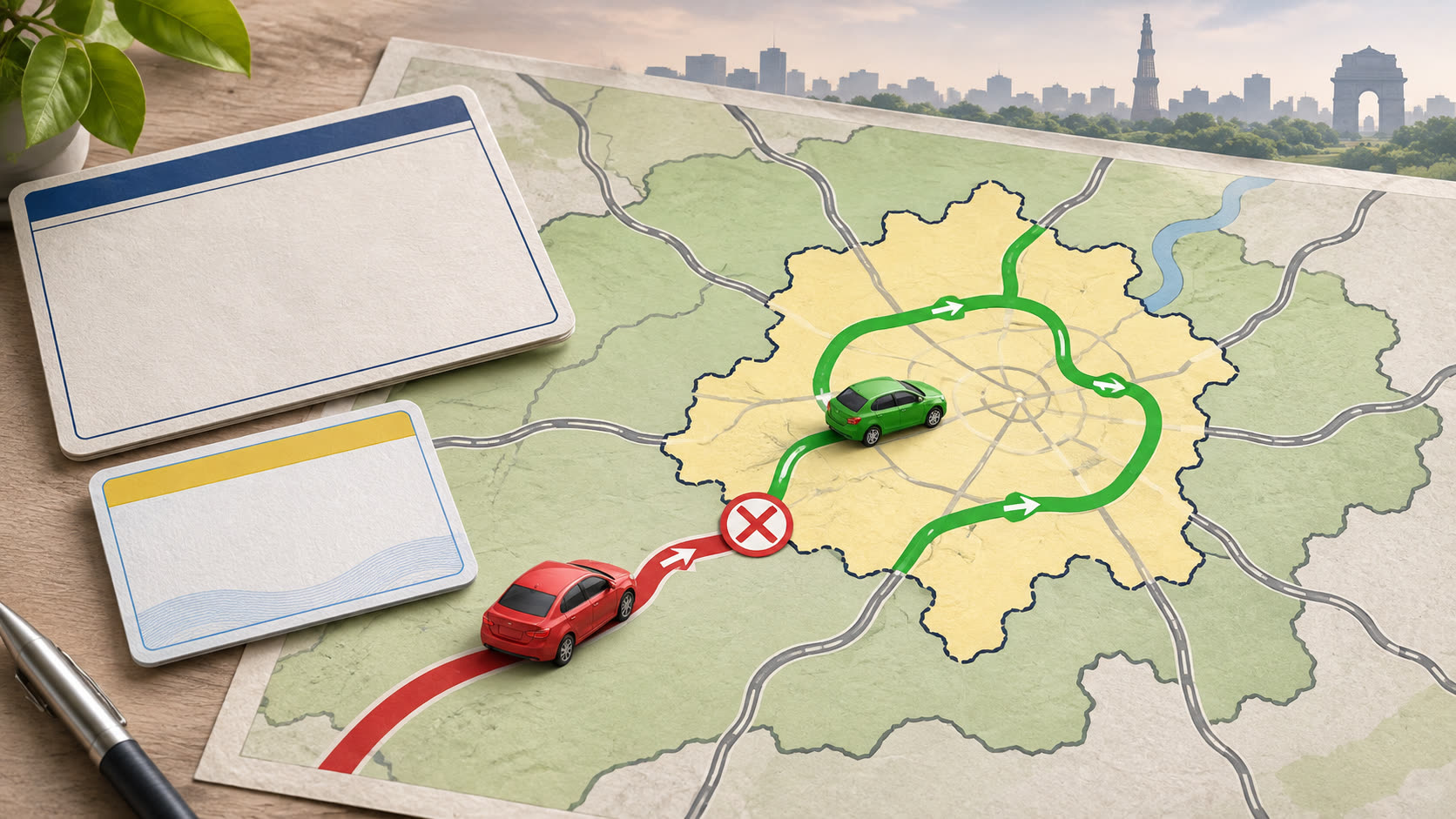
So an older car registered in another state or NCR city may no longer face the withdrawn Stage III restriction while travelling within the wider region, but it can still be stopped at Delhi’s border if it falls below BS-VI. A route that passes through Gurugram or Noida is not automatically a route into Delhi. Drivers should check the registration state, the emission standard on the RC and the latest traffic advisory before starting.
What remains in force
- CAQM’s Stage I and Stage II actions remain active and will be reviewed as air quality changes.
- The CAQM order says its earlier restrictions on dust-generating demolition and outdoor construction, along with the direction for up to 50% physical attendance in government and private offices for the specified period, continue to apply through 20 Nov.
- Delhi’s separate winter framework continues to restrict below-BS-VI outstation vehicle entry until 31 Jan 2027.
- A new deterioration in AQI, or an unfavourable IMD/IITM forecast, could lead to a fresh CAQM order and renewed vehicle curbs.
What to check before an NCR trip
- Check the registration state and Bharat Stage standard printed in the vehicle documents.
- Keep the PUC certificate valid. The Delhi Traffic Police advisory specifically ties the permitted local vehicles to a valid PUC.
- If the journey crosses Delhi or a high-vehicle-density NCR district, compare the permitted route and current restrictions in the road-trip planner.
- If a restriction changes the route, use the fuel-cost calculator to estimate the effect of extra distance using the vehicle’s own mileage and the applicable fuel rate.
- For a route that uses an expressway or national highway, check the likely toll bill in the toll-charge calculator before travelling.
What to watch next
CAQM said its GRAP sub-committee would keep reviewing Delhi’s air quality and the IMD/IITM forecast before taking further decisions. For vehicle owners, the key point is that the 17 Nov order changes the temporary Stage III position; it does not guarantee unrestricted access to Delhi for older outstation vehicles. The registration location, emission standard and the latest official advisory still decide whether a particular trip is allowed.
Sources
- Commission for Air Quality Management: “Revocation of actions under Stage III of GRAP” — 17 Nov 2026
- Delhi Traffic Police: “GRAP Stage-III Revoked; Stage-I & II Curbs Remain in Force Across Delhi” — 18 Nov 2026
- The Times of India: “GRAP-3 revoked as air improves, BS-3 petrol and BS-4 diesel can ply in Delhi” — 18 Nov 2026
- HT Auto: “GRAP 3 restrictions revoked in Delhi as it sees better air quality” — 18 Nov 2026