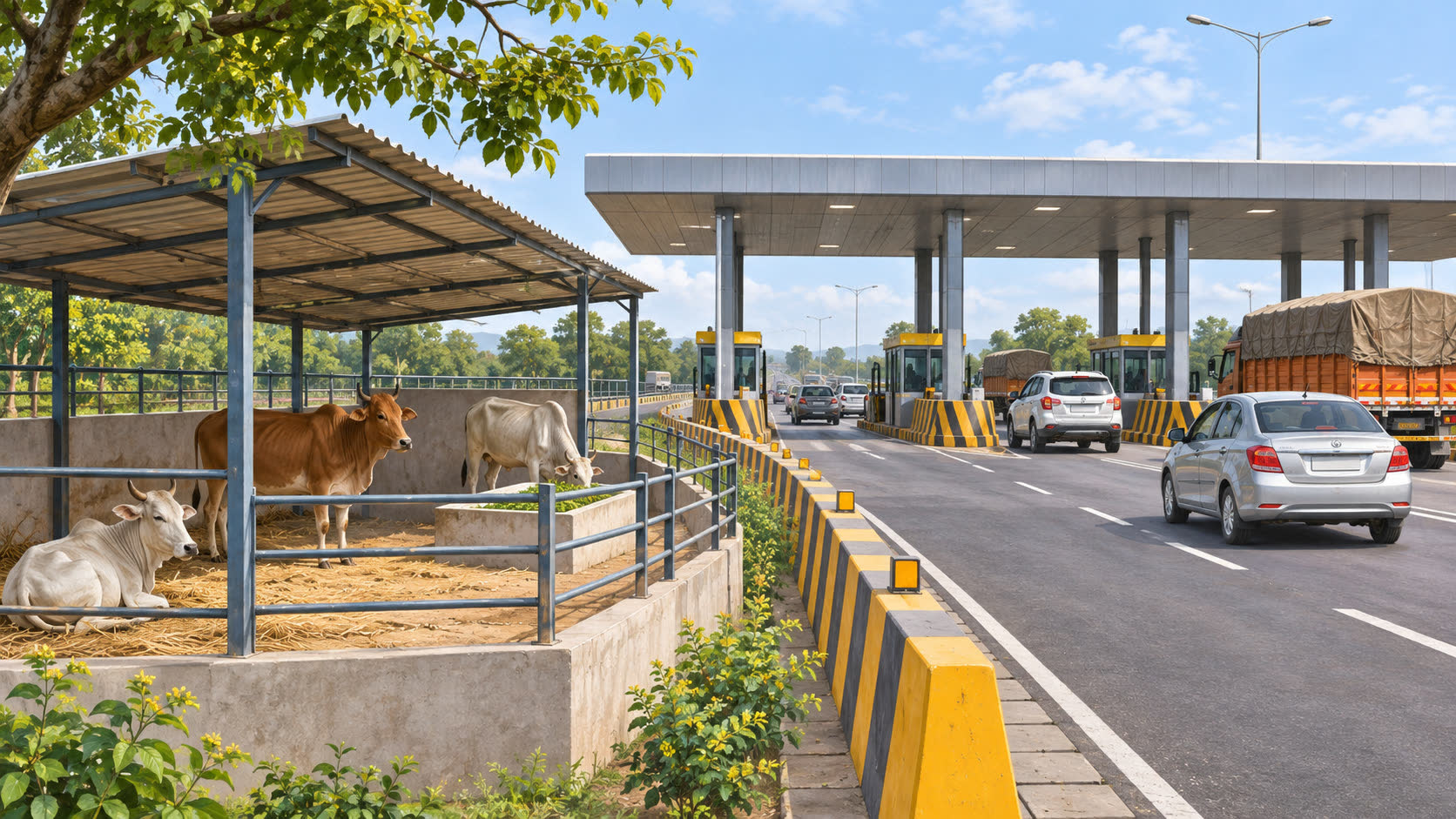
The Supreme Court has suggested that the National Highways Authority of India (NHAI) explore cattle shelters near toll plazas, with at least some contribution potentially coming from its Corporate Social Responsibility (CSR) funds. The suggestion is part of an ongoing case and is not yet a final nationwide mandate, but it could shape how stray-cattle hazards are handled on national highways.
For motorists, the immediate position is clear: the hearing has not announced a new toll fee, FASTag charge or toll exemption. It has reopened a practical question that affects road safety — who must remove animals from high-speed corridors, who provides shelter and how the work is funded.
Key takeaways
- The Supreme Court suggested that NHAI consider shelters near toll plazas and contribute through CSR funds.
- NHAI told the court that implementing the earlier nationwide directions could cost more than ₹5,000 crore if shelters had to be built across India.
- The ₹5,000-crore figure is NHAI's estimate for broad implementation, not a new toll levy or an approved budget allocation.
- NHAI and the court-appointed amicus will discuss a workable arrangement, with the matter listed again in January 2027.
- No new toll rate, FASTag rule or nationwide shelter deadline has been announced for drivers at this stage.
What the Supreme Court discussed
A bench of Justices Vikram Nath, Sandeep Mehta and N V Anjaria heard NHAI's application on 17 November 2026 in the suo motu matter titled In Re: City Hounded by Strays, Kids Pay Price. NHAI was seeking clarification of earlier directions on stray cattle and other animals on national highways and national expressways.
Solicitor General Tushar Mehta said NHAI faced practical difficulties because it does not have the statutory power to acquire land for shelters. He argued that state governments and local authorities were better placed to construct and operate the facilities. The court's response, as reported by The New Indian Express, The Tribune and Business Standard, was that NHAI need not bear the entire cost but could contribute to shelters through its CSR corpus.
That distinction matters. The court was discussing a possible funding and operating model; it did not announce that every toll plaza must immediately build a shelter or that NHAI must pay a specified amount. The amicus curiae, Gaurav Agarwal, was asked to confer with NHAI and file a response before the next stage of the case.
Why the ₹5,000-crore estimate matters
NHAI told the court that complying with the earlier directions on a nationwide basis could cost more than ₹5,000 crore if it had to arrange shelters for stray cattle across the country. The figure was reported independently by The New Indian Express, The Tribune, Business Standard and Livemint. It is a submission made in court, not a final project cost, a sanctioned expenditure or a number that will be recovered from toll users.
The court's 19 May 2026 judgment had already linked stray-animal management with public safety. Its directions require NHAI, state governments, Union Territories and local authorities to work together to remove animals from highways, relocate them to appropriate shelters and provide food, water and veterinary care. The judgment also called for dedicated highway patrol arrangements and prominently displayed helpline numbers.
The new hearing is therefore about implementation and responsibility rather than a new safety principle. A shelter near a toll plaza could provide a practical handover point for animals removed from the highway, but it would still need land, fencing, water, veterinary support, staff and a clear agency responsible for day-to-day operations.
What changes for highway users now
Nothing in the hearing changes the amount paid at a toll plaza today. Drivers can continue to use the toll-charge calculator for a route estimate, but should not add a new cattle-shelter fee to their trip budget. The judge's observation that some plazas may continue after road-construction costs are recovered was part of the court exchange; it was not an announcement of a toll refund, a new exemption or a change to the existing tolling schedule.
The practical safety issue remains active while the legal and administrative questions are worked out. On a highway stretch where animals are present, drivers should reduce speed early, avoid abrupt swerving into another lane and keep a safe gap from heavy vehicles that may block the view. If an animal is obstructing the carriageway, use the highway or emergency reporting channel displayed on the route rather than entering a live lane to move it.
Before a long journey, keep the vehicle documents, insurance details and FASTag information accessible. FuelPrice's road-trip document checklist covers the records to check before departure, while the site's road-trip planner can help organise stops and route timing. These tools do not replace a highway authority's safety response, but they reduce avoidable delays when a trip is interrupted.
What NHAI, states and local bodies must settle
The next phase will have to separate responsibilities that were discussed together in court. NHAI manages national-highway infrastructure and can coordinate patrols, reporting and access near toll plazas. State and local authorities generally have the field machinery, land access, animal-control staff and links to shelters or gaushalas. A workable arrangement would need to state who captures an animal, who transports it, who pays for its care and who responds when the same stretch becomes hazardous again.
It will also need to clarify how any CSR contribution is approved and monitored. The court has not named a fixed contribution, a list of plazas or a construction timetable. The January 2027 hearing is the next point to watch for a formal direction or a more specific implementation plan.
What drivers should watch next
- Any written response filed by the amicus or NHAI before the January hearing.
- Whether the court defines a limited NHAI contribution or assigns broader operational duties.
- State-wise arrangements for shelters, patrols and reporting on national-highway stretches.
- Any separate NHAI notification that affects toll-plaza operations or road-user reporting channels.
Is there a new toll rule today?
No. The court's suggestion concerns a possible road-safety and animal-shelter arrangement. It does not create a new FASTag payment, change a toll rate or make a driver responsible for funding a shelter. FuelPrice's earlier report on the Supreme Court's NHAI cattle-shelter hearing covered the initial proceeding; this follow-up adds the CSR discussion, the cost estimate and the next procedural step.
Bottom line
The Supreme Court is pressing NHAI and state authorities to turn a broad highway-safety direction into a workable system for stray cattle. For motorists, the immediate takeaway is not a higher toll bill but the need to treat the issue as unresolved policy: the CSR idea, the ₹5,000-crore estimate and the January hearing may determine what changes on the ground.
Sources
- Supreme Court of India, “2026 INSC 506”, 19 May 2026
- The New Indian Express, “‘Lives lost due to stray cattle on roads’: SC asks NHAI to build shelters at toll plazas”, 17 Nov 2026
- Business Standard, “NHAI vs states: Who must remove stray animals from national highways?”, 18 Nov 2026
- The Tribune, “Lives lost: SC tells NHAI to explore setting up cow shelters at plazas”, 18 Nov 2026
- The Pioneer, “SC asks NHAI to build cattle shelters at toll plazas”, 18 Nov 2026
- Livemint, “Why NHAI says it cannot remove stray cattle from highways: ₹5,000 crore cost flagged in Supreme Court”, 18 Nov 2026