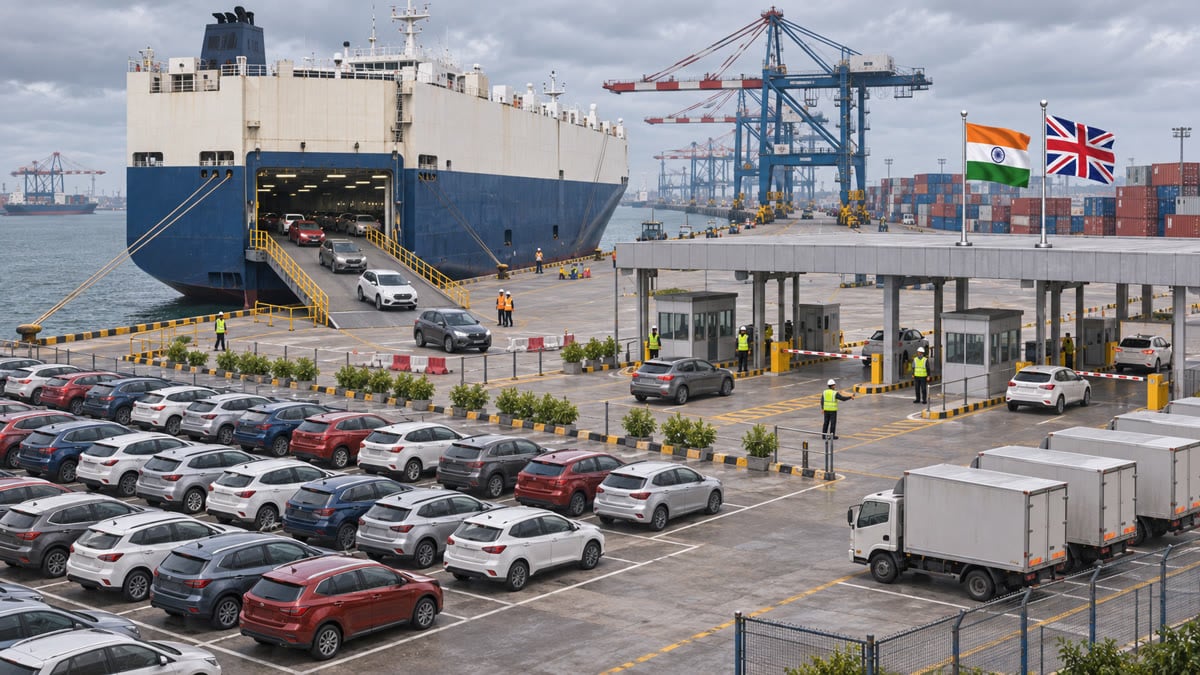
The Directorate General of Foreign Trade (DGFT) has opened applications for 2027 tariff-rate quotas under the India–UK Comprehensive Economic and Trade Agreement (CETA), with the window running from 6 November to 21 November 2026. The notice could widen the supply of UK-origin imported vehicles in India, but it is an allocation process for eligible businesses—not a direct booking window or a guaranteed showroom price cut for individual buyers.
DGFT Public Notice No. 39/2026-27, dated 6 November 2026, covers 24,500 passenger cars and 2,750 goods vehicles imported as completely built units (CBUs). That makes the total notified quota 27,250 vehicles for calendar year 2027. The figures and categories are stated in the notice and have also been reported by Financial Express and Maritime Gateway.
Key takeaways
- Applications are open from 6 November to 21 November 2026 for the 2027 allocation.
- The passenger-car quota is 24,500 units, split across three engine-capacity categories.
- A separate 2,750-unit goods-vehicle quota excludes electric and hydrogen-fuel vehicles.
- Only manufacturers and dealers or channel partners authorised by UK-origin vehicle makers can apply.
- Consumers should treat the quota as a supply and customs-policy development, not as an immediate discount announcement.
What DGFT has opened
The application window applies to specified UK-origin vehicles for calendar year 2027. Eligible applicants must seek an allocation through DGFT’s Import Management System under the tariff-rate quota process. The covered passenger vehicles must be new CBUs that have not been registered anywhere before importation, according to the public notice as reproduced by specialist trade and tax publications.
If applications exceed the available quantity, the allocation is to be handled proportionately among eligible applicants. The process therefore decides which authorised businesses receive access to the concessional-duty quota; it does not reserve a particular car for a retail customer. The current window also does not announce a delivery date for any model.
How the 27,250-vehicle quota is split
The following allocation is from DGFT’s public notice dated 6 November 2026. Engine capacity is used to place passenger vehicles into the relevant band; the separate goods-vehicle category has its own fuel exclusions.
| Category | Quota | Coverage |
|---|---|---|
| Passenger vehicles | 6,000 units | Petrol vehicles up to 1,500 cc |
| Passenger vehicles | 6,000 units | Petrol vehicles above 1,500 cc up to 3,000 cc, or diesel vehicles above 1,500 cc up to 2,500 cc |
| Passenger vehicles | 12,500 units | Petrol vehicles above 3,000 cc, or diesel vehicles above 2,500 cc |
| Goods vehicles | 2,750 units | CBUs for goods transport, excluding electric and hydrogen-fuel vehicles |
The passenger-car bands total 24,500 units. The quota is therefore broad enough to cover both smaller-engine vehicles and larger premium or luxury vehicles, but the number of cars that reach Indian showrooms will depend on which manufacturers and authorised importers apply, receive an allocation and complete the import process.
What the CETA concession means for buyers
India–UK CETA came into force on 15 July 2026, according to the Ministry of Commerce and Industry. Its vehicle provisions allow qualifying imports to access preferential customs treatment within the notified quota. That treatment applies at the import stage and is subject to origin, documentation, engine category and quota conditions.
It should not be read as a uniform price reduction across every UK-made vehicle. A final Indian price can still reflect the model’s specification, currency movement, shipping and port costs, importer margins, taxes, registration, insurance and any other on-road charges. The importer may pass on some or all of the customs benefit, but the public notice does not promise a fixed consumer saving.
Reports have described the CETA duty schedule in different ways as the agreement phases in its concessions. The practical point for a buyer is that the applicable rate must be checked for the specific model, engine band, year and quota authorisation; a general claim about a future low rate should not be treated as the price of a car available today.
Who is affected now
The immediate applicants are original-equipment manufacturers, authorised importers, dealers and manufacturer-authorised channel partners. Individual buyers cannot apply for a quota allocation under this notice. Their interest is downstream: a successful allocation may lead to additional UK-origin models, revised availability or new price lists during 2027.
For buyers comparing a large petrol or diesel import with a locally produced vehicle, the engine bands matter because they affect the quota category and the customs treatment. It is also important to distinguish a UK-origin vehicle from a car merely sold by a brand that has a UK presence. The origin and certificate requirements remain part of the import process.
What to check before treating a quota car as cheaper
- Ask whether the vehicle is UK-origin and eligible under the relevant CETA category.
- Check whether the authorised importer has received a 2027 allocation and whether the vehicle is a new CBU.
- Request a written breakup of customs duty, freight, insurance, taxes, registration and other on-road costs rather than relying on a headline discount.
- Compare ownership costs with the vehicle’s engine size and likely use. The fuel cost calculator can help estimate trip spending, while the live fuel-price hub shows current petrol and diesel rates.
- Use the road-trip planner to compare how the vehicle’s size, fuel type and expected running pattern fit the journeys it will actually make.
What happens next
The application window closes on 21 November 2026. DGFT will then process eligible applications under the quota procedure, after which authorised importers can decide which models and quantities to bring in for 2027. The next useful signals for consumers will be allocation announcements, confirmed model lists, delivery timelines and actual price sheets—not the quota number alone.
For now, the policy changes the opportunity for importers more immediately than it changes the choices at a dealership. Buyers considering a UK-origin car should wait for a model-specific landed and on-road price before assuming that the CETA quota will lower their total cost.
Sources
- TaxGuru — DGFT Invites India–UK CETA TRQ Applications for CY 2027 (Public Notice No. 39/2026-27, 6 Nov 2026)
- The Financial Express — Quota open for 24,500 car imports under UK FTA: DGFT invites applications (6 Nov 2026)
- The Economic Times — DGFT invites applications for vehicle import quotas under India–UK FTA (7 Nov 2026)
- Maritime Gateway — DGFT opens 2027 UK vehicle import quotas, applications close on 21 November (7 Nov 2026)
- Press Information Bureau, Ministry of Commerce and Industry — India–UK CETA Comes into Force (15 Jul 2026)
- Department of Commerce — India–UK CETA: Goods and tariff-rate quota framework (2026)
This article is for general information only and is not financial, insurance or legal advice.