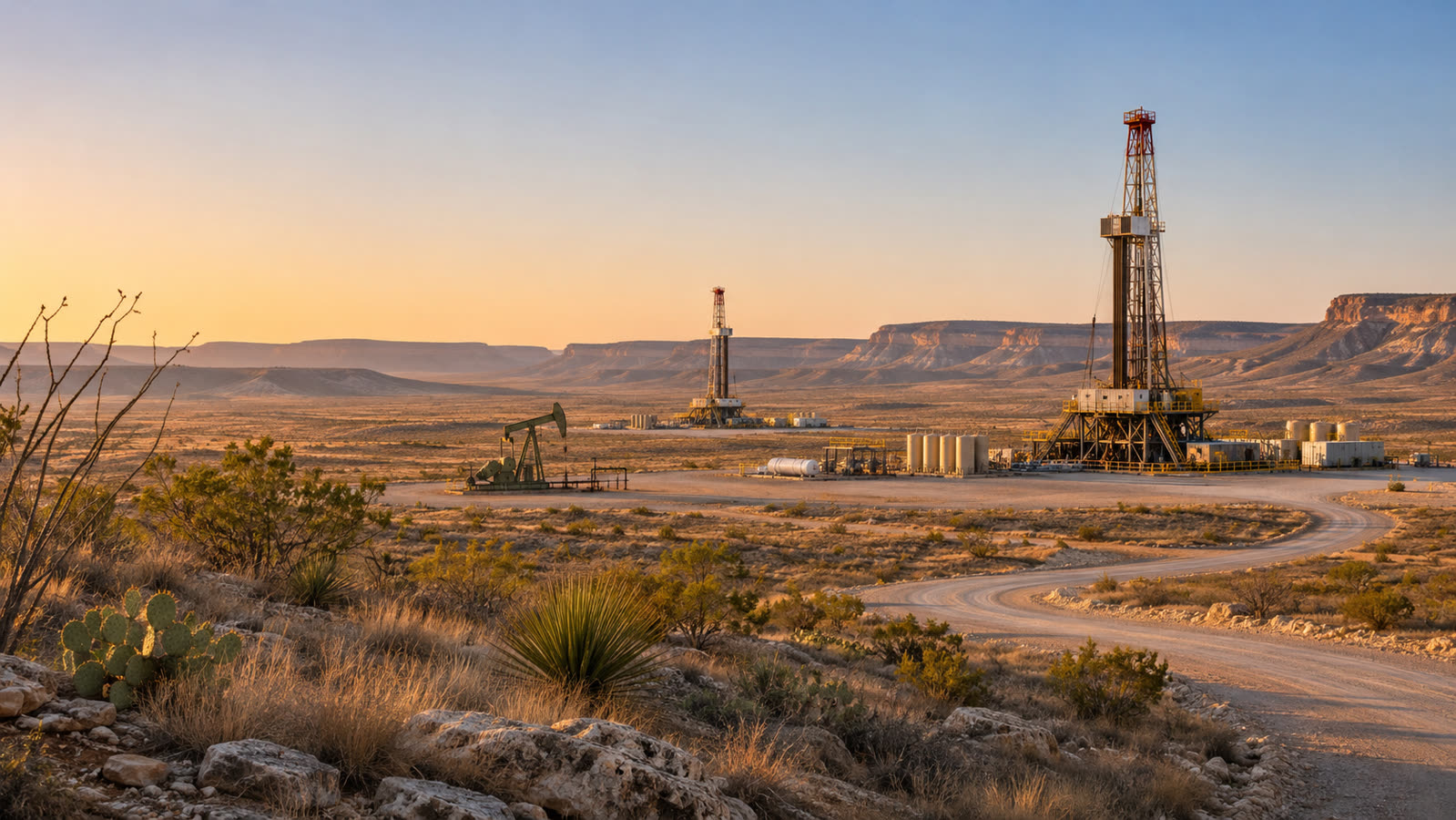
Diamondback Energy said on 16 Nov 2026 that it had agreed to acquire Double Eagle assets in the Midland Basin in a cash-and-stock deal valued at about US$5 billion. The company and Bloomberg report estimated oil production from the acquired assets at 35,000 barrels per day in 2027, making the agreement a new signal for the global oil-supply outlook rather than an immediate change at the pump.
Key takeaways
- Diamondback has signed a definitive agreement to buy certain subsidiaries of Double Eagle IV Midco and Double Eagle V Midco.
- The announced consideration is about US$2.15 billion in cash plus approximately 15.56 million Diamondback shares; Bloomberg put the combined transaction value at about US$5 billion.
- The assets are in the core Midland Basin, part of the Permian Basin in West Texas, and are expected to contribute about 35,000 barrels per day of oil in 2027.
- The agreement is not the same as a completed acquisition. Diamondback says closing remains subject to customary conditions.
- For drivers and fleets, the deal is a medium-term supply and producer-strategy signal, not a reason to assume that retail petrol or diesel prices will move immediately.
What Diamondback is buying
The transaction covers selected Double Eagle subsidiaries holding assets in the Midland Basin, the West Texas portion of the Permian. The region is one of the most important US shale-producing areas and is watched by international oil traders because changes in its drilling pace can affect expectations for future US supply.
Diamondback’s 16 Nov company release described the consideration as approximately US$2.15 billion in cash and 15.56 million shares, subject to customary adjustments. Bloomberg’s same-day report independently described the cash-and-stock purchase as worth about US$5 billion and said the deal would add about 35,000 barrels per day to Diamondback’s oil production in 2027. Using both descriptions matters because the headline value includes a share component, while the exact value can change with the company’s stock price and closing adjustments.
The oil-production figure is an estimate, not a guaranteed delivery schedule. Diamondback’s release also treats future production, drilling plans and the expected benefits of the transaction as forward-looking matters that depend on market conditions, operations and approvals. That distinction is important for any reader trying to translate a corporate acquisition into a fuel-price forecast.
Why this matters to global oil markets
The immediate significance is consolidation. Diamondback is taking a larger economic and operating position in an established shale basin, while Double Eagle is transferring part of its future drilling inventory to a larger listed producer. This can change who controls development decisions, how capital is allocated and how quickly wells are brought online, even if the deal does not create a sudden new flow of crude on the day it is announced.
The broader significance is global because US shale is part of the supply response watched alongside OPEC+ policy, Middle East export routes, inventories and refinery demand. More potential output from the Permian can contribute to future supply flexibility, but one transaction cannot set Brent or West Texas Intermediate prices by itself. The market will still test the deal against actual drilling activity, infrastructure capacity, commodity prices and the pace at which the assets reach production.
There is also a useful signal in the timing. A producer is committing cash and shares to a long-life inventory of oil and gas projects while energy markets remain sensitive to geopolitical risk and changes in demand. That does not prove that prices will rise or fall. It does show that Diamondback sees strategic value in expanding its position in the basin, while accepting the operational and financial risks that come with a large acquisition.
What it means for fuel users
A US shale deal is not a direct price notice for motorists. Retail fuel prices are shaped by benchmark crude, refining margins, local supply, freight, taxes, regulation and exchange rates. The expected oil output is also for 2027, so it should not be treated as 35,000 barrels per day becoming available immediately.
For a household or fleet, the practical takeaway is to separate a supply headline from the number on a forecourt sign. Readers can check dated market and retail-rate movements through the live fuel prices section, then use the fuel cost calculator to see how a change in price would affect a regular route. A longer journey can be budgeted with the road-trip planner, where distance and vehicle efficiency matter as much as the crude-market story.
Transport operators should watch diesel margins, freight rates and local wholesale conditions rather than treating the acquisition as a guaranteed cost reduction. EV owners are similarly insulated from the direct effect of one shale transaction, although oil and gas prices can influence the wider cost and policy environment in which charging, electricity and vehicle markets develop.
What to watch next
The first checkpoint is completion. The deal remains an agreement subject to closing conditions, so the ownership change is not final until those conditions are satisfied. The next market checkpoint is Diamondback’s production guidance: investors and fuel-market observers will want to see how the 35,000-barrel-per-day estimate is reflected in plans for 2027 and whether the ramp-up is on schedule.
It will also be worth watching whether the transaction changes Diamondback’s drilling pace or capital commitments. If the company develops the acquired inventory faster, the supply effect could arrive earlier; if permits, services, takeaway capacity or weak prices slow development, the headline estimate may take longer to appear. Those are scenarios, not confirmed outcomes.
The reader takeaway
Diamondback’s agreement is a significant new US shale consolidation with a stated future-production estimate, but it is not an instant global oil-price event. For fuel users, the sensible reading is to track completed closing, actual production updates and benchmark prices separately. The deal becomes more relevant to pump prices only if the expected barrels are delivered into a market where supply, demand and refining conditions support a measurable change.
Sources
- Diamondback Energy: “Diamondback Energy, Inc. Announces Core Midland Basin Acquisition” (16 Nov 2026)
- Bloomberg News: “Diamondback Agrees to Buy Double Eagle Assets for $5 Billion” (16 Nov 2026)
- Reuters: “Diamondback nears $5 billion deal to buy drilling portfolio from Double Eagle, FT says” (15 Nov 2026)
This article is for general information only and is not financial, insurance or legal advice.