ExxonMobil has taken a final investment decision on the US$12.5 billion Longtail gas-and-condensate project offshore Guyana after the government approved its field development plan and production licence. The development is targeted to start in 2030, so it will not change pump or gas prices immediately, but it marks Guyana's first gas-focused offshore project and could add to future Atlantic-basin energy supply.
Key takeaways
- ExxonMobil announced the US$12.5 billion investment and final investment decision on 12 Nov 2026, after Guyana's regulatory approvals.
- Longtail's planned FPSO is designed to handle about 1.2 billion standard cubic feet of gas per day and up to 250,000 barrels of condensate per day.
- The project is expected to include about 45 subsea production and injection wells and target a 2030 start-up.
- Gas could be sent ashore by pipeline, but ExxonMobil says that depends on later investment, market-demand and infrastructure decisions.
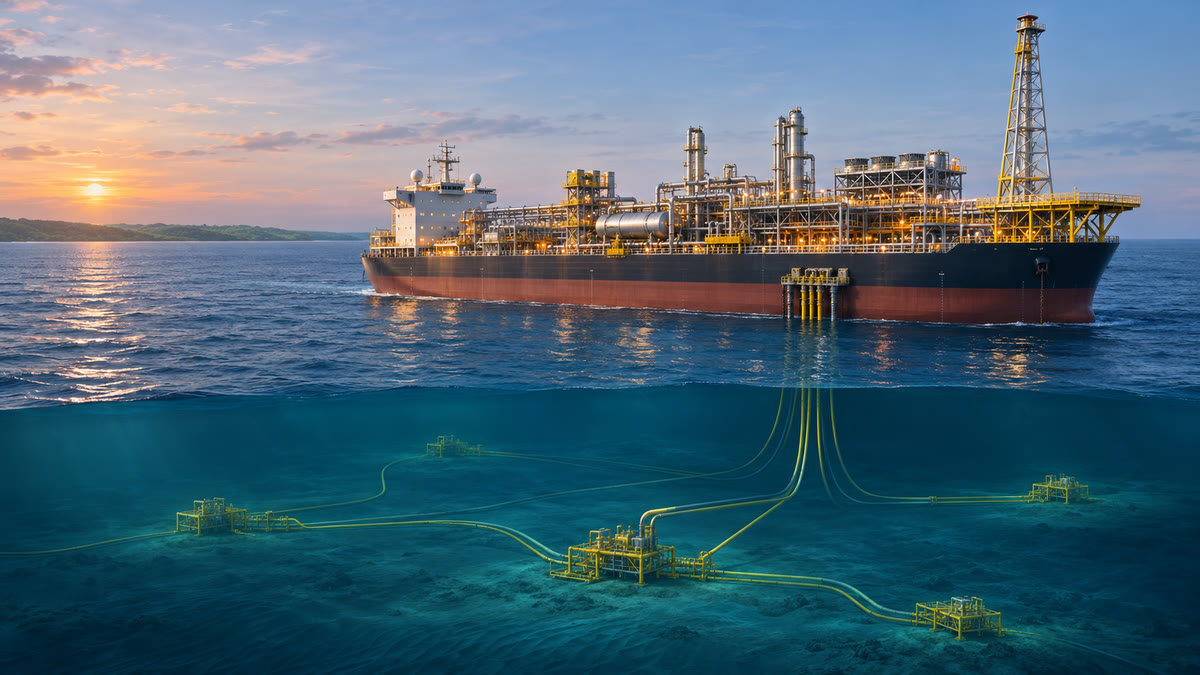
Image note: The hero is a FuelPrice editorial illustration of an offshore FPSO and subsea infrastructure. It is representative, not an official photograph of the Longtail vessel.
What ExxonMobil approved
ExxonMobil's 12 Nov announcement followed approval by Guyana's Ministry of Natural Resources of the Longtail Field Development Plan and its Petroleum Production Licence. The company described Longtail as the eighth development in the Stabroek block, offshore Guyana, and said the project will focus on non-associated gas and condensate-rich reservoirs rather than treating gas only as a by-product of oil production.
The planned development carries an additional US$12.5 billion investment. Its floating production, storage and offloading vessel, or FPSO, is designed for about 1.2 billion standard cubic feet per day of gas handling and up to 250,000 barrels per day of condensate production. ExxonMobil and the Oil & Gas Journal both reported that the project is expected to use about 45 subsea production and injection wells.
Those are design capacities, not a promise that the vessel will immediately produce those volumes. Reservoir performance, construction, commissioning, approvals and market conditions can all affect the final schedule and output. ExxonMobil's own release warns that project plans, production rates and resource recoveries are forward-looking estimates.
Why the gas route matters
Longtail is important to Guyana because its current offshore boom has been led primarily by crude oil. ExxonMobil said its four producing Stabroek projects were producing about 900,000 barrels of oil per day as of 12 Nov 2026, with the Uaru project expected to take block production above 1 million barrels per day when it starts in the fourth quarter of 2026. The Oil & Gas Journal reported the same production path.
Gas changes the logistics. Oil can be loaded onto tankers for export, while natural gas needs a customer and a delivery system: it may be used onshore, transported by pipeline, or processed for wider trade if the required facilities are built. Guyana's approval release says Longtail's licence includes gas-utilisation and export planning requirements, including an assessment of reservoir performance, production forecasts, export timing and possible gas markets.
ExxonMobil said a pipeline to shore remains possible, but only subject to future investment decisions, market demand and the development of supporting infrastructure. That qualification is central to the story. The project has received a final investment decision for the offshore development, but the announcement does not confirm a completed gas-export chain or a future LNG sales contract.
What it means for global energy markets
For international fuel users, the immediate effect is limited. Longtail is aimed at a 2030 start-up, and a project scheduled several years ahead cannot by itself lower today's petrol, diesel or gas prices. Near-term prices remain driven by current crude supply, refinery availability, shipping conditions, storage and regional taxes. Readers can compare current retail prices in the live fuel prices directory and estimate a journey's petrol or diesel requirement with the fuel cost calculator.
The longer-term significance is supply diversification. Guyana is adding a gas-led development to a rapidly expanding offshore production base, while global buyers are seeking more sources outside established routes. If Longtail's gas is connected to domestic industry or an export system, it could strengthen Guyana's role in Atlantic energy markets. If the infrastructure decision is delayed, the project's offshore capacity could still advance without creating immediate new pipeline or LNG supply.
That is why the announcement should be read as a project milestone, not as a new fuel-price forecast. The US$12.5 billion commitment confirms that ExxonMobil and its partners have sanctioned development, while the gas-market outcome will depend on what happens next onshore.
What to watch next
The next milestones are the FPSO build and installation plan, the detailed gas-utilisation and export study, and any decision on a pipeline or other route to market. The timing of construction and the ability to deliver the planned gas and condensate rates will also matter more than the headline capacity.
ExxonMobil operates the Stabroek block through ExxonMobil Guyana Limited, which holds a 45% interest; Hess Guyana Exploration holds 30% and CNOOC Petroleum Guyana holds 25%. Those ownership figures were stated in both the company release and Oil & Gas Journal's report. As Longtail develops, watch whether those partners make a firm gas-infrastructure decision and whether the 2030 target changes.
For readers, the practical takeaway is simple: Longtail is a significant future supply project, but it is not a reason to expect a pump-price change today. Track current regional prices, calculate the fuel share of a trip, and treat future production and export figures as targets until the project is built and connected to buyers. Further developments will be listed in FuelPrice's worldwide fuel news.
Sources
- ExxonMobil, “ExxonMobil advances next phase of Guyana development with Longtail,” 12 Nov 2026.
- Department of Public Information, Guyana, “Press Release: GoG approves eight Petroleum Production Licence: Longtail Petroleum Production Licence,” 12 Nov 2026.
- Oil & Gas Journal, “ExxonMobil takes FID for Longtail development offshore Guyana,” 13 Nov 2026.
This article is for general information only and is not financial, insurance or legal advice.