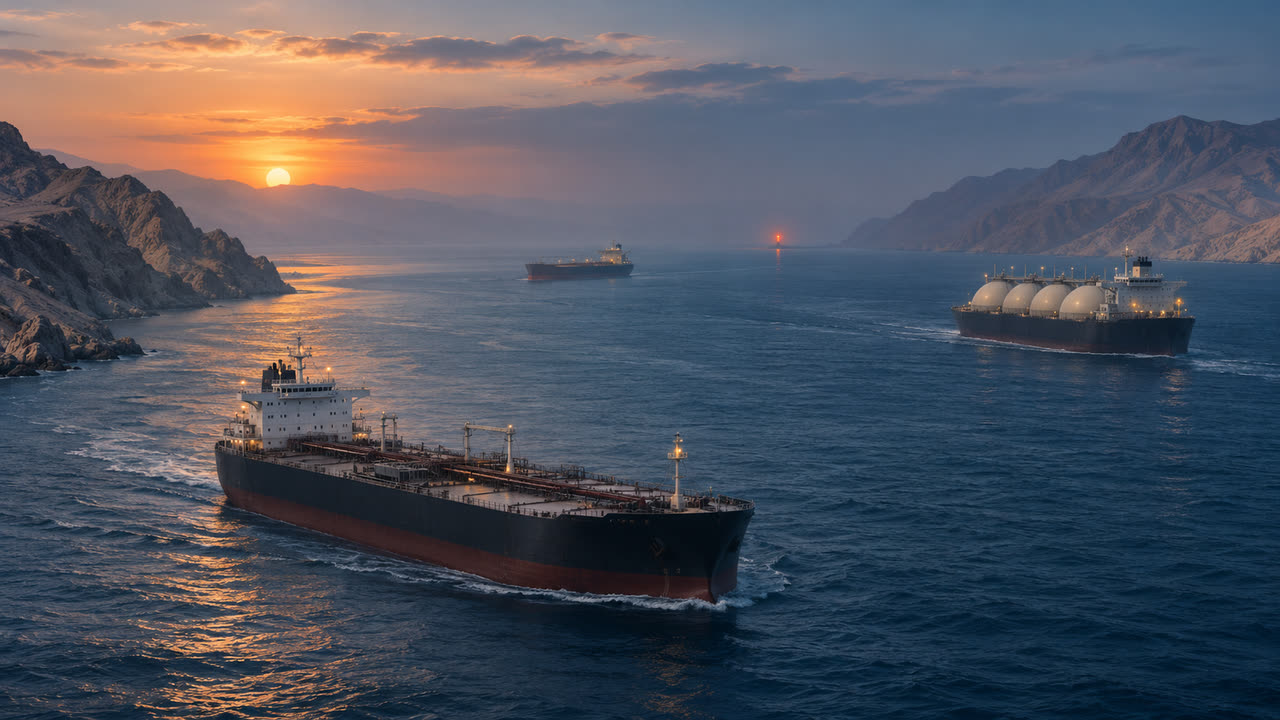
Shipping through the Strait of Hormuz has slowed after a fresh run of tanker incidents, adding a new supply-route risk for crude oil, liquefied natural gas (LNG) and refined fuels even as the wider oil market has recently shown signs of better supply. The development matters globally because shipowners may delay voyages, reroute cargoes or pay more for security and insurance before any change appears at a retail fuel pump.
Key takeaways
- The Joint Maritime Information Center (JMIC) said the regional maritime threat level was severe in its 12 November 2026 advisory.
- JMIC listed recent tanker attacks around Oman, the Strait of Hormuz and the Arabian Gulf; separate reports from Iran said three tankers hit naval mines and caught fire.
- Reuters, citing Kpler tracking data, reported only five commodity-vessel transits on Saturday and none recorded on Sunday, compared with 31 over the previous weekend.
- The reports do not establish a total closure or a confirmed retail fuel shortage, but they do show that route reliability has become a market risk.
What happened in the Strait
JMIC’s Update 113, covering the Middle East maritime region through 12 November, recorded a series of recent incidents. It said a tanker reported being struck by an unknown projectile northeast of Lima, Oman, on 10 November, with the crew safe and no environmental damage reported. It also listed an attack on the tanker NCC FAJR north of Khasab, Oman, on 11 November, and two reports in the Arabian Gulf involving FUJAIRAH ENERGY and DOMINICA PROSPERITY.
The details matter because the official maritime record and the latest Iranian account are not identical. JMIC described the incidents in its list as attacks involving unknown projectiles. On 14 November, the Associated Press reported that Iranian state television said three oil tankers had struck naval mines and caught fire around the Strait of Hormuz. Iran’s report did not identify the vessels’ flags or destinations, and AP said it gave no details about casualties. That claim remains reported rather than independently confirmed.
JMIC said the regional threat level was severe and that commercial traffic through the Strait of Hormuz remained below its baseline. The maritime center’s operational summary said independent tracking data indicated single- to low-double-digit transits per day, while US Naval Cooperation and Guidance for Shipping data showed an average of about 34 US-assisted transits per day over the preceding 96 hours. Those datasets measure different things and should not be read as a single traffic count.
Why slower traffic matters for fuel markets
Reuters reported on 14 November that traffic had slowed after tanker attacks and that US-Iran talks aimed at resolving the conflict had stalled. The report, carried by Gulf Times, cited Kpler ship-tracking data showing five commodity vessels transited the strait on Saturday, with none registered on Sunday, against 31 over the prior weekend.
That is a warning about reliability, not proof that the waterway is closed. Vessels can move with transponders off, use different routes or appear in tracking data later. The common signal across the JMIC and Reuters reports is that operators are behaving more cautiously around a route that connects Gulf energy exporters with global buyers.
For oil and gas markets, the first pressure point may be freight and insurance rather than the crude molecule itself. A shipowner that waits, changes route or needs additional security can raise the delivered cost of a cargo. Buyers may also bid for alternative barrels, LNG cargoes or refined products, widening regional price differences even when headline crude prices are moving for other reasons.
What it means for drivers, fleets and transporters
A supply-route shock does not pass one-for-one into every retail fuel price. Local taxes, currency movements, refinery margins, inventories and the timing of wholesale contracts can delay, soften or amplify the effect. Petrol, diesel and LNG can also react differently because each has its own production, storage and shipping pattern.
For a household or fleet, the practical question is not whether one headline predicts the next pump move. It is how much exposure a vehicle has to fuel costs if local prices remain elevated. Readers can check current figures through FuelPrice’s live fuel-price pages and estimate a route with the fuel cost calculator. These tools help separate a verified local price from a market-risk headline.
Operators should also distinguish a temporary risk premium from a sustained physical shortage. A few days of slower sailings can lift freight and futures volatility without immediately emptying stations. A longer disruption, repeated attacks, or confirmed damage to loading and export infrastructure would carry a more direct supply impact.
What to watch next
- Verified maritime updates: new JMIC or UKMTO reports, including crew safety, environmental damage and whether vessels resume their voyages.
- Actual traffic: confirmed tanker, LNG-carrier and commodity-vessel movements, rather than a single AIS snapshot.
- Physical market signals: crude differentials, diesel and jet-fuel margins, LNG freight rates and regional inventories.
- Diplomatic progress: the Associated Press reported that Qatar was trying to mediate an interim arrangement to restore traffic, while Reuters said talks had stalled.
This is a materially new development in a wider maritime-energy crisis. FuelPrice previously reported on an earlier tanker incident involving the Velos Sapphire near Qatar; the latest reports point to a broader question about how consistently commercial vessels can use the route.
Reader takeaway
As of 14 November 2026, the available reporting shows reduced and more cautious traffic around the Strait of Hormuz, not a confirmed total closure or a universal retail-fuel shortage. Global fuel users should watch verified shipping and market data together: the route can become more expensive and less reliable before a local pump price visibly changes.
Sources
- Joint Maritime Information Center, “Update 113 to JMIC Advisory Note: Regional Tension – Impact on Maritime Security” (12 Nov 2026)
- Associated Press, “Drone strike kills Palestinians in Gaza, and other Mideast news” (14 Nov 2026)
- Reuters via Gulf Times, “Shipping slows through Strait of Hormuz after tanker attacks” (14 Nov 2026)
- Associated Press, “Trump’s shifting Iran rhetoric leaves Mideast in limbo” (14 Nov 2026)
This article is for general information only and is not financial, insurance or legal advice.