Reported Policybazaar data puts average EV motor-insurance claim severity at ₹41,543, versus ₹36,185 for comparable ICE cars, in reports published by ETAuto and Fortune India on 06 Oct 2026. The ₹5,358 gap, reported as 14%, shows why battery, repair-network and monsoon cover matter alongside the quoted premium.
Key takeaways
- The comparison covers vehicles in their first three years and a similar ₹10–15 lakh price bracket; large-loss claims were excluded.
- Reported average EV claim severity rose to nearly ₹65,000 during the monsoon, versus around ₹52,000 during the rest of the year, a 25% increase.
- Battery-protection cover adoption among EV owners rose from 51% to 70% over six months in the reported data; around 80% chose at least two key add-ons.
- Tier-II cities recorded 33 EV claims per 100 insured vehicles, compared with 30 in Tier-I cities; East India recorded 41 per 100, versus 27 in South India.
All figures in this article are reported Policybazaar data published by ETAuto and Fortune India on 06 Oct 2026. They are platform-level observations, not an IRDAI tariff or a quote for any individual policy.
What the reported data shows
Claim severity means the average amount paid or incurred for a claim in the reported dataset. It is not the same as an insurance premium. A higher average repair bill can affect how insurers assess risk and how owners value add-on protection, but it does not mean every EV policy costs more than every petrol or diesel policy.
| Measure | EV figure | Reported comparison |
|---|---|---|
| Average claim severity | ₹41,543 per claim | ₹36,185 per claim for comparable ICE cars; EV figure reported 14% higher |
| Monsoon claim severity | Nearly ₹65,000 per claim | Around ₹52,000 outside the monsoon; reported increase of 25% |
| Battery-protection adoption | 70% of EV owners | Up from 51% six months earlier |
The comparison is deliberately narrower than a whole-market premium survey. It covers cars in their first three years, a similar ₹10–15 lakh price band and excludes large-loss claims, according to the two reports. That makes the figures useful for understanding repair exposure, but not for predicting the final renewal price of a specific car.
Why EV claims can cost more
ETAuto and Fortune India attribute the higher reported severity to expensive battery systems, complex electronics, imported components and a smaller specialist repair network. Battery replacement can account for as much as 40–50% of a vehicle’s total value, depending on the model, the reports say. That does not mean every collision requires a new battery pack: many claims involve bodywork, sensors, cooling systems, charging hardware or other components.
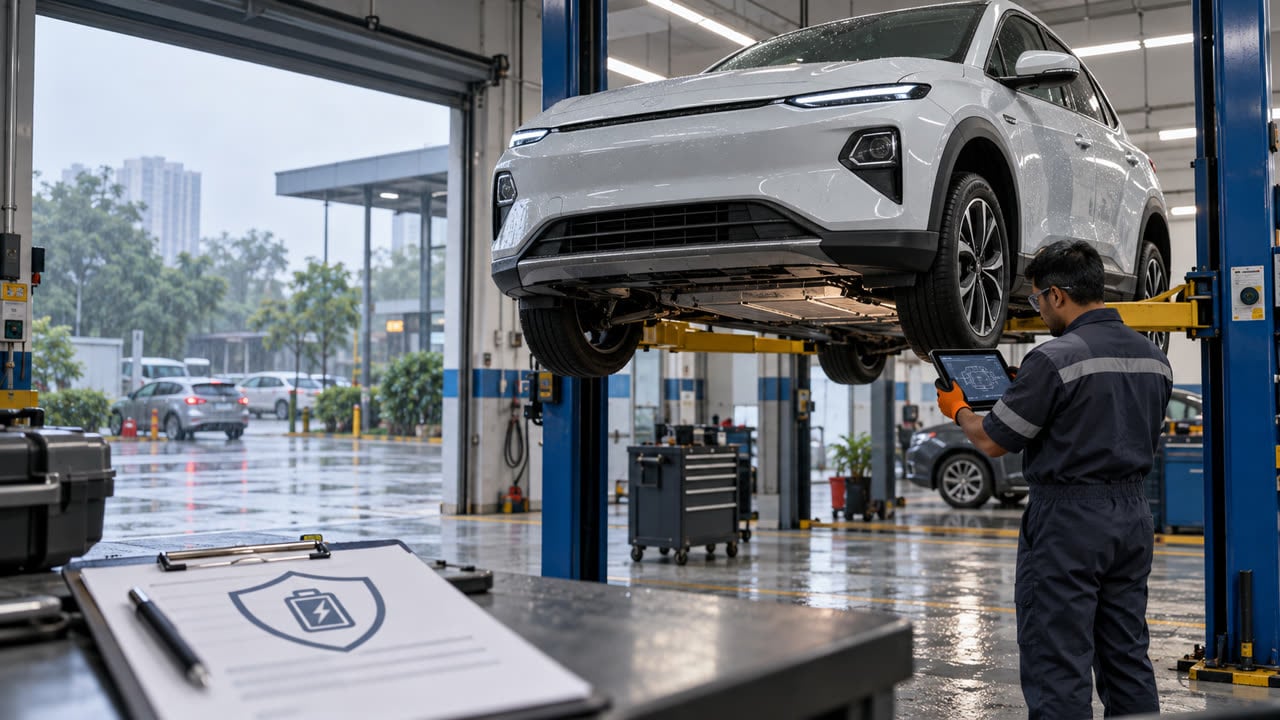
High-voltage systems can also require specialised diagnosis and safety procedures. A damaged battery enclosure or battery-management system may therefore need an EV-equipped workshop rather than a general body shop. The practical effect for an owner is that the repair network, towing process and policy wording can matter as much as the headline premium.
Where the reported claim frequency is higher
The same 06 Oct reports found 33 claims per 100 insured EVs in Tier-II cities, compared with 30 in Tier-I cities and 27 in Tier-III cities. By region, East India recorded 41 claims per 100 insured EVs, followed by North India at 34, West India at 32, Northeast India at 30 and South India at 27.
These are observations from the reported sample, not a forecast for every city. ETAuto and Fortune India point to weather, road quality and usage patterns as possible contributors, but the data does not establish that any one factor caused the difference. For a buyer or fleet operator, the useful implication is to check whether authorised EV repair and towing support is available where the vehicle is normally driven.
What EV owners can check at renewal
A like-for-like comparison starts with the policy type. Third-party-only cover, standalone own-damage cover and comprehensive or package cover protect different risks, so their premiums cannot be compared as if they were the same product.
- Battery and high-voltage parts: Check how the wording treats the traction battery, motor, battery-management system, power electronics and charging equipment. Water ingress and power-surge protection may depend on a specific add-on and its exclusions.
- Damage versus degradation: Accidental damage is different from normal battery-capacity loss. The policy schedule, deductible, depreciation rules and claim limits decide what can be considered for a claim.
- Repair and towing: Note the cashless garage list, EV-trained workshop access, towing limits and the process for notifying the insurer before repairs begin.
- Actual vehicle details: Compare IDV, vehicle age, registration location, claim history and add-ons for the same car. A reported average cannot replace a quote based on the owner’s actual profile.
For a plain-language background on battery treatment, IDV, exclusions and claim checks, see the EV versus petrol car insurance guide.
Insurance cost is only one part of EV ownership
Claim severity is separate from the daily running-cost question. A comparison between an EV and an ICE car also depends on annual distance, local electricity and fuel prices, charging access, scheduled service and possible repair downtime.
The fuel cost calculator can help model the energy cost for a regular commute or trip using the relevant distance and rate assumptions.
For public-charging access, the state-wise EV charging directory provides a practical starting point for checking the network near a home, workplace or route.
What to watch next
The reported figures are a signal about claim costs, not a new rule or a universal premium increase. The next useful data point will be whether the pattern holds across older vehicles, higher-value EVs, commercial fleets and a wider set of insurers. Changes in battery-cover wording, approved repair networks and monsoon-claim handling may also affect the value of different policies.
Until broader data is available, the 06 Oct 2026 reports are best read with their limits in view: they compare a defined sample of early-life, similarly priced cars and exclude large losses. They do not prove that every EV owner will pay more or that a particular add-on will cover every battery-related event.
Reader takeaway
The important distinction is between claim severity and premium. The latest reported sample shows higher average EV claim costs, a sharper monsoon figure and rising battery-protection uptake. For a renewal or purchase, the relevant question is not only the premium but also which high-value components, weather risks, repair steps and exclusions the policy actually covers. Actual offers vary by vehicle, location, insurer and driver profile.
Sources
- ETAuto: “EV insurance claims 14% costlier than ICE cars, tier-II cities see higher frequency: Policybazaar” — 06 Oct 2026.
- Fortune India: “EV insurance claims 14% costlier than ICE cars, monsoon pushes severity to ₹65,000: Report” — 06 Oct 2026.
This article is for general information only and is not financial, insurance or legal advice.