Starting 1 November 2026, eligible non-commercial vehicle owners who live within 20 km of a National Highway toll plaza can choose a concessional annual FASTag local pass priced at ₹1,500 or ₹3,000, depending on where the plaza is located. The change matters most to people who cross the same plaza regularly: it creates an annual option alongside the existing monthly local pass, but it does not create a pass for every toll plaza on a route.
The Ministry of Road Transport and Highways announced the rule on 27 October 2026 under the National Highways Fee (Determination of Rates and Collection) (Fifth Amendment) Rules, 2026. The new pass is limited to eligible private vehicles, a specific plaza and the conditions set out in the notification.
Key takeaways
- The rule takes effect on 1 November 2026 for eligible non-commercial vehicle owners living within 20 km of a National Highway fee plaza.
- The annual fee is ₹1,500 for a plaza outside municipal or local-town limits and ₹3,000 for a plaza within those limits.
- A valid, functional FASTag is required, and the pass is tied to one selected plaza rather than being transferable.
- It will be available at eligible toll plazas from 1 November and through the Rajmargyatra app from 1 December 2026.
- Closed user-fee roads and plazas with a service or alternative road are excluded.
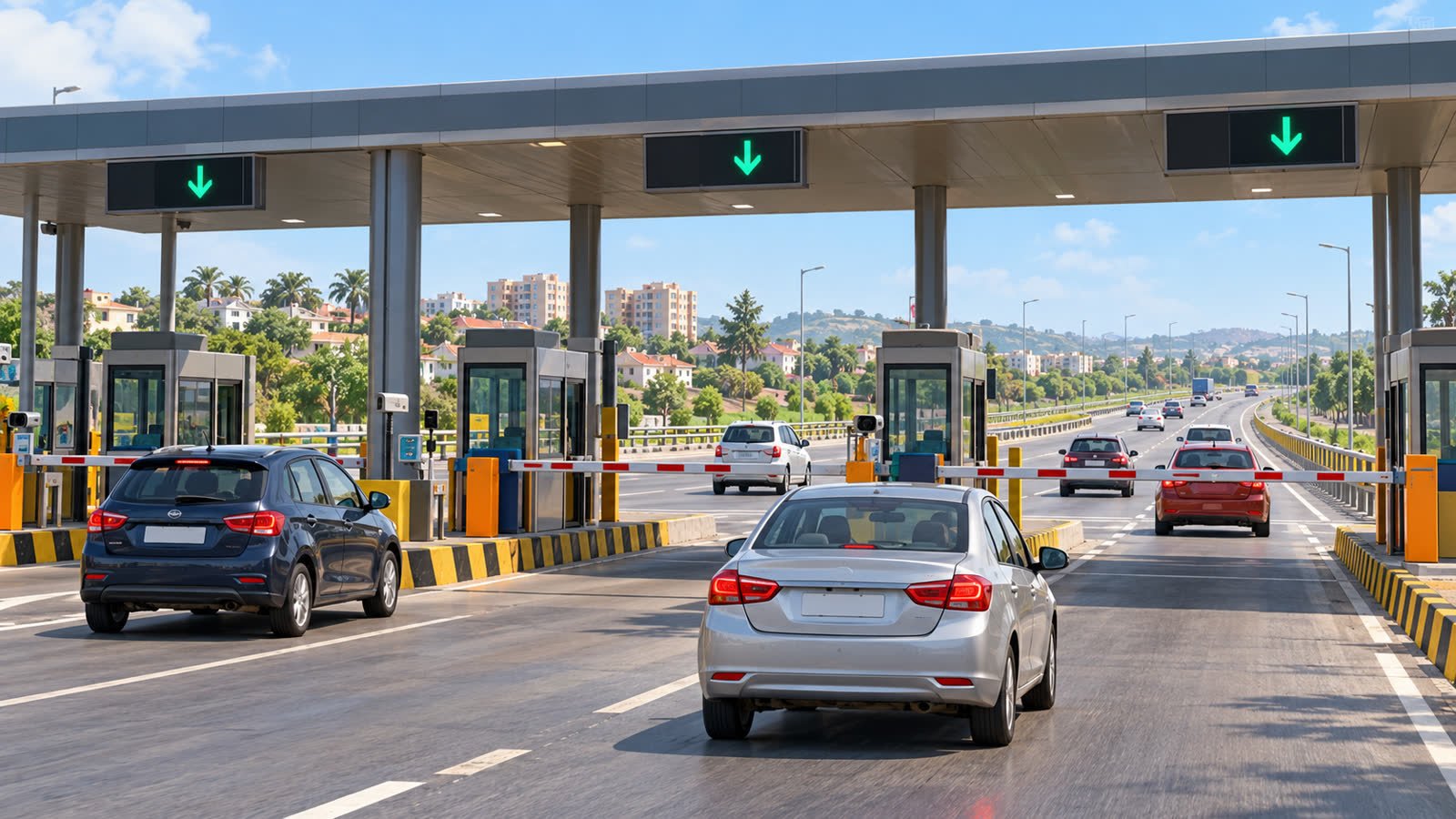
Hero image: illustrative digital artwork of a representative toll plaza; it is not a photograph of a specific NHAI location.
What changes from 1 November
The new provision gives qualifying local residents a choice between the existing monthly pass and a concessional annual local pass for commuting through one fee plaza. The government’s 27 October release says the annual pass is valid only for that fee plaza and cannot be transferred to another plaza. That distinction is important for anyone whose regular journey crosses several toll points.
The fee depends on the plaza’s location
The Ministry’s fee structure has two bands. A fee plaza outside municipal or local-town limits attracts an annual charge of ₹1,500, while a plaza within those limits attracts ₹3,000. On a simple annualised basis, those amounts equal ₹125 a month and ₹250 a month respectively; these are arithmetic equivalents, not separate monthly tariffs.
| Eligible plaza location | Annual local pass | Annualised equivalent |
|---|---|---|
| Outside municipal or local-town limits | ₹1,500 per year | ₹125 per month |
| Within municipal or local-town limits | ₹3,000 per year | ₹250 per month |
That gives frequent commuters a simple comparison: multiply the current monthly-pass charge for the relevant plaza by 12 and compare it with the applicable annual fee. The comparison is useful only after confirming that the particular plaza, vehicle and address meet the new rules.
Who can qualify
The rule is aimed at residents who use a National Highway fee plaza near home, not at commercial fleets or occasional highway travellers. The main checks are:
- The vehicle must be non-commercial and covered by the local-pass provision.
- The owner must reside within 20 km of the relevant fee plaza.
- The vehicle must have a valid and functional FASTag registered for non-commercial use.
- The pass must be linked to the particular fee plaza being used and cannot be moved to another plaza.
The Indian Express reported that the eligibility process uses DigiLocker and VAHAN to check the resident’s address, vehicle details and linked FASTag. Users should therefore keep the vehicle and address records consistent before attempting to obtain the pass.
Where the local pass will not apply
The new concession is not universal. The government says it will not be available on National Highways or expressways where the fee is collected through a closed user-fee system. It also will not be issued where a service road or alternative road is available for commuters.
It should not be read as a route-wide toll exemption. A local pass bought for one plaza will not cover another plaza farther along the same journey. Drivers planning a longer trip can use the toll-charge calculator to estimate the full route cost rather than assuming that a local pass covers every toll.
How and when to get it
The notified timetable has two stages. The annual local pass is to be available at eligible toll plazas from 1 November 2026. The Ministry says it will also be available through the Rajmargyatra app from 1 December 2026.
Before paying, a resident should confirm the exact fee plaza, check whether the plaza falls inside or outside municipal limits, and verify that the linked FASTag is active. The government’s wording allows eligible users to choose between the monthly and annual local pass; it does not say that every plaza will offer the annual option.
What it means for daily commuters
For a resident who crosses the same toll point repeatedly, the annual option could reduce the administrative burden of renewing a monthly pass and may lower the total paid over a full year, depending on the applicable band. The practical value is strongest when the same plaza is used often enough to justify an annual commitment. It is weaker for occasional users, for journeys that use alternative roads, or for trips that cross multiple plazas.
The change also makes the address-radius test more important. Living in the same district or near a highway is not the same as satisfying the 20 km condition for a specific plaza. The eligibility decision is tied to the plaza and the records used to verify the vehicle owner’s residence.
Checklist before relying on the pass
- Identify the exact toll plaza used for the regular commute.
- Confirm the registered address is within 20 km of that plaza.
- Check that the vehicle is non-commercial and the FASTag is active and correctly linked.
- Check whether a service road or alternative road removes eligibility.
- Compare the relevant annual fee with the current monthly-pass cost and expected usage.
- For complaints, balance or toll-rule questions, consult the FASTag toll-rules guide and the official Rajmargyatra channels.
What to watch next
The immediate milestone is the 1 November 2026 start at eligible plazas, followed by the stated 1 December 2026 Rajmargyatra-app availability. The government has also reserved the ability to revise the rates each year, with any revision taking effect on 1 April. That means users comparing the pass over several years should recheck the fee rather than treating ₹1,500 or ₹3,000 as a permanent price.
For a journey that extends beyond the local plaza, the road-trip planner can help separate the local commute question from the wider fuel, toll and time calculation.
Sources
- Press Information Bureau, “Government of India Introduces Concessional Local Pass for National Highway Users Living Near Fee Plazas”, 27 Oct 2026
- Autocar India, “Govt introduces FASTag local pass for residents within 20km of toll plazas”, 28 Oct 2026
- The Indian Express, “Cheaper toll plaza travel for local residents: How NHAI’s new annual pass works”, 28 Oct 2026