India’s festive electric-vehicle retail rose 26.78% year on year during the 11–20 October 2026 Navratri period, even as dealers and automakers reported that supply was struggling to keep pace. For buyers, the headline is a split market: interest in EVs is rising, but a booking does not guarantee an immediate delivery because availability depends on the model, variant and battery-related supply chain.
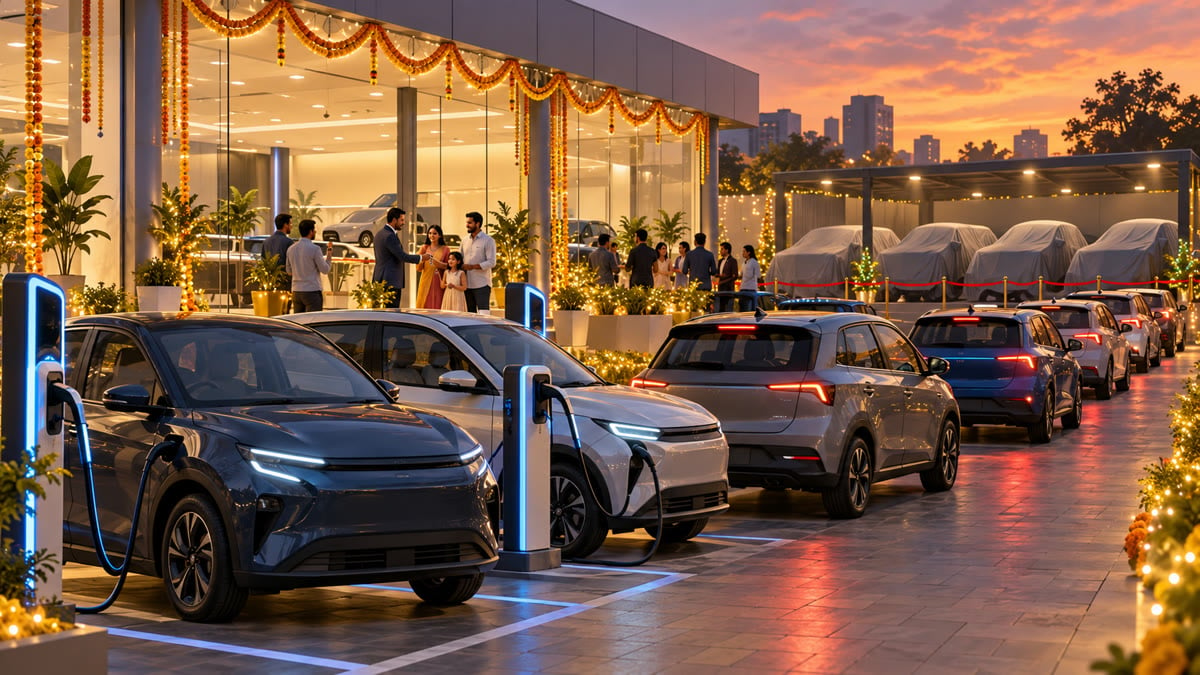
Image note: The hero is an illustrative editorial visual generated for this article. It is not a photograph of a specific EV model or dealership.
Key takeaways
- Provisional Federation of Automobile Dealers Associations (FADA) data recorded 1,17,437 EV retail sales across segments during Navratri 2026, compared with 92,628 in Navratri 2025.
- Electric passenger-vehicle retail rose 25.97% to 12,305 units from 9,768 a year earlier, even while overall passenger-vehicle retail fell against the unusually strong 2025 comparison.
- Business Standard reported Hyundai’s Creta Electric waiting period at four to six weeks, extending to eight weeks for some variants; wider industry reports cited waits of up to eight months for some EVs.
- Buyers need to separate the advertised model from the actually available variant, then check delivery timing, charging access and the running-cost assumption behind the purchase.
What the festive data shows
FADA’s provisional retail data covers the ten days from 11 October to 20 October 2026. Across electric two-wheelers, three-wheelers, passenger vehicles and commercial vehicles, retail reached 1,17,437 units, up from 92,628 during Navratri 2025. That is a 26.78% increase. The figures are provisional retail data compiled from transport-office registrations, according to ETAuto and Rediff.
Electric passenger vehicles accounted for 12,305 of those 2026 sales, compared with 9,768 in the corresponding 2025 period, a 25.97% increase. Electric two-wheelers were the largest part of the EV total at 75,758 units, up 33.41% from 56,787. Electric commercial vehicles rose 96.04% to 1,288 units, but that increase came from a much smaller base. These are retail registrations, not factory dispatches, so they show vehicles reaching customers rather than the exact number produced during the period.
The comparison needs context. Navratri 2025 ran for 11 days and coincided with the GST 2.0 rate change, which brought a large amount of deferred buying into that window. In 2026, the overall passenger-vehicle total was 1,82,728 units, down 21.91% from 2,34,004 a year earlier, while EV passenger-vehicle retail still increased. ETAuto and Times of India Auto both reported that FADA’s figures make the powertrain shift more visible than the headline total alone.
Why deliveries are taking longer
Recent reporting points to a supply problem rather than a simple lack of buyer interest. Business Standard reported that automakers were facing shortages across petrol, CNG and electric vehicles, with EV availability particularly affected by specialised chips, components and logistics. ETAuto separately reported that dealers were finding vehicles unavailable even as demand rose, and that global supply-chain uncertainty was adding pressure.
Waiting periods are not uniform across India or across a single product line. In its 22 October 2026 report, Business Standard said Hyundai Motor India told the outlet that demand for the Creta Electric had roughly doubled from about 400–500 units a month to about 1,000 in recent months. The company put the wait at four to six weeks, stretching to eight weeks for some variants after a supplier fire affected deliveries. Those figures are company comments reported by the outlet; they are not a national waiting-period rule.
Rediff’s 29 October 2026 report also carried a wider warning from FADA’s president that some buyers had faced waits of up to eight months. That should not be read as the wait for every EV. It shows why a broad “EV waiting period” number can mislead: the actual window can change with battery size, trim, colour, plant allocation, shipping and dealer inventory.
Who is most exposed to the delay
The immediate impact falls on buyers who need a vehicle by a fixed date, including households planning a festive delivery and operators whose vehicle must enter service quickly. A delayed registration also delays the point at which a buyer can begin using the vehicle to replace petrol or diesel trips. For delivery riders, taxi operators and small commercial users, the operating-cost case may be strong, but the vehicle is useful only after it arrives and charging is available where it works.
There is also a risk of comparing a headline price or a popular model with a different variant that a dealer can actually deliver. A base trim may have one battery size and charging equipment, while a higher trim may be the one in stock. A written quotation should make the exact variant, ex-showroom price, on-road charges, charger package and expected handover window clear. Manufacturer and dealer estimates can change, so the date of the quote matters.
What buyers can check now
Confirm the supply position
Ask which exact variant is allocated, whether the vehicle has a manufacturing or dispatch slot, and whether the stated date is an estimate or a committed handover date. Check the booking terms for cancellation, refund and price-revision conditions. A dealer’s available-stock statement is not the same as a nationwide availability claim.
Compare running cost with a real route
EVs remove petrol or diesel purchases from the trip, but charging cost depends on home electricity, public-charging tariffs, charging losses and how often rapid charging is used. Use the fuel-cost calculator to establish the petrol or diesel baseline for a regular route, then compare it with the actual charging tariff available to the vehicle. The result is an estimate, not a promised saving.
Map charging before taking delivery
Check the state-wise EV charging directory for stations near home, work and regular stops. A buyer who depends on public charging needs to verify opening hours, connector compatibility and whether a station is realistically on the route rather than merely present on a map.
Test the long-trip assumption
For a highway journey, use the road-trip planner to examine distance and stop points, then confirm charging availability separately. This is particularly important during the festive rush, when a busy station can add time even if the route has enough nominal chargers.
What to watch after Diwali
The next useful test will be the complete October retail picture, including the Dhanteras-to-Diwali period. It should show whether the Navratri rise in EV retail was sustained and whether manufacturers were able to turn bookings into registrations. Inventory at dealerships, battery-component availability and delivery times for high-volume variants will be more useful signals than enquiry numbers alone.
Charging capacity is another watch point. Stronger EV retail increases the need for reliable home and public charging, but the retail data does not say how many buyers have a dedicated charger, how often they charge away from home or whether a particular city has enough fast-charging capacity. Those are local ownership questions, not conclusions that can be drawn from national registration totals.
Reader takeaway
India’s festive EV numbers confirm that electric mobility is moving beyond a niche purchase, but they do not remove the practical constraint of getting the vehicle on time. The useful decision point for a buyer is the exact available variant, its written delivery window and the charging plan for the first month of ownership. Compare those details with the route and running cost you actually expect, and treat broad industry growth figures as market context rather than a promise about one booking.
Sources
- Rediff.com — “Festive Season Sees EV Demand Outstrip Supply, Long Waiting Periods” — 29 Oct 2026
- Business Standard — “EV supply struggles to keep pace with surging demand during festive season” — 22 Oct 2026
- ETAuto — “Navratri vehicle retail dips 6.5% on high base, EVs buck trend with 27% growth: FADA” — 21 Oct 2026
- TOI Auto — “Navratri 2026 Auto Retail Falls 6.5% YoY, EV Sales Cross 1.17 Lakh: FADA” — 21 Oct 2026