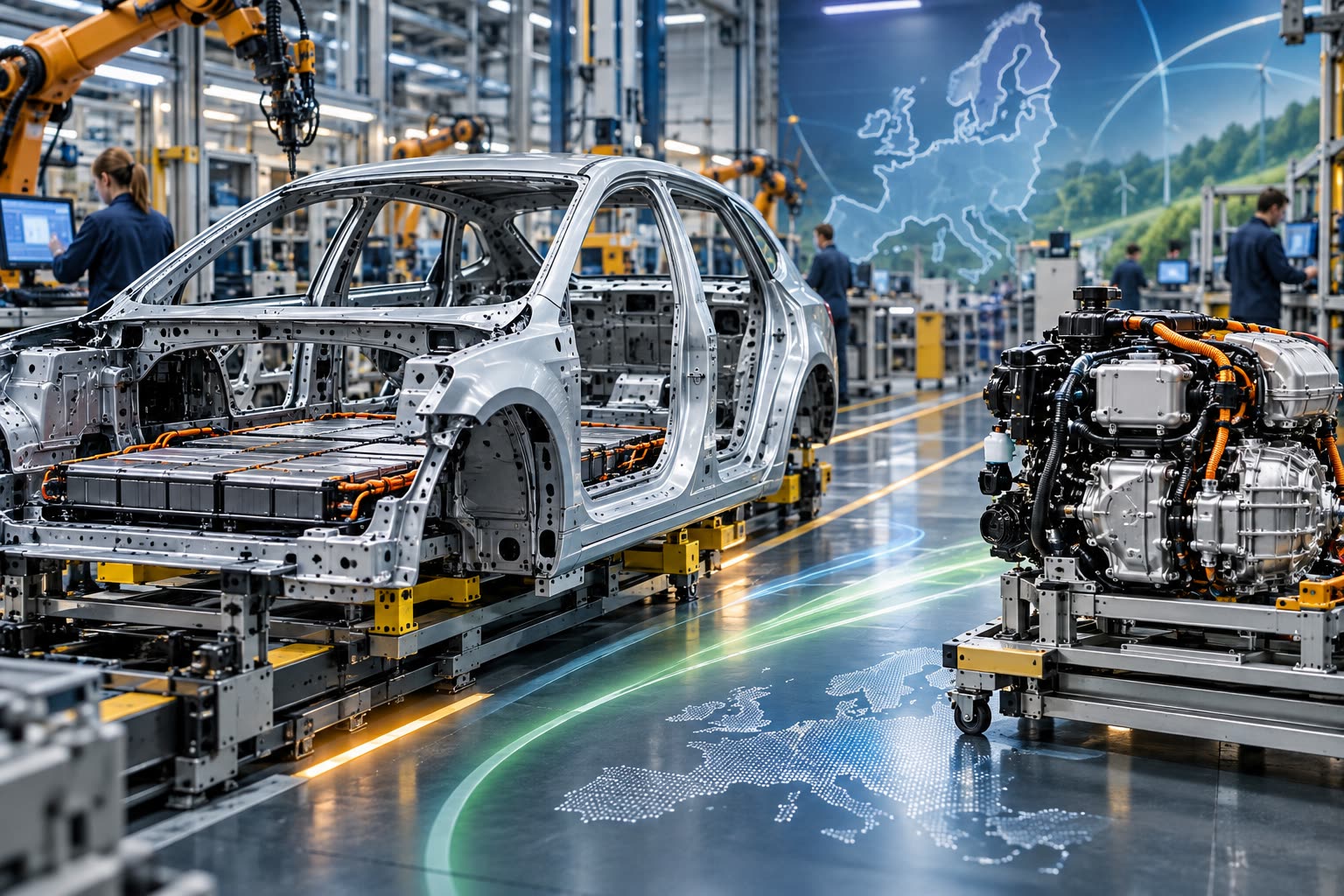
France and Germany agreed on 16 October 2026 to support a revised European auto framework that would require a 90% reduction in fleet-average tailpipe CO₂ emissions from new cars by 2035, while keeping room for hybrids, biofuels and other low-carbon technologies. The position is politically important but not yet an EU rule: it still needs wider member-state backing, a final legislative text and European Parliament approval, so the current 100% target remains in force for now.
Key takeaways
- The joint Franco-German position backs a 90% tailpipe-emissions reduction target for new cars from 2035.
- Unlike the European Commission's earlier proposal, the remaining 10% would not need an additional compensation measure under the reported compromise.
- Hybrids, plug-in hybrids, range extenders and low-carbon fuels could retain a role, but the exact rules are still being negotiated.
- There is no immediate change for drivers or existing petrol and diesel vehicles; current EU law remains the operative framework.
What France and Germany agreed
German Chancellor Friedrich Merz said after the European Council meeting that Berlin and Paris had reached an understanding on the future of Europe's automotive policy. He described the approach as 90% CO₂-free from 2035, with the remaining 10% not requiring compensation, while also allowing biofuels and other technologies to contribute to the climate goal.
The language matters. This is a joint political position from two major European carmaking countries, not an adopted regulation. Merz said the plan still needed legislative implementation and support from the European Parliament. Reuters likewise reported that France and Germany were trying to soften the proposed rules and that the details still required wider European backing.
The compromise also connects emissions policy with industrial policy. The Franco-German plan would give greater weight to European production in relevant public purchasing, subsidy and investment rules. Reuters reported that the proposed definition of "Made in EU" would cover the 27 EU member states and European partners that were part of the bloc's internal market on 1 January 2020, a category that would include the United Kingdom. The exact eligibility conditions and reciprocity requirements are not final.
Why the 90% target matters
Under the current EU framework, new cars and vans are subject to a 100% fleet-wide CO₂ reduction target from 2035, expressed by the European Commission as 0 grams of CO₂ per kilometre. The Commission's proposed automotive package already introduced a 90% tailpipe-reduction route, but said the remaining 10% would be addressed through low-carbon steel made in the Union, e-fuels and biofuels.
The Franco-German position would go further in one respect: it would keep the 90% target without requiring an extra compensation mechanism for the remaining emissions. That would give manufacturers more technology flexibility on paper, particularly for hybrid and renewable-fuel pathways. It would not, however, remove the need to meet the final legal standard if the EU adopts a different text after negotiations.
For drivers, the practical distinction is between a sales and production rule and a vehicle-use ban. The 2035 framework concerns new passenger cars and vans registered in the EU. It does not require an existing petrol, diesel or hybrid vehicle to be scrapped or taken off the road. It could influence which new powertrains remain available, how manufacturers allocate research budgets and which models qualify for public support.
What it means for buyers and fleets
There is no immediate change to showroom eligibility, fuel rules or charging requirements. Buyers who are considering a vehicle before 2035 should therefore treat claims about the final post-2035 mix as provisional until the European Commission, member states and Parliament agree the legal text.
If the position becomes law, the market signal would be more technology-neutral than a simple all-electric mandate. Battery-electric models would remain central to the transition, while hybrids, plug-in hybrids, range extenders and vehicles using qualifying low-carbon fuels could have more room than under a strict zero-tailpipe outcome. That could affect model availability, residual values and the balance between upfront cost, fuel use and charging access, but none of those outcomes is guaranteed by the political agreement alone.
For a real trip or monthly budget, the useful comparison is still vehicle-specific: fuel economy, electricity consumption, local fuel prices, charging access and annual distance can outweigh a headline about future regulation. Drivers comparing petrol or hybrid running costs can use the fuel cost calculator, while live fuel prices help keep the fuel side of that comparison current.
What it means for manufacturers and suppliers
Automakers would gain planning flexibility if the 90% position is adopted, but they would also face stronger pressure to show where vehicles, batteries and components are made when seeking public support. The reported European-preference element could reward local assembly and sourcing while creating additional compliance questions for vehicles built in neighbouring countries or imported from Asia.
That tension is why the agreement matters beyond France and Germany. Europe is trying to defend an industrial base, accelerate EV production and compete with Chinese manufacturers at the same time. A broader technology menu may help factories keep hybrid and combustion-related expertise, while European-content rules could push investment toward batteries, power electronics and other components made within the region. The final balance will be set by the legal text, not by the announcement.
What changes now
Nothing changes immediately. The current EU 2035 target remains the reference point until a new regulation is approved. The next milestones are a wider agreement among EU governments, a Commission legislative process and a vote in the European Parliament. The definition of eligible European production, treatment of renewable fuels and rules for hybrids will be important signals to watch.
For now, the clearest takeaway is that Europe has moved closer to a 90% emissions framework, but it has not rewritten the rules. EV buyers and fleet operators can monitor the policy while comparing actual fuel, charging and maintenance costs; drivers planning an electric transition can also check the EV charging directory for the networks available in their region.
Sources
- German Federal Government, "Press statement by Chancellor Merz after the European Council Autumn 2026" (16 Oct 2026)
- European Commission, "Cars and vans" (accessed 17 Oct 2026)
- Reuters, "France and Germany reach agreement on vehicle emissions and UK status" (16 Oct 2026)
- DW, "Germany, France agree deal to support Europe's struggling car industry" (16 Oct 2026)
- Le Monde, "The Franco-German auto agreement spares Stellantis but leaves Renault exposed" (16 Oct 2026)