Road Transport and Highways Minister Nitin Gadkari said on 27 Oct 2026 that the recent backlash over E20 petrol was a “paid campaign” at a Confederation of Indian Industry conference. The remarks came a day after the Ministry of Road Transport and Highways (MoRTH) notified amendments that add E100 alongside E85 for certified flex-fuel vehicles, but the rule does not ask existing E20 cars or bikes to switch fuel or be modified.
For drivers, the practical point is the distinction between E20-compatible vehicles and vehicles certified for much higher ethanol blends. The new rule creates a regulatory path for future flex-fuel models; it does not turn every petrol vehicle into an E85 or E100 vehicle.
Key takeaways
- Gadkari made the “paid campaign” remark at a CII event in New Delhi on 27 Oct 2026, according to reports by The Indian Express and The New Indian Express.
- MoRTH’s 26 Oct 2026 release says E85 and E100 are for vehicles specifically designed and certified as flex-fuel vehicles.
- E20 compatibility does not by itself establish suitability for E85 or E100.
- Existing vehicle owners do not have to modify their vehicles or switch fuel because of this notification.
- Owners should follow the fuel-compatibility sticker and the manufacturer’s owner’s manual before using any higher ethanol blend.
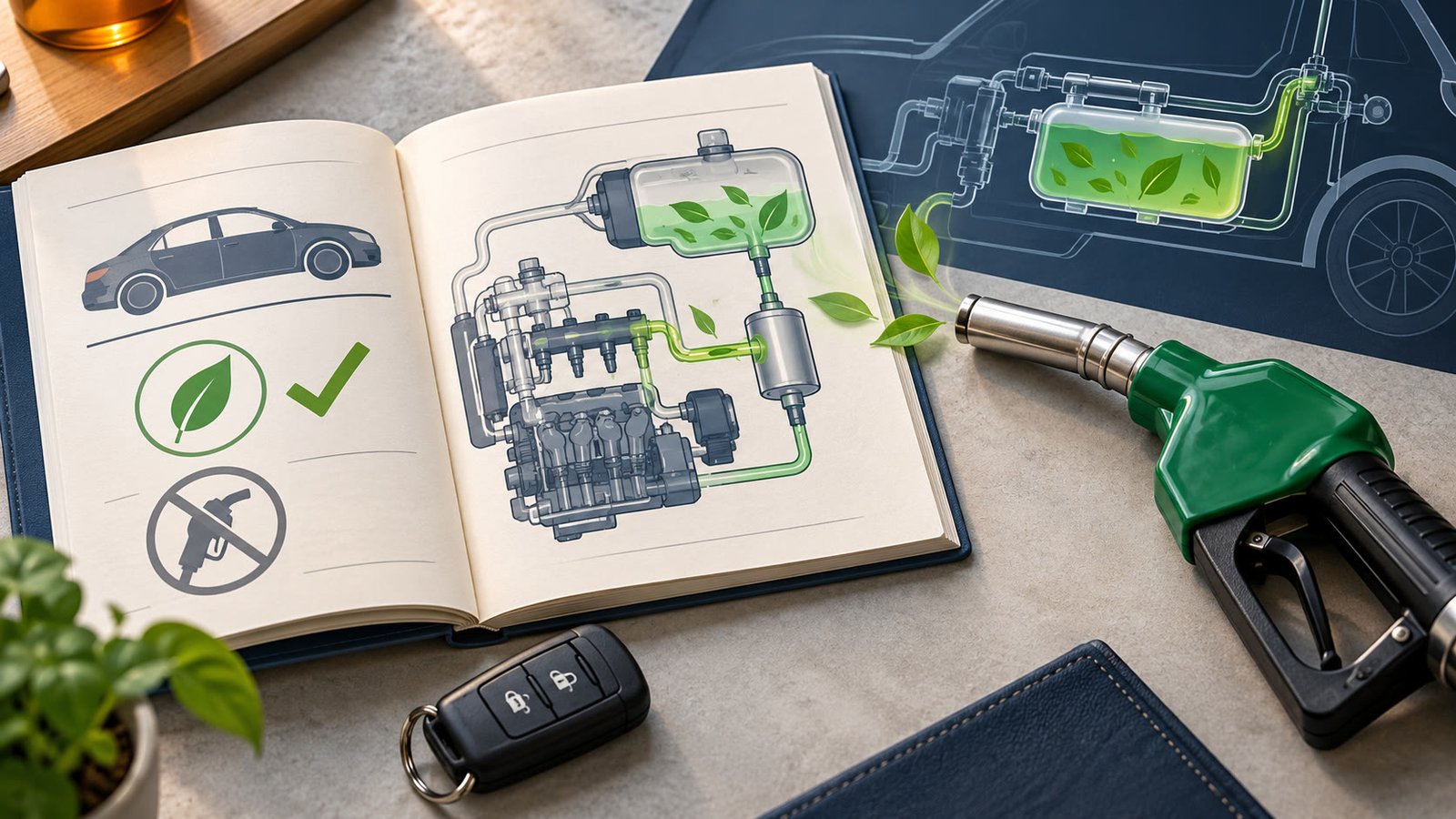
Illustration: AI-generated editorial visual of a vehicle fuel-compatibility check; it is not an official product photograph.
What Gadkari said about E20 petrol
Gadkari’s comment was made while speaking about alternative fuels and highway development at the CII national conference on “Highways of India’s Future: Smart, Safe and Sustainable”. The Indian Express and The New Indian Express both reported that he described the recent public anger over 20% ethanol-blended petrol as a paid campaign. That is the minister’s characterization of the controversy, not a new compatibility test or a fresh change to the fuel rules.
The timing matters because the government had announced a separate regulatory update the previous day. The latest statement therefore puts the political debate and the technical rule change in the same news cycle, but they should not be treated as the same thing.
What the E85 and E100 rule actually changes
MoRTH’s 26 Oct 2026 PIB release says the Central Motor Vehicles Rules, 1989, now expressly include E100 alongside E85 in the emission-certification provisions. The ministry describes E85 as petrol containing up to 85% ethanol by volume, while E100 is a fuel consisting predominantly of ethanol.
The rule is enabling rather than compulsory. It gives manufacturers a clearer certification route for flex-fuel vehicles whose fuel-system components, materials and engine controls are designed for the approved blend range. The same MoRTH release says E85 or E100 is intended only for vehicles specifically designed and certified for those fuels, and that compatibility with E10 or E20 alone does not establish suitability for E85.
MoRTH also says the amendment does not require existing owners to switch to E85 or modify their vehicles, and that the rules take effect from publication in the Official Gazette. That is why a conventional petrol car or two-wheeler should continue to be operated according to its maker’s declared fuel compatibility, not according to the headline about E100.
Fuel users who want the wider background can read our earlier explainer on the E100 flex-fuel rule. It covers the notified change; this follow-up focuses on the fresh E20 remarks and the owner checks that matter now.
E20, E85 and E100 are not interchangeable
The labels describe different ethanol concentrations. E20 means petrol blended with 20% ethanol. E85 means a blend with up to 85% ethanol, while E100 is predominantly ethanol. A vehicle approved for one blend should not automatically be assumed to be approved for another, particularly when the higher blend requires different fuel-system materials and calibration.
This distinction is important for older vehicles and for buyers considering future flex-fuel models. A vehicle’s fuel sticker and owner’s manual are the first references. If the vehicle documentation does not declare compatibility with a particular blend, the MoRTH notification does not provide permission to use that fuel.
What the government’s technical record says
In a written Rajya Sabha answer dated 17 Dec 2025, the road transport ministry said an inter-ministerial committee had examined vehicle compatibility and mileage, supported by research from Indian Oil Corporation, the Automotive Research Association of India and the Society of Indian Automobile Manufacturers. The official answer said field trials with E20 did not indicate compatibility issues or negative effects, including abnormal wear in legacy vehicles, across parameters such as drivability, startability and material compatibility.
That is the government’s stated technical position and should be read separately from the minister’s “paid campaign” remark. The same answer also noted that real-world mileage is influenced by driving habits, maintenance, tyre pressure, alignment and air-conditioner use. In other words, a driver evaluating running cost should look at measured fuel economy over comparable trips rather than infer a mechanical problem from a single social-media claim.
What vehicle owners should check now
- Check the fuel label: look at the vehicle’s fuel-compatibility sticker and confirm the blend range stated by the manufacturer.
- Read the manual: use the owner’s manual for fuel, service and warranty instructions instead of assuming that E20, E85 and E100 are equivalent.
- Separate rule from availability: the E100 amendment enables certified vehicles; it does not by itself announce a nationwide E100 pump network or require a fuel change for existing vehicles.
- Track your own cost: compare actual kilometres per litre and the local pump rate. Drivers can check current petrol prices and estimate a route’s outlay with the fuel cost calculator.
For fleet operators, the same checklist applies at a larger scale: verify every vehicle’s declared blend compatibility, confirm that the planned fuel is available on the operating route, and record service or warranty conditions before changing procurement or maintenance practice. The new rule may widen future vehicle choice, but it does not remove the need for that vehicle-level verification.
What to watch next
The next evidence will come from vehicle manufacturers and fuel retailers. Manufacturers would need to certify specific flex-fuel models, while retailers would need to make the approved higher blends available with clear labelling. Until those steps occur, the immediate consumer takeaway remains narrow: E20 users are not being instructed to move to E85 or E100, and the latest notification does not change the fuel recommended for an existing vehicle.
Gadkari’s statement has reopened the public conversation around E20, but owners will get the most useful answer from the compatibility information attached to their own vehicle. The notified rule expands what can be certified in future; it does not override the manufacturer’s instructions for the car or two-wheeler already in the driveway.
Sources
- The Indian Express — “E20 protest was a paid propaganda, says Nitin Gadkari” — 27 Oct 2026
- The New Indian Express — “Gadkari calls E20 fuel criticism ‘paid campaign’, says four crore cars run trouble-free” — 27 Oct 2026
- Press Information Bureau / MoRTH — “MoRTH updates rules to facilitate E85/E100 flex fuel vehicles” — 26 Oct 2026
- Rajya Sabha — Written Answer No. 2013, “Transition to E20 Fuel and Discontinuation of E10 Petrol” — 17 Dec 2025