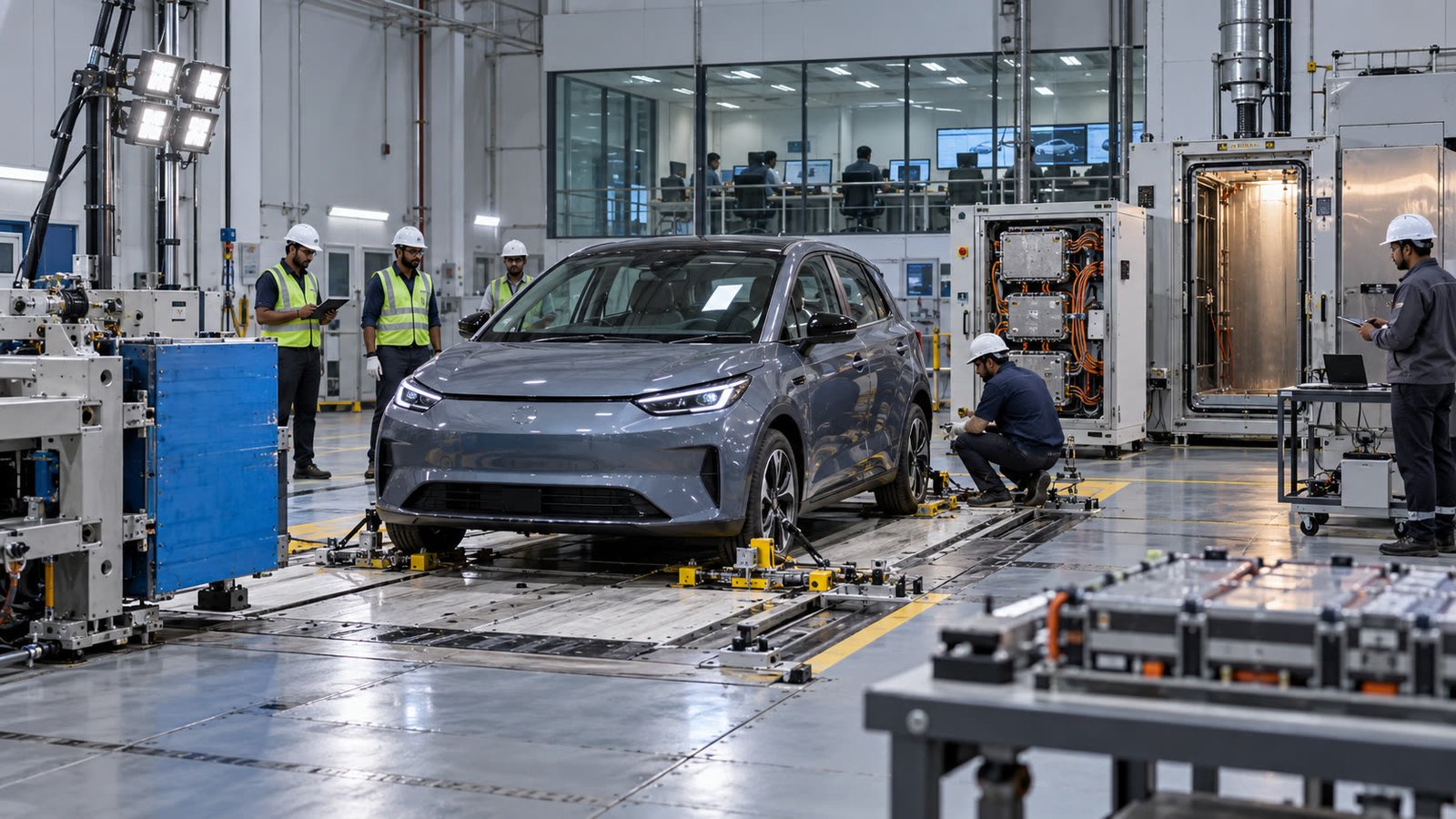
 Editorial illustration generated for FuelPrice; it is not an official GARC photograph.
What changed: Chennai-based Global Automotive Research Centre (GARC) is expanding its testing capacity for electric vehicles, batteries, advanced driver-assistance systems (ADAS), crash safety and heavy commercial vehicles under the PM E-DRIVE scheme. The change does not create a new buyer subsidy or an immediate compliance task, but it could give Indian manufacturers more domestic capacity to validate safety and performance before new EVs reach the road.
Autocar Professional reported the upgrade on 28 Sep 2026. For drivers, buyers and fleet operators, the important point is that this is a back-end infrastructure development: it affects how vehicles and components can be tested and certified, not the price or range of a particular EV today.
Key takeaways
- GARC's Oragadam facility near Chennai is adding EV, battery, ADAS, crash-safety and heavy-commercial-vehicle testing capability.
- The Ministry of Heavy Industries' 2025-26 annual report records a ₹780 crore allocation for upgrading four PM E-DRIVE testing agencies and a ₹776.29 crore consolidated proposal approved for the work.
- PM E-DRIVE has a ₹10,900 crore outlay and has been extended to 31 March 2028, according to the official scheme record and current reporting.
- The announcement does not ask existing EV owners to retrofit vehicles, and it does not promise a retail price cut or a new purchase incentive.
What GARC is adding
GARC operates at Oragadam, Chennai, and is an automotive testing agency under the Ministry of Heavy Industries' National Automotive Board. Its work covers testing, research, homologation and certification. The latest upgrade is designed to broaden that role as electric and electronically controlled vehicles become more common.
According to Autocar Professional, the planned additions include EV and EV-battery testing, electromagnetic-interference and electromagnetic-compatibility testing, a heavy-commercial-vehicle testing facility, a powertrain-laboratory upgrade, passive-safety equipment, ADAS test equipment and component-testing capability. Installation of the procured equipment has begun, the report said.
These facilities matter because a vehicle's battery system, powertrain, electronic systems and safety functions must be assessed against applicable requirements before a model can be cleared for sale. A larger domestic testing base can make that process more predictable for manufacturers and component suppliers, although it cannot replace model-specific test results or regulatory approval.
How the PM E-DRIVE funding fits
The Ministry of Heavy Industries' Automotive Industry Annual Report 2025-26 says the committee of PM E-DRIVE testing agencies submitted a consolidated ₹776.29 crore proposal on 11 July 2025 after industry consultation. The report says the proposal was approved by the ministry's oversight committee and the Union heavy industries minister. It records a broader ₹780 crore allocation for upgrades at ARAI in Pune, ICAT in Manesar, NATRAX in Indore and GARC in Chennai.
NDTV's report from the PM E-DRIVE industry dialogue held on 25 September 2026 also cited ₹776.29 crore as the approved upgrade amount for those four centres. That independent check is useful because it separates the testing-infrastructure investment from the demand incentives that reduce the upfront cost of some eligible EVs.
The official PM E-DRIVE record lists the scheme's original ₹10,900 crore outlay and the 7 August 2025 extension to 31 March 2028. Autocar Professional likewise reported the ₹10,900 crore scheme size and the 31 March 2028 operating horizon. The testing-agency allocation is therefore one part of a wider programme that also covers electric buses, trucks, ambulances and charging infrastructure.
What this means for EV buyers and fleets
For a private buyer, the immediate effect is limited. There is no announced change to an existing vehicle's registration, insurance, charging routine or warranty because GARC is adding equipment. The benefit is indirect: future vehicles may have access to more local capacity for battery, electronic-interference, crash and ADAS validation before launch.
For fleet operators, especially those considering electric buses or commercial vehicles, stronger testing capability could support more consistent evidence on durability, safety systems and battery performance. It is still important to distinguish a testing facility from a safety rating or an approval: the facility performs assessments, while the vehicle and its manufacturer remain responsible for meeting the applicable standards.
Charging availability remains a separate ownership question. Readers planning an EV route can check the state-wise EV charging station directory before treating a testing upgrade as a complete mobility solution. For a petrol-vehicle baseline or a trip-cost comparison, the FuelPrice fuel-cost calculator can show how fuel use changes with distance and mileage.
What does not change today
- There is no new retail EV subsidy or manufacturer price announcement in the GARC upgrade report.
- Existing vehicle owners are not being asked to take their cars, scooters or commercial vehicles to GARC for a retrofit.
- A new test capability does not guarantee a particular model's range, crash performance, battery life or ADAS performance. Buyers and fleets still need to check the model-specific certification, warranty terms, service support and battery-safety information.
What to watch next
The next useful milestones are commissioning of the new equipment, the capabilities formally available for testing, and model-level certification or homologation updates from manufacturers. The Ministry's scheme notifications and the testing agencies' own public information should clarify when each facility becomes operational.
The reader takeaway is straightforward: GARC's upgrade is an ecosystem change, not a price-cut announcement. It can strengthen the testing layer behind India's EV market, but the practical buying decision will still depend on the individual vehicle's certified performance, safety evidence, charging access and after-sales support.
Sources
- Autocar Professional — “GARC Upgrades Automotive Testing Infrastructure Under PM E-DRIVE” — 28 Sep 2026
- Ministry of Heavy Industries — “Automotive Industry Annual Report 2025-26” — 28 Mar 2026
- NDTV Auto — “PM E-DRIVE: e-2W Penetration Nears 10%, e-3W L5 Crosses 46% As EV Adoption Gathers Pace” — 25 Sep 2026
- PM E-DRIVE, Ministry of Heavy Industries — “Scheme Notifications” — 7 Aug 2025 extension record