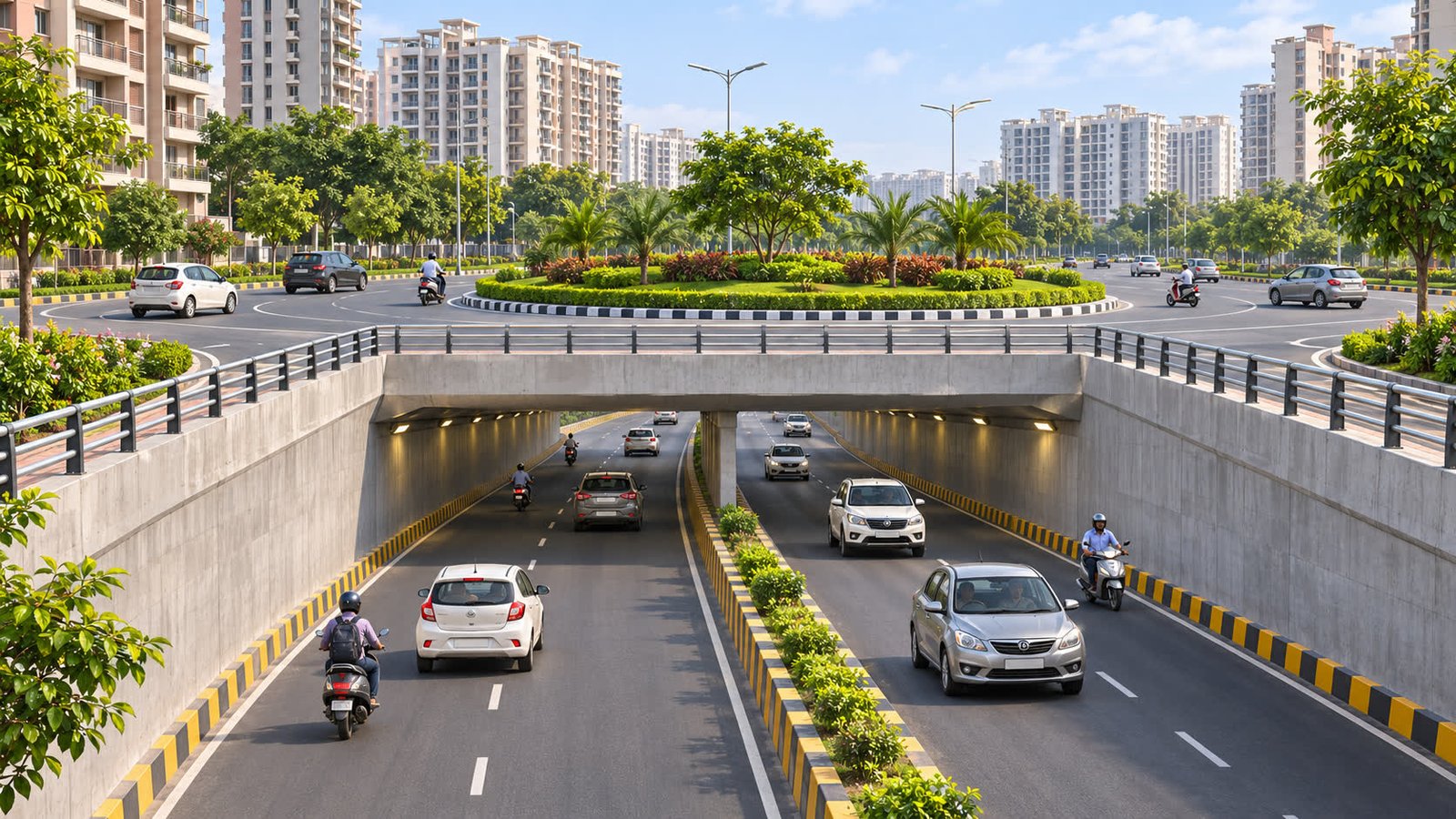
The Gaur Chowk (Char Murti Chowk) underpass in Greater Noida West is open for a traffic trial from 6 am on 5 November 2026 until 10 pm on 8 November 2026. It gives drivers moving between Greater Noida West, Surajpur, Ghaziabad and nearby Delhi-NCR corridors a new way to pass beneath one of the area’s busiest junctions, but the permanent opening is still conditional on the trial.
Current status as of 7 November 2026: the announced trial remains the operative arrangement; a permanent opening date has not been published.
Key takeaways
- The trial started at 6 am on 5 November and is scheduled to run until 10 pm on 8 November, according to the Greater Noida Industrial Development Authority (GNIDA).
- Reports describe the underpass as approximately 700 metres long and running parallel to the Taj Highway.
- It is intended to let through traffic bypass the Gaur Chowk roundabout, but reported traffic and capacity figures are authority estimates, not a confirmed post-trial result.
- GNIDA has made the regular opening conditional on the trial’s outcome and has not announced a permanent opening date.
- Drivers should follow signs and traffic personnel because access arrangements may be adjusted while the route is being tested.
What has opened at Gaur Chowk
Gaur Chowk, also known as Char Murti Chowk, is a major junction in Greater Noida West. The Indian Express described it as a connection point for movements towards Ghaziabad, Greater Noida’s Surajpur side, Delhi and the National Highway 24 corridor. NDTV reported that the new underpass is designed to make travel between Greater Noida West, Surajpur, the Delhi–Meerut Expressway and Crossings Republic more direct.
The underpass runs below the roundabout and parallel to the Taj Highway. That layout is meant to separate through movement from traffic using the junction itself. In practical terms, a driver travelling straight through the corridor may be able to avoid a signal cycle and the queue around the rotary, while local traffic still uses the surface roads and junction approaches.
The Indian Express reported that roughly one lakh vehicles pass through the intersection each day and that officials expected around 30,000 of them to use the underpass. NDTV reported the same broad authority estimate. Those figures describe the intended use of the project, not a verified reduction in journey time or fuel consumption. The actual benefit will depend on how traffic distributes between the underpass, surface lanes and nearby access roads after the trial.
This is a trial, not a final opening
In its 5 November update, GNIDA said the trial would run from 6 am on 5 November to 10 pm on 8 November. The authority’s position is that the route will be opened for regular vehicle movement if the test is successful. It also said the project was completed ahead of the original December 2026 schedule, but that does not amount to a permanent-opening notification.
NDTV reported that the trial is intended to check traffic flow, the signal system and operational gaps. The Indian Express also reported that any shortcomings identified during the test would be addressed before regular public use. This distinction matters to drivers: a route that is available during a supervised trial may not have the same access, lane pattern or operating status after the announced window closes.
The trial also coincides with a busy festival-travel period. That can create unusually high demand around shopping areas and residential corridors, making early traffic conditions harder to compare with an ordinary weekday. Drivers should therefore avoid assuming that one smooth or slow journey proves the underpass has permanently solved congestion at the junction.
What it means for daily commuters
For people who cross Gaur Chowk regularly, the immediate benefit is another through option rather than a guaranteed time saving. Before leaving, use a road-trip planner to compare the route through the junction with the alternative you normally take. Keep a time buffer during the trial because traffic staff may redirect vehicles if queues build at an entry or exit.
There is also a fuel-use question, but no official saving figure has been published. A shorter or less stop-start movement can reduce the fuel used by a petrol or diesel vehicle, while a temporary diversion or a slow approach can erase that benefit. A fuel-cost calculator can help compare the old and new route using the vehicle’s measured mileage and the current fuel price rather than an assumed saving.
If the journey continues towards a tolled expressway or another fee corridor, check the route separately with the toll-charge calculator hub. The underpass trial is a local traffic change; it should not be treated as a change to any toll fee unless the relevant authority issues a separate notification.
What drivers should check now
- Trial status: Confirm that the underpass is open before starting a journey, especially near the end of the announced window or after any operational update.
- Approach roads: Follow the latest lane markings, signs and instructions from traffic personnel instead of relying on an older route memory.
- Junction movements: NDTV reported that two U-turns were opened near the junction and that the parallel service road was resurfaced. Those changes may affect the way local traffic joins or leaves the corridor.
- Regular opening: Do not assume that access will continue after 8 November. Wait for GNIDA’s confirmation of the permanent operating arrangement.
- Trip cost: Compare actual time, distance and fuel use over several journeys before treating the underpass as a permanent cost or commute-time saving.
What happens after 8 November
The next decision rests on the trial’s traffic and operational results. GNIDA is expected to review how vehicles move through the underpass and surrounding junction, identify any shortcomings and then decide whether to open it for regular traffic. The authority has not published a final inauguration or permanent-opening date.
For commuters, the useful test is not only how many vehicles enter the underpass during its first trial days. It is whether queue length, surface-road movement and travel time remain manageable during normal peak periods once traffic behaviour settles. Until that evidence and the authority’s next update are available, the underpass is best treated as a live route option with a temporary status.
Reader takeaway
Greater Noida West drivers now have a new underpass option at Gaur Chowk, but the 5–8 November opening is a monitored trial rather than a confirmed permanent change. Check the route before travelling, follow on-ground instructions, and compare the real time and cost of the journey before building the underpass into a routine commute.
Sources
- Greater Noida Industrial Development Authority — Char Murti Chowk underpass trial update — 5 November 2026
- The Indian Express — Relief for Noida commuters: Long awaited Gaur Chowk underpass opens tomorrow for trial run — 4 November 2026
- NDTV India — Gaur Chowk underpass starts: travel between Greater Noida West, Surajpur, Delhi–Meerut Expressway and Crossings Republic to ease — 5 November 2026