Haryana’s Transport Department has told petrol, diesel and CNG outlets in the state’s National Capital Region (NCR) districts to verify a vehicle’s valid Pollution Under Control Certificate (PUCC) before refuelling, with manual checks required until automatic number plate recognition (ANPR) systems are fully operational. The instruction, reported on 3 Oct 2026, adds a state-level operating step to the NCR no-PUC, no-fuel rule that took effect on 1 Oct.
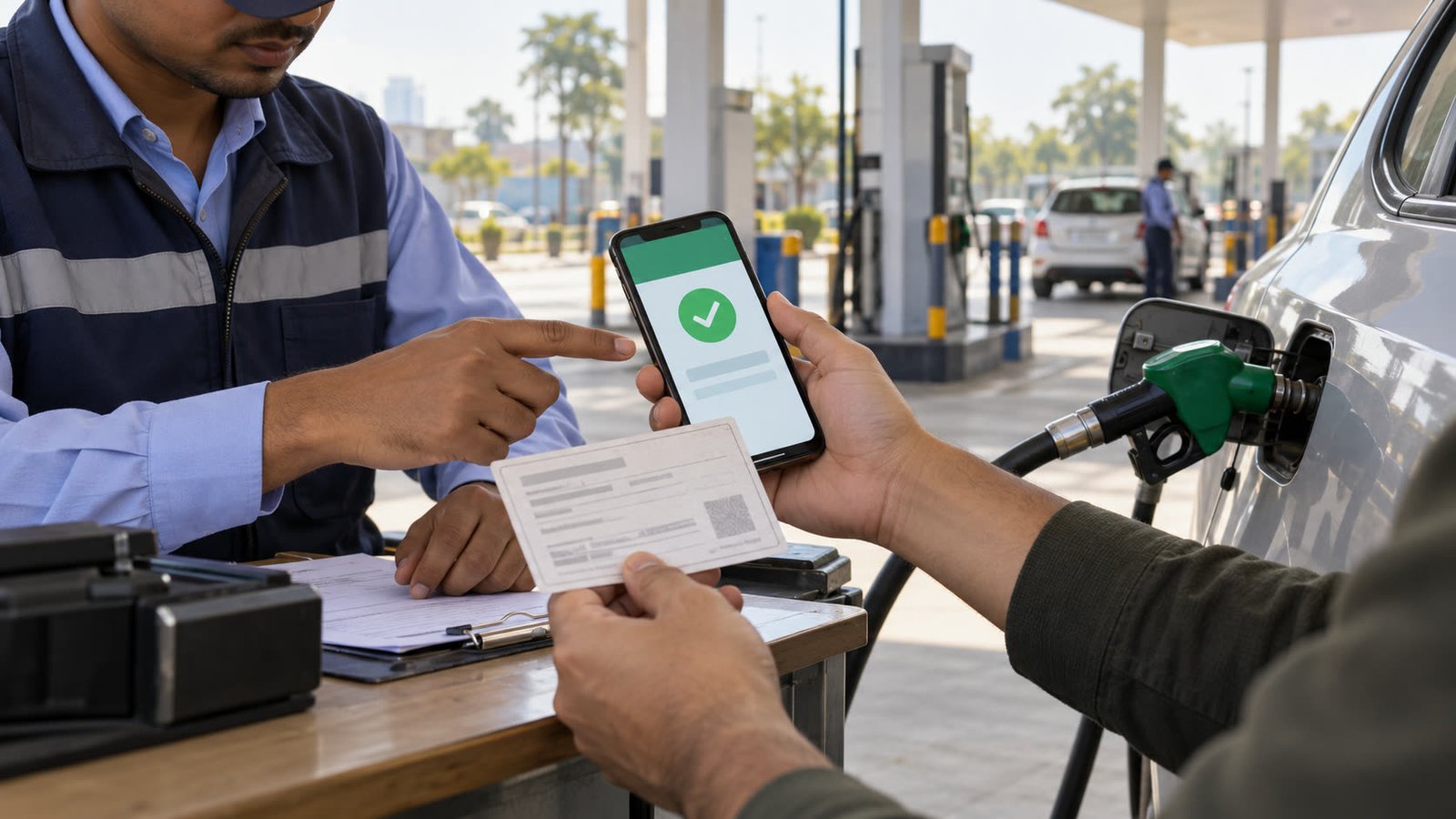
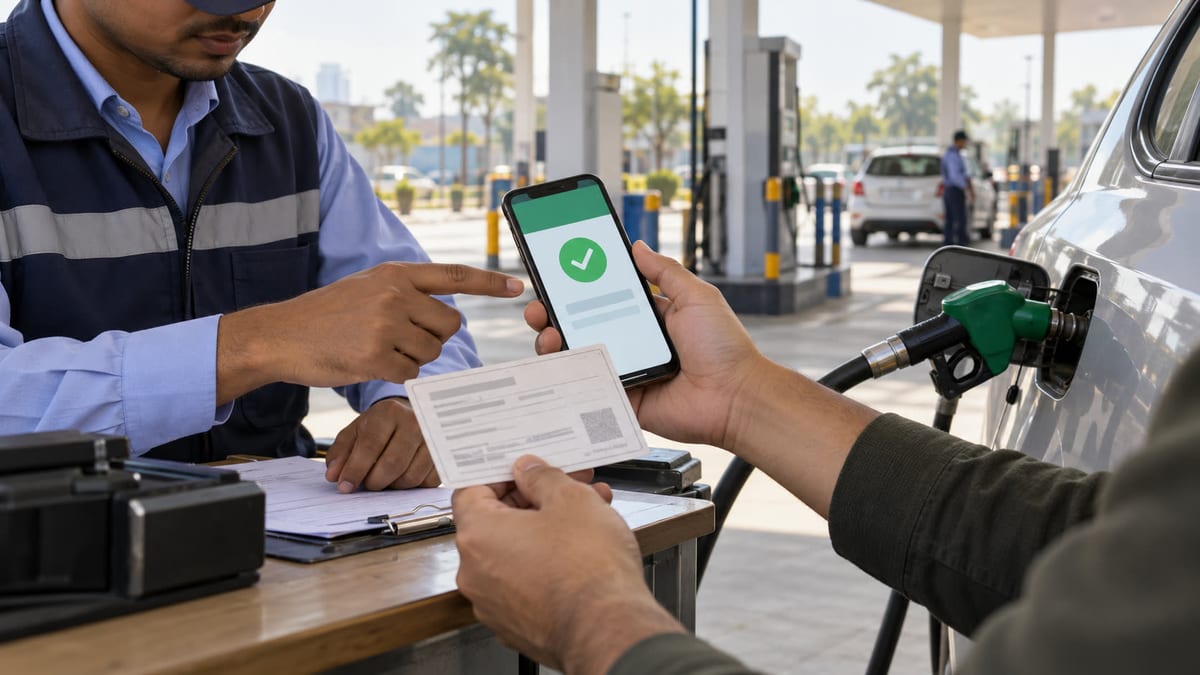 Illustrative editorial image of a manual PUCC check at a fuel station; it is not a photograph of a specific Haryana outlet. Credit: FuelPrice (AI-generated illustration).
Key takeaways
- The direction applies to fuel stations in Haryana’s NCR districts, not to every district in the state.
- Petrol, diesel and CNG outlets must verify a valid PUCC before refuelling under the current implementation instructions.
- Manual verification is required while ANPR systems and their online database links are being completed.
- If a valid certificate cannot be produced, the pump must refuse fuel and record the vehicle’s registration number for official purposes.
- Driving or operating a vehicle without a valid PUCC may attract a fine of up to ₹10,000 under the applicable Motor Vehicle Rules.
What changed at Haryana NCR fuel pumps
Hindustan Times and The Tribune reported on 3 Oct 2026 that Haryana’s Transport Department had directed petrol pump operators and retail outlets in the state’s NCR districts to check PUCC validity before dispensing fuel. The directions cover petrol, diesel and CNG stations and tell operators to deny fuel when a driver cannot produce a valid certificate.
The Gurugram district administration’s official release, posted on 1 Oct 2026, confirms the local operating position for petrol and diesel: distribution to vehicles without a valid PUCC is not permitted, ANPR installation is under way and joint teams from food and supplies, traffic police and the Regional Transport Authority may conduct vehicle checks. The Haryana-wide instruction is therefore an implementation update inside an existing NCR pollution-control framework, not a new petrol or diesel price revision.
This follows FuelPrice’s earlier Delhi-NCR no-PUCC, no-fuel enforcement report. The new development is the more specific operating instruction for Haryana’s NCR pumps while automated checks are still being installed.
How the verification is expected to work
ANPR is the planned automated route
Once operational, ANPR cameras at fuel stations are intended to read a vehicle’s registration number and match it with the online PUCC database. This is the technology-led process described in the Haryana directions and in the Commission for Air Quality Management’s (CAQM) Direction No. 101 framework.
The CAQM’s official 15 May 2026 release says Direction No. 101 envisages dispensing fuel across the NCR only after production of a valid PUCC from 1 Oct 2026. The stated purpose is to address vehicle emissions that contribute to PM2.5, nitrogen oxides and carbon monoxide. It does not change the displayed retail price of fuel.
Manual checks apply until systems are ready
The immediate practical point for drivers is that a camera is not required for the check to apply. Hindustan Times reported that, until ANPR systems are fully installed and operational across Haryana’s NCR districts, pump staff have been told to verify the PUCC manually before refuelling.
If a driver cannot produce a valid certificate, the pump must refuse fuel and record the vehicle’s registration number for official purposes. The vehicle is to be directed to the nearest authorised PUC testing centre. Operators have also been told to display prominent bilingual warnings in English and Hindi, implement the directions immediately and submit an action-taken report, according to the reported Transport Department order.
Who is affected
The rule applies to vehicles seeking fuel at covered stations in Haryana’s NCR districts. It is not an all-India fuel rule and does not apply automatically to districts outside the NCR. The CAQM wording is framed around fuelling in the NCR, so motorists entering the region should not assume that a vehicle registered outside Haryana will bypass the check.
Cars, two-wheelers, commercial vehicles and CNG vehicles may all face a certificate check when they refuel at a covered outlet. The useful detail is the certificate’s validity status, not merely whether a vehicle has ever undergone a test. A recently tested vehicle whose updated record has not appeared in the database may still need to show the available certificate or test receipt while the record is corrected.
FuelPrice’s PUC certificate check and renewal guide explains how to read the valid-until date, check the online record and prepare for a fuel-station verification. That process remains relevant nationwide, while the fuel-denial rule described here is specific to Delhi-NCR implementation.
Fuel denial and the possible fine are separate issues
A pump refusing fuel and a traffic or pollution fine are not the same outcome. The reported Haryana instructions say a vehicle without a valid PUCC can be denied fuel, while driving or operating such a vehicle may attract a fine of up to ₹10,000 under the applicable Motor Vehicle Rules. The wording is a maximum, not a statement that every refused refuelling automatically produces a ₹10,000 penalty.
The Tribune also reported that the Transport Department warned of punitive action for non-compliance with the directions. Operators and drivers therefore have different responsibilities: pumps must implement the verification process, while vehicle users remain responsible for keeping the vehicle’s emission certificate valid under the applicable rules.
What drivers should expect during the transition
Implementation may look uneven for a short period because the automated system is still being completed. One outlet may use a camera-linked lookup, while another may ask staff to inspect the certificate manually. That difference does not by itself mean the rule is optional; it reflects the transition method described in the current instructions.
A fresh PUC test can also take time to appear in a government-linked record. Keeping the current certificate or test receipt available can help explain a mismatch at the pump, but the final acceptance decision remains subject to the station’s operating instructions and the relevant authority’s records.
What to watch next
- Completion and operational coverage of ANPR cameras at Haryana NCR fuel and CNG stations.
- Whether the state publishes a station-level list or a public process for correcting PUCC and vehicle-registration mismatches.
- How the action-report requirement is monitored and whether additional instructions are issued to oil marketing companies.
- How exceptional cases under CAQM Direction No. 101, such as medical emergencies or disaster response, are handled at individual outlets.
- Whether enforcement becomes consistent across Gurugram, Faridabad, Sonipat, Jhajjar and other NCR areas covered by the direction.
Reader takeaway
For anyone travelling through Haryana’s NCR districts, a valid PUCC is now part of the refuelling checklist, not just a document to carry for a roadside inspection. Check the certificate’s valid-until date before setting out, keep the current record or receipt accessible and allow for a manual verification at the pump until the ANPR rollout is confirmed as operational in that area. As of 4 Oct 2026, the rule affects fuel access in the NCR; it does not change petrol, diesel or CNG prices.
Sources
- Valid PUCC required before petrol and diesel distribution — Gurugram district administration, Haryana PRMS, 1 Oct 2026.
- CAQM’s 28th Full Commission Meeting reviews key agenda items pertaining to prevention and control of air pollution in Delhi-NCR — Press Information Bureau, 15 May 2026.
- No PUC, no petrol: Haryana NCR pumps told to verify certificates before refuelling from October 1 — Hindustan Times, 3 Oct 2026.
- ‘No PUC, no fuel’: Haryana orders strict compliance at petrol pumps in NCR districts — The Tribune, 3 Oct 2026.